


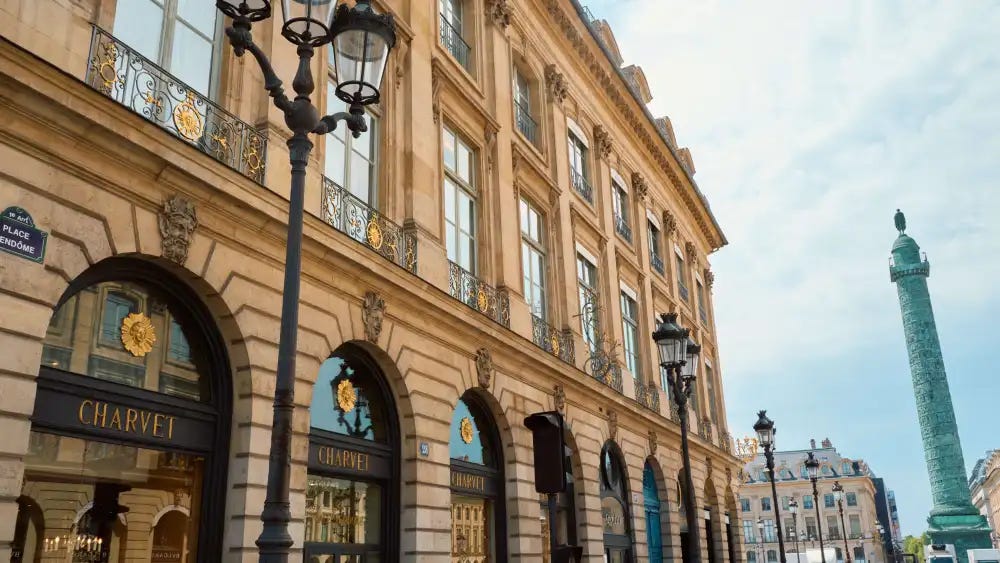
This story broke this week and almost nobody is writing the real angle on it.
On July 2nd, Chanel announced it had acquired Charvet, France’s oldest shirtmaker, founded in 1838, whose striped linen shirts typically go for about €655 ($746).
The headlines said: “Luxury brand buys historic shirtmaker.”
The real story is completely different.
This deal tells you everything about how the most strategically disciplined luxury company in the world is thinking about the next decade and why their approach is almost the opposite of what every other luxury conglomerate is doing.
Let me show you what’s actually going on.
First, What Just Happened (And Why It Sold Out in Hours)
Chanel and Charvet have grown close since artistic director Matthieu Blazy rekindled their historic bond by tapping the cult shirtmaker to make three oversize cotton button-up shirts for his debut collection for Chanel last October. Weighed down with a signature Chanel chain at the hem, they were among the “It” pieces of the spring 2026 collection, and have been worn by celebrities including Nicole Kidman, Jessie Buckley and Jacob Elordi.
The resulting $7,130 co-branded tuxedo shirt sold out in boutiques within hours of hitting the shelves.
A $7,130 shirt. Sold out in hours.
The runway featured perfectly pressed, loose-fitting shirts in a range of colours, complete with a discreet Chanel inscription. These shirts were priced at $3,800.
$3,800 for the entry-level collab shirt. $7,130 for the tuxedo version.
Both gone before most people knew they existed.
That commercial validation, the proof that ultra-high-net-worth consumers would pay this price and queue for this product is what turned a creative collaboration into a permanent marriage.
Bruno Pavlovsky, president of fashion and president of Chanel SAS, said: “We decided to get married. Chanel is a house primarily aimed at women, though we have a growing male clientele, while Charvet is a house primarily aimed at men, though it’s drawing more and more women.”
“It’s part of our legend and storytelling. We thought it made sense for the future of Charvet to be secured by Chanel,” he added.
The Brand They Just Acquired: 188 Years of Dressing Legends
Before we get to the strategy, you need to understand what Charvet actually is. Because “luxury shirtmaker” undersells it in the same way “streetwear brand” undersells Trapstar.
Founded in Paris in 1838 as the world’s first specialist shirt store, the iconic Charvet brand holds a special place in the history of luxury fashion. At a time when tailors visited their clients at home, Charvet broke new ground by opening an opulent salon dedicated to menswear, changing the way luxury clothing shopping was perceived.
Founded in 1838, Charvet is France’s oldest shirtmaker and has dressed luminaries including Marcel Proust, Winston Churchill, John F. Kennedy, Yves Saint Laurent, Karl Lagerfeld and Sofia Coppola.
Marcel Proust. Winston Churchill. JFK. Karl Lagerfeld.
Few people know that the connection between Chanel and Charvet also has a romantic history. Arthur Boy Capel, the British aristocrat, was one of the most loyal clients of this prestigious Parisian house, as well as Gabrielle Chanel’s partner. His fondness for impeccably tailored Charvet shirts and pyjamas also left its mark on Coco herself, who often reached for pieces from his wardrobe during their relationship. The connection between these two houses predates both of them as modern businesses.
Coco Chanel wore her lover’s Charvet shirts. Now Chanel owns Charvet.
Walking into Charvet’s boutique on Place Vendôme is almost like stepping back into another era. Although it operates in the contemporary world of luxury, this French house still upholds customs that are nearly two centuries old. Clients’ measurements, order histories, tailoring notes and invoices are still carefully written by hand in large leather ledgers, just as they were in the 19th century.
“At Charvet, there’s not one blue, there are 500 blues. There’s not one white, there are dozens. What’s extraordinary is the level of precision and sophistication in the details,” said Pavlovsky. The third floor of the store is home to what is billed as the world’s largest collection of shirtings, with 6,000 types of poplins, batistes, zephyrs and voiles, and another room dedicated just to collars. Monograms are hand-embroidered and can be custom designed.
500 blues. 6,000 types of fabric. Hand-embroidered monograms.
This is the antithesis of everything the internet age has built. It’s irreproducible by algorithm, impossible to scale, and entirely dependent on human knowledge accumulated across 188 years.
Which is exactly why Chanel wanted it.
The Succession Problem: Why the Colbans Said Yes
The transaction also appears to solve a succession problem that had begun to shadow the brand’s future. The Colbans, who are in their 70s, were keen to secure the long-term continuity of the company to preserve its unique know-how and specialized staff.
With the next generation pursuing careers entirely outside the fashion industry, a corporate sale became the only path forward.
Pavlovsky said: “They don’t have any internal or family successors, and we had a super good feeling… so we have decided that the future of Charvet will be with Chanel.”
When a heritage brand has no succession plan, when the next generation doesn’t want the business —he founder’s choice becomes:
Option A: Sell to a private equity firm that extracts margin, scales aggressively, and depletes the very qualities that made the brand worth owning.
Option B: Sell to a strategic partner that has genuine cultural alignment, the financial strength to invest in the brand’s future, and a credible commitment to preserving what makes it irreplaceable.
When Chanel approached Charvet to develop shirts for Matthieu Blazy’s debut show in October 2025, owner operators Anne-Marie and Jean-Claude Colban didn’t want to “make life complicated,” bogging down the process with “complex contracts.”
Jean-Claude Colban said: “This relationship developed quite naturally, marked by open and collaborative dialogue, and rooted in shared values: the transmission of expertise, respect for craftsmanship, and a meticulous attention to quality down to the smallest details. My sister Anne-Marie and I are delighted with this new chapter in Charvet’s history.”
The Chanel Numbers: Why They Could Afford to Do This Right
Before we get to the real strategy, the financial picture matters.
Chanel returned to growth in 2025, with revenue up 2% to $19.3 billion, aided by Blazy’s refreshed classic designs that attracted first-time buyers and sparked demand that outpaced supply.
Operating profit rose 5.2% to $4.7 billion. Revenue growth was driven by Matthieu Blazy’s new designs, such as reinvented bags and jackets, attracting both loyal and first-time shoppers.
Chanel’s Americas region led growth at +7.2%.
$19.3B revenue. $4.7B operating profit. 24% operating margin.
And the momentum story is even stronger than the 2025 full-year numbers suggest:
Chanel’s CEO said they saw growing momentum across all divisions starting in the second half of 2025 and continuing into 2026, which translated into revenue growth in the high-single digits. “We are on track and confident for the year ahead and beyond,” said CEO Leena Nair.
The company invested approximately $700 million into manufacturing capabilities in 2025, including leather goods production, as it continued to address quality concerns and secure long-term control over specialized suppliers.
$700 million into manufacturing and supply chain in a single year. This is a company that treats its manufacturing infrastructure as a strategic asset.
Chanel’s 2024 revenue was $18.7 billion and operating profit reached $4.479 billion. The company ended the year with a positive net cash balance, giving it room to buy a heritage maker like Charvet for what it adds to menswear, tailoring and ultra-premium positioning over the long haul.
Net cash positive. $4.7B operating profit. $700M invested in manufacturing.
The Real Strategy: What Chanel Is Actually Building
Charvet is not primarily a shirt acquisition. It’s the latest instalment in Chanel’s decade-long strategy to build an empire of irreplaceable craft.
In recent years, Chanel has acquired or taken stakes in leading entities such as Confection de Sully, Domicia Production, Marque & Mod, Maroquinerie de Champagne, the JY BH Group, Les Ateliers de May, the Grey Mer shoe manufacturer, as well as stakes in Roveda, Nuova Impala, Mantero, Cariaggi, Leo France, and Vimar 1991.
Confection de Sully. Domicia Production. Marque & Mod. Maroquinerie de Champagne. JY BH Group. Les Ateliers de May. Grey Mer. Roveda. Nuova Impala. Mantero. Cariaggi. Leo France. Vimar 1991.
Thirteen artisan workshops acquired or invested in before Charvet.
Each one a different craft:
Embroidery
Leather goods
Shoemaking
Silk weaving
Featherwork
Buttonmaking
Knitwear
By 2025, Chanel had invested $700 million in participations in SMEs that are their long-term partners, bringing the total number of suppliers it controls close to 75.
75 artisan suppliers. $700M invested. Now controlling the supply chain of human expertise itself.
This is not conventional M&A. This is vertical integration of knowledge.
Chanel vs LVMH: Two Completely Different Visions of Luxury’s Future
To understand why the Charvet acquisition matters, you have to understand the fundamental difference between how Chanel and LVMH are building for the future.
LVMH’s model: Brand portfolio + scale
Historically, LVMH’s growth strategy has hinged on aggressive acquisitions. The 1980s and 1990s brought Dior, Givenchy, Berluti, Guerlain, and Kenzo into its fold. The acquisition of Sephora in 1999 revolutionised beauty retail, while the $15.8 billion takeover of Tiffany & Co. in 2021 remains the largest luxury deal in history.
LVMH buys consumer-facing brands. Names. Logos. Heritage that customers already know.
The thesis: own the most famous names in luxury. Scale them globally. Use the group’s financial power to expand each brand’s reach.
75 Maisons. €84.7B revenue. The world’s largest luxury conglomerate.
Chanel’s model: Craft infrastructure + exclusivity
Unlike conglomerates, Chanel has eschewed acquisitions of consumer-facing brands, preferring organic growth. It invests deeply in vertical integration, owning artisan workshops.
Chanel doesn’t buy brands. It buys the knowledge and tools that make luxury possible.
Not the name on the label. The hands that make the product. The 188-year archive of fabric expertise. The workshop in Saint-Gaultier where 60 people produce shirts that nowhere else can replicate.
LVMH thesis: The scarce asset in luxury is famous names and brand heritage.
Chanel thesis: The scarce asset in luxury is irreplaceable human craft knowledge.
Who’s right?
Look at the comparative performance:
Chanel (2025): Revenue $19.3B (+2%), operating profit $4.7B (24% margin), returning to high-single digit growth in 2026, Blazy-fuelled demand outstripping supply.
LVMH Fashion & Leather Goods (2025): LVMH’s fashion and leather goods division declined 5% to €37.77 billion in 2025.
Chanel is growing while LVMH’s fashion crown jewels are declining. In a luxury slowdown, which strategy is proving more resilient?
The one based on accumulated craft knowledge that can’t be replicated at scale.
The Matthieu Blazy Effect: Why a Designer Made This Acquisition Possible
You cannot understand the Charvet deal without understanding what Matthieu Blazy has done to Chanel in eight months.
Creative director Matthieu Blazy’s reinvented classics like the slouchy “maxi flapbag” and frayed tweed jackets drove recruitment of new clients, causing demand to exceed supply.
“The recruitment of new clients who hadn’t previously bought Chanel has been phenomenal,” said Simon Longland, director of fashion buying at Harrods. “The demand has far outstripped supply, correctly so on some of the special pieces because, while there may be people disappointed they don’t have the jacket they wanted, if everyone who wanted the jacket had got it, they would all be arriving somewhere in the same jacket.”
They’re managing scarcity deliberately. Letting demand exceed supply. Creating the experience of missing out as a feature, not a bug.
Chanel topped the Lyst index in the first quarter of 2026, after the platform updated its methodology to offer a more comprehensive measure of brand heat.
#1 on the Lyst brand heat index. Beating Hermès, Bottega Veneta, The Row, Prada. All of them.
Blazy’s early collections have revitalised the brand, driving double-digit sales growth in early 2026. His $7,130 shirt has already proven the market appetite for zero-logo luxury.
Zero-logo luxury. This is the phrase that explains everything.
The consumer who buys a $7,130 Chanel x Charvet shirt does not buy it because it says “Chanel.” They buy it because they know with a knowledge that requires cultivation, education, and taste that this specific shirt is made from a specific Egyptian cotton poplin, cut by hands that have been doing this for generations, in a workshop where the craft has been passed down for 188 years.
The logo is irrelevant to the purchase. The craft is everything.
And that consumer the zero-logo luxury consumer is the most valuable consumer in the world right now.
Ultra-high-net-worth consumers are experiencing severe fatigue from loud, logo-heavy branding.
They’re exhausted by Gucci Gs, LV monograms, and Balenciaga’s deliberately ugly streetwear. They want the opposite: things that require knowledge to appreciate, that signal taste not wealth, that are irreplaceable not aspirational.
Charvet is the perfect product for this consumer.
And Blazy is the perfect designer to bridge between Chanel’s legacy and Charvet’s craft.
The Three Strategic Bets Hidden in This Acquisition
Beyond the headline, this deal is actually making three simultaneous bets:
Bet 1: Menswear Entry Through the Back Door
Chanel is making a stealth entry into ultra-premium menswear without diluting its namesake brand equity.
Pavlovsky said: “Now we have a name, Chanel, for women, and a name for men, Charvet. Even if Chanel is about women, we see more men coming in.”
Men’s luxury is growing. The global menswear luxury market is expanding faster than womenswear. Gen Z and Millennial men are buying luxury fashion at rates previous generations never approached.
But Chanel can’t launch a menswear line. The brand equity is too feminine, too coded, too associated with the interlocked CC and the quilted bag.
They can, however, own Charvet.
Which gives them the menswear customer, the menswear revenue, the menswear cultural credibility all without touching the Chanel brand positioning.
Rather than launching an exclusively menswear line, the focus is on creating unisex pieces that erase the boundaries between women’s and men’s style.
This is brand architecture genius.
Use Charvet to access the menswear market. Use the Chanel x Charvet collaboration as the bridge that makes it luxury. Keep both identities distinct but connected.
Bet 2: Place Vendôme Real Estate Is a Strategic Asset
Chanel is anchoring a prime piece of Place Vendôme real estate onto its balance sheet while also securing a turnkey operation in high-end menswear.
Charvet occupies 28 Place Vendôme — one of the most exclusive addresses in the world. The same square hosts Cartier, Van Cleef & Arpels, Boucheron, Chopard, Bulgari.
You don’t vacate Place Vendôme. You don’t find another Place Vendôme.
It’s a fixed, irreplaceable piece of Paris’s luxury geography. And Chanel just put it on their balance sheet.
In an era when luxury real estate at flagship locations is being acquired by conglomerates specifically for the address, not just the store — this is a strategic asset that appreciates independently of Charvet’s revenue.
Bet 3: Locking In Irreplaceable Human Knowledge
Charvet employs some 40 people at its store on Place Vendôme in Paris, and another 60 at its production workshop in Saint-Gaultier in central France.
100 people total.
These 100 people represent knowledge that cannot be recreated, hired in from elsewhere, or replaced by automation. The craftspeople in Saint-Gaultier have spent decades learning to work with 6,000 different fabrics. The fitters on Place Vendôme have been measuring clients and maintaining handwritten order histories for their entire careers.
When these people retire, this knowledge largely dies.
Unless it’s embedded in an institution with the financial resources to train successors, document techniques, and create the continuity of apprenticeship that keeps the craft alive.
Chanel, which already funds 19M, a centre dedicated to preserving artisan crafts in Paris is exactly that institution.
They’re not buying a shirt company. They’re buying a 188-year knowledge archive and ensuring it survives the next 188 years.
The Lesson for Every Brand Builder: What Chanel Is Teaching Us
This deal is a luxury industry story. But the strategic principles apply to every brand, at every scale.
1. Collaboration Before Acquisition Is Due Diligence
Blazy didn’t read a Charvet information memorandum. He made shirts with them.
The collaboration three shirts in the debut collection, worn by Nicole Kidman, sold out in hours was the most comprehensive due diligence possible. It tested product quality, operational compatibility, creative alignment, and market appetite simultaneously.
When the shirts sold out at $7,130, Chanel had all the financial justification they needed.
The creative relationship turned into the commercial proof that turned into the acquisition.
Whatever you’re thinking about acquiring or partnering with work with them first. The collaboration reveals what the data room can’t.
2. The Most Valuable Assets Can’t Be Replicated
Every acquisition eventually gets stress-tested by competition.
Competitor can match your product specs? They will.
Competitor can match your marketing budget? They will.
Competitor can match your distribution? They will.
Competitor can match 188 years of fabric expertise, handwritten client ledgers, and the institutional knowledge of 100 craftspeople in Saint-Gaultier?
They cannot.
The scarcest assets are the ones that compound over human lifetimes rather than financial quarters. Charvet’s competitive moat is measured in generations, not quarters.
What’s the Charvet equivalent in your industry? The thing that takes decades to build, can’t be replicated by capital alone, and becomes more valuable as AI makes everything else easier to copy?
That’s where you build. That’s what you protect.
3. Quiet, Consistent Infrastructure Investment Beats Flashy Brand Acquisitions
Nobody covered Chanel’s acquisition of Maroquinerie de Champagne. Nobody wrote about their stake in Mantero. Nobody tracked their investment in Les Ateliers de May.
But 13 acquisitions later, they’ve built an artisan infrastructure that gives them a manufacturing and supply chain advantage that LVMH’s brand portfolio can’t match in the craft-quality segment.
Chanel has maintained elevated investment levels across manufacturing, retail, and supply chain integration in a totally counter-cyclical way even as luxury spending contracted for the first time in 15 years.
Counter-cyclical investment is the phrase that defines Chanel’s strategy.
When everyone else pulled back, Chanel invested. When luxury was contracting, Chanel was buying workshops, training craftspeople, and deepening the craft moat.
Now, with “Blazymania” driving high-single digit growth while LVMH’s fashion division contracts, the counter-cyclical investment is paying off.
The Final Reality
Chanel just bought a company that makes shirts. The shirts cost $750. The tuxedo version costs $7,130. Both sell out within hours.
But the shirt is almost irrelevant.
The deal represents a backdoor strategy into high-end menswear and a permanent real estate play on the Place Vendôme.
More than that, it’s the latest chapter in a decade-long strategy to build something that no competitor can replicate by spending money: a network of irreplaceable human expertise, embedded in workshops across France, protected by Chanel’s financial resources, and animated by Matthieu Blazy’s creative vision.
The numbers:
Chanel revenue: $19.3B (2025), growing high-single digits in 2026
Operating profit: $4.7B (24% margin)
Manufacturing investment: $700M in 2025 alone
Artisan suppliers controlled: close to 75
Charvet’s history: 188 years, dressed Churchill, JFK, Proust, Lagerfeld
Co-branded shirt sell-out price: $7,130
Time to sell out: hours
The strategy:
While LVMH acquires famous names, Chanel acquires irreplaceable knowledge.
While competitors chase brand desirability, Chanel builds craft permanence.
While the industry debates AI’s impact on luxury, Chanel invests in the one thing AI genuinely cannot replicate: 188 years of human expertise, embedded in workshops, passed from hand to hand, written in leather ledgers that haven’t changed since the 19th century.
As Chanel’s CFO put it: “Creativity only germinates and grows in soil irrigated by craftsmanship.”
Charvet is the soil. And Chanel just made sure nobody else can farm it.
Are you building something that compounds over decades or optimising for the next quarter?
David
P.S. The romantic history buried in this deal is genuinely extraordinary. Arthur “Boy” Capel the British aristocrat and Coco Chanel’s great love was one of Charvet’s most loyal clients. He wore their shirts. Coco Chanel wore them after him. When she founded what would become the most valuable fashion house in France, she carried the aesthetic sensibility of a Charvet shirt with her. Now, 100 years after Coco Chanel built her empire, the house she founded has come full circle to own the shirtmaker that her great love dressed himself in. That’s not just an acquisition footnote. That’s a 100-year love story expressed as a corporate transaction. And it tells you something important about how the best luxury brands think: not in quarters, not in trends, but in decades and legacies and the weight of beautiful things that outlast the people who made them.