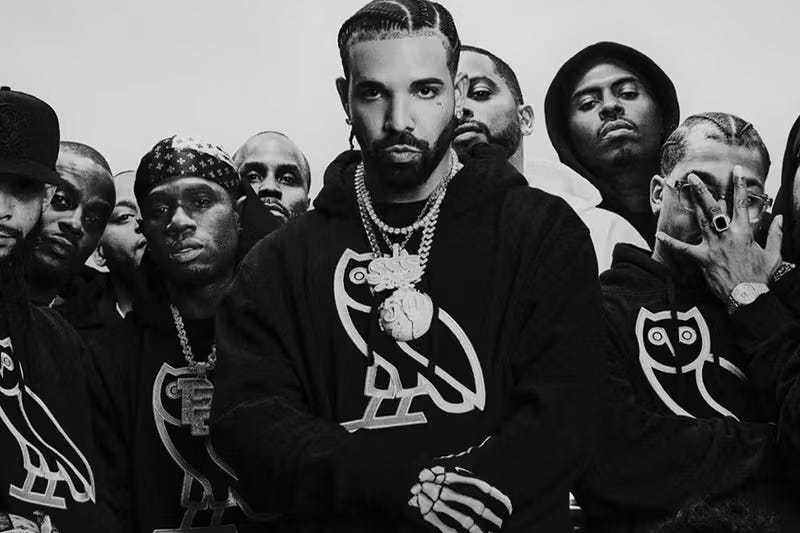
15 years ago, OVO was a blog. October’s Very Own. A Toronto kid, a website, some free mixtapes, an owl logo. Drake, Oliver El-Khatib and Noah “40” Shebib building something for their friends before anybody was calling it a brand.
This week it sold. Authentic Brands Group acquired a 51% stake in OVO’s intellectual property. Vince Holding Corp acquired the entire operating business, 12 stores across Canada, the US and the UK, the e-commerce platform, the wholesale relationships, and the Toronto team.
Drake’s own words: “We’re just a couple kids from Toronto who started something we believed in. Here we are 20 years later, same kids with bigger dreams.” Every outlet covered it. Every outlet used the same phrase: “Drake retains a significant ownership stake.”
Nobody printed the actual number. It’s 44%. It’s in the filing. And the rest of that filing tells you something far more important than what Drake got paid, it tells you exactly what the deal is for every creator brand that gets an offer like this. Because Drake is the third one I’ve written about in twelve months, and the structure was identical every single time. Let me show you what actually happened, what he traded, and what you should take from it.
The Deal, In Plain English
The IP: OVO’s trademarks now sit in a Delaware entity called ABG OVO. Authentic owns 51%. Drake owns 44%. Vince owns 5%.
The business: Vince Holding Corp (Nasdaq: VNCE) bought the whole operating company all OVO operating entities, 12 retail stores, e-commerce, wholesale, and the existing team staying in Toronto. Vince becomes the core global apparel and retail licensee, running design, product development and merchandising. The IP sold for $117,647,058.82.
And $100,000,000 ÷ 0.85 = that exact figure, which tells you the parties negotiated to a clean $100M net and grossed it up. In a separate exhibit, 5% of the entity changed hands for $6 million, implying a $120 million total valuation. Two different negotiations, two different sets of parties, landing within 2% of each other. So OVO’s intellectual property is worth roughly $120 million.
OVO is expected to do approximately $50 million in revenue this year.
$120M ÷ $50M = 2.4x revenue.
Put that against every creator and consumer brand exit I’ve written about in this newsletter:
Thorne → P&G $3.8B ~$650M (5.8x)
Poppi → PepsiCo $1.95B ~$400M (4.9x)
Rhode → e.l.f. ~$1B ~$212M (4.7x)
Huel → Danone ~€1B £250M (3.4x)
Salt & Stone → Advent $500M+ $165M (3.0x)
OVO → Authentic/VNCE ~$120M ~$50M (2.4x)
OVO transacted at the bottom of the range. 15 years of cultural equity. One of the most recognisable founders alive. Nearly a billion combined social reach through the Authentic network. Stores in three countries. And it printed the lowest multiple on the board.
Why? Four Honest Possibilities
It isn’t an exit, it’s a rollover. Drake kept 44%. If OVO triples under Authentic’s licensing machine, that 44% is worth far more than a clean 5x sale today. The multiple looks low precisely because he didn’t sell the upside.
Apparel is in a valuation winter.I wrote about this in the Gymshark piece, the apparel sector EV/EBITDA average has collapsed from roughly 33x in 2021 to around 10.8x today. Lululemon trades near 5.5x. OVO transacted into a category the market has re-rated brutally. Compare it to the beauty, supplement and functional beverage exits above and you’re comparing two different climates.
The operating business needed work. The filing tells us the sellers had to clear all OVO debt and liens before the operating companies transferred and it’s explicit that neither Vince nor its subsidiaries funded that repayment. The sellers paid off the debt themselves before handing over the keys. That’s a negotiating outcome, and it tells you something about the shape the business was in.
The buyer’s balance sheet set the ceiling. Vince Holding Corp has an $81 million market cap. They did $300 million in net sales in fiscal 2025 with $15.1 million of adjusted EBITDA — and posted a $2.6 million operating loss in Q1 2026 carrying $29.1 million of debt.
This was never a buyer with the firepower for a 5x multiple. My honest read is that it’s mostly the first one. Drake didn’t sell OVO. He converted majority ownership into cash plus a 44% financial stake in the trademark vehicle and handed the operating burden to somebody else. Whether that’s a good trade depends entirely on Authentic’s machine.
The Pattern: This Is the Third Time in 12 Months
I have now written about this exact structure three times.
Kevin Hart → Authentic. Co-ownership of the “Kevin Hart” brand with ABG, plus an equity stake in ABG itself.
David Beckham → Authentic. Sold 55% of DB Ventures for $269 million, retained 45%, became an ABG shareholder, and still collected a $36 million dividend from his holding company in 2023.
Drake → Authentic. IP into ABG OVO. Retains 44%. Operating business to a licensee.
Same shape. Every time.
The trademarks go into a holding vehicle that Authentic majority controls
The operating business goes to a licensee
The licensee pays royalties back into the vehicle
The founder holds a minority position in the vehicle rather than owning the thing outright
This is Authentic’s entire business model, and they are extraordinarily good at it. More than 1,700 licensees across 150 countries. More than $38 billion in annual systemwide retail sales. More than 50 brands. Nearly a billion social followers. When they call you, this is the deal. It will not be a different deal.
The Bit That Makes This Deal Genuinely Unusual
Several publications reported that “Vince Holding Corp is 75% owned by Authentic.” That’s not right. Vince Holding Corp is a publicly traded Nasdaq company. What Authentic owns 75% of is ABG Vince a separate vehicle holding the Vince trademark, created in May 2023 when VNCE contributed its own IP to a newly formed Authentic subsidiary for $76.5 million in cash plus a 25% membership interest. So Authentic now sits on both sides:
51% of ABG OVO (OVO’s trademarks)
75% of ABG Vince (Vince’s trademarks)
And the operator of both brands is the same public company, which holds 25% of one vehicle and 5% of the other
Jamie Salter described Vince’s role as reflecting “Authentic’s model of pairing brands with best-in-class operators.” That’s a very polite description of a closed loop. The IP owner selects the operator. The operator pays royalties to the IP owner. The IP owner majority-controls both vehicles.
None of this is improper. It’s a disclosed, arm’s-length transaction between sophisticated parties, with the actual agreements attached rather than summarised which is better disclosure than most deals get. But if you’re a founder being offered this structure, you should understand that the counterparty may be on both sides of your table.
The Clauses Every Creator Should Read Before Signing Anything Like This
Four terms in the licence agreement determine what Drake’s 44% is actually worth. If you ever get offered a version of this deal, these are the four you negotiate hardest.
1. The term is 31 years.
Initial term runs to the end of Vince’s fiscal 2036, with three renewal options of seven years each. Take all three and this runs to roughly 2057.
2. The royalty is capped and the floor is guaranteed.
Single-digit percentage on retail and e-commerce. 10% or lower on wholesale. Sitting against that is a guaranteed minimum royalty that escalates through the term, with the licensee required to post a letter of credit for 100% of that minimum. The IP vehicle’s downside is contractually floored. The operator carries the volume risk.
3. The territory can be cut unilaterally.
The territory is the US and Canada plus the rest of the world, excluding seven sanctioned countries. But the outer ring is defined as “option territory” and the agreement says it may be changed unilaterally by ABG OVO at any time.
The same unilateral right covers “option products”: hosiery, headwear, accessories, hydration bottles. Vince gets a right of first offer on certain European countries. Nothing beyond that. The licensee’s addressable market can be reduced by the licensor’s decision alone. The protection is a right to be asked first about part of Europe.
4. You can lose the brand for missing a store count.
The termination list is longer than the royalty section. Authentic can terminate for the ordinary reasons and also for failing to operate a minimum number of retail locations in a contract year, failing to hit minimum net sales, and failing to maintain required insurance. A licence you can lose for missing a store count is a fundamentally different instrument from one you can only lose for not paying. The dollar thresholds were omitted from the public filing under Item 601. Structure public, numbers private.
What Drake Actually Traded
Let’s be fair here, because the cynical read would be wrong. What he gave up: Majority control of the trademarks. The ability to set territory and category strategy. The operating business entirely.
What he got: Liquidity. A nine-figure transaction on a brand doing $50M in revenue in a category trading at compressed multiples. A clean balance sheet exit. The debt got retired, the operating headaches transferred, and the Toronto team stays employed under an operator with real infrastructure.
44% of the upside, permanently. If Authentic does to OVO what it did to Shaq’s brand, or to Elvis, or to Beckham, that 44% compounds for decades. Authentic increased the Elvis estate’s annual value roughly 5x in twelve years. Creative control. He continues shaping the brand’s creative vision, which for a brand whose entire value is cultural authenticity is not a small term.
And critically: OVO Sound, the record label, is a completely separate company and takes no part in this transaction at all. He didn’t sell the music business. He sold the apparel business. That’s a genuinely reasonable trade for someone whose primary business is not clothing.
The Four Lessons for Anyone Building a Creator Brand
1. Your multiple is set by your category, not your fame.
Drake is one of the most famous people alive. OVO printed 2.4x revenue. Hailey Bieber’s Rhode printed 4.7x. Chad Janis, a 25-year old nobody had heard of, printed roughly 4x with Gruns. Fame doesn’t set the multiple. Category economics, growth rate and margin structure set the multiple. If you’re building in apparel right now, understand what the sector is trading at before you build your exit expectations around a beauty comp.
2. Subscription and consumable beat apparel every single time.
Look at that comparison table again. Every brand above OVO is a consumable, a supplement, or a beauty product with genuine repeat-purchase mechanics. Rhode’s lip treatment gets repurchased every 4-6 weeks. Huel gets consumed daily. Poppi replaces a soda habit. Salt & Stone deodorant runs out. A hoodie doesn’t run out. That’s the whole gap between 2.4x and 4.9x.
3. “Significant ownership stake” is an adjective. Get a number.
Every outlet ran the adjective. The filing had the number. When you’re negotiating, and when you’re reading somebody else’s deal, insist on the number. 44% of a Delaware entity that owns the trademarks, with the operating business sold elsewhere and a single-digit royalty flowing back that’s a specific position with specific economics. “Significant stake” is a press release. Percentages are a deal.
4. Understand who controls your addressable market after the deal closes.
This is the one nobody thinks about until it’s too late. The single most consequential term in the entire OVO licence isn’t the royalty rate. It’s the clause letting the licensor unilaterally reduce the territory and product categories at any time. You can negotiate a great royalty on a market that later gets cut in half without your consent.
When someone offers to buy your IP and license it back, the questions that matter are: who decides where this brand can be sold, who decides what categories it can enter, and what happens to my stake if those decisions go against me?
A Toronto blog with an owl logo became a $120 million trademark. That’s a genuinely great outcome, and I don’t want the analysis to obscure it. 15 years from mixtape website to a nine-figure transaction with the most sophisticated brand-licensing platform in the world.
But the version of this story that everybody published this week“Drake sells OVO, terms not disclosed, retains significant stake” tells you almost nothing useful.
$117,647,058.82 for the IP. A $120M valuation corroborated twice. 2.4x revenue in a compressed category. 44% retained in a vehicle he no longer controls. A 31 year licence with a single-digit royalty, a guaranteed minimum floor, unilateral territory rights sitting with the licensor, and termination triggers that include missing a store count.
That’s the deal.
And every single term of it was public, for free, on the day it was announced for anyone willing to open the exhibit and read it. If someone offers you this structure, you now know exactly what the four questions are. Ask them before you sign, not after.
P.S. The most instructive detail in the entire transaction is the sequencing. On August 24th, in order: the IP left first, then the debt got cleared, then the operating companies sold. And the filing is explicit that neither Vince nor any of its subsidiaries funded that debt repayment the sellers cleaned out the balance sheet themselves before handing over the keys. Vince acquired three clean companies. Somebody else absorbed the cost of making them clean. Deal sequencing tells you who had leverage far more reliably than the press release does. Read transactions in chronological order, not in headline order.
P.P.S. Watch Vince Holding Corp from here, because it’s the most interesting live experiment in consumer right now. An $81 million market cap company that did $300 million in net sales has just taken on a second brand, with management guiding the deal earnings-neutral in fiscal 2026 and accretive in fiscal 2027. If the “operator-as-a-service” model works one public company operating a portfolio of Authentic-owned IP VNCE gets re-rated and every creator brand suddenly has a ready-made operating partner to sell into. If it doesn’t, they’ve added complexity to a business already posting operating losses. Two analysts have it at an average $9 target against roughly $7.60. Almost nobody is watching this, and it may be the most important structural question in creator-brand M&A over the next three years.


