


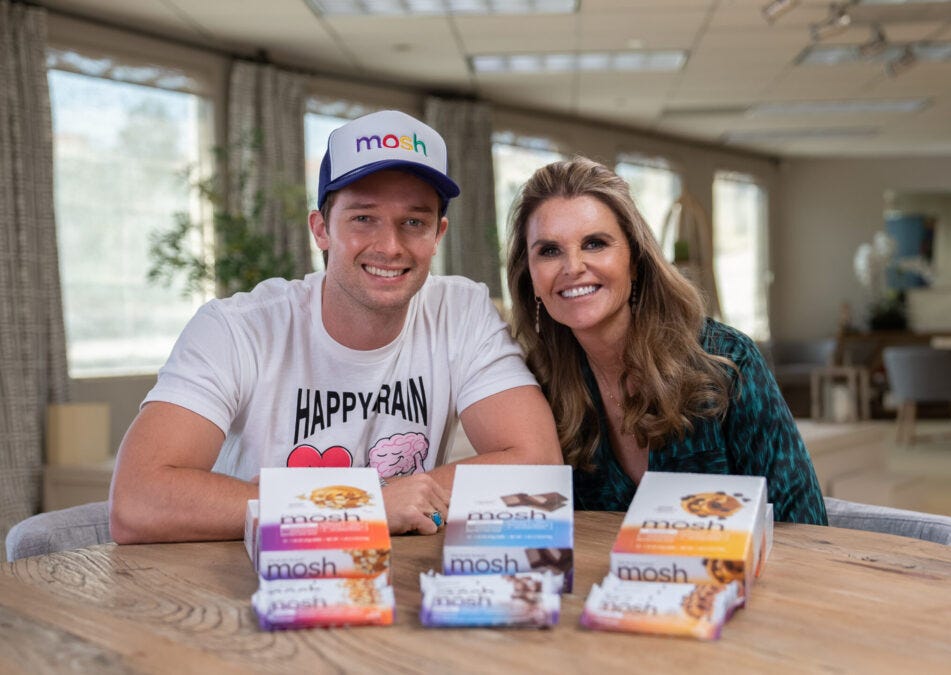
Quick question: When you think of Patrick Schwarzenegger, what comes to mind? Saxon Ratliff from White Lotus? Arnold’s son? The guy who dated Miley Cyrus?
Here’s what most people don’t know: Before Season 3 of White Lotus made him famous, Patrick Schwarzenegger was quietly building one of the most impressive angel investment records in consumer packaged goods.
The portfolio:
Early investor in Liquid I.V., an electrolyte drink mix → Sold to Unilever
Early investor in Poppi, a modern soda that promotes gut health → Sold to PepsiCo for $1.95B
Early investor in Super Coffee, a better-for-you alternative for sugary coffee drinks → Now doing $100M+ revenue
Seed investor in Dave’s Hot Chicken → Sold
Early investor in Blaze Pizza → Sold
Four investments. Four exits or category-defining outcomes.
Every single one in the “better-for-you” consumer health space. Every single one before it was obvious. And now Patrick has stopped just investing in other people’s companies.
He built his own. With his mother. About brain health. Born from the most personal imaginable place.
This week, MOSH raised $13 million Series A, launched into Target nationwide, and made the argument that brain health might be the next gut health.
Let me tell you the full story, because it’s better than anything Saxon Ratliff ever did.
First: How a 20-Year-Old With Arnold Schwarzenegger’s Last Name Learned to See Consumer Trends Before Anyone Else
Most celebrity investors get checks because of their name. Patrick’s first investment happened because he was a broke college student who bet on a friend.
The Blaze Pizza origin: Patrick Schwarzenegger went on to franchise his own Blaze Pizza locations, including one at USC while he was a student there, and one at The Grove in Los Angeles. That company grew to almost 400 stores. His take? Millions. At age 20.
What he said about it: “Wow, this is easy. I just made millions of dollars off my first small investment. I’m gonna do this forever. And so, I sold out of that and put all the money towards other companies. And it was not as easy as that company was, but it’s been a great time since.”
Refreshingly honest. But after Blaze, he developed an actual thesis, not just vibes: “My investment thesis is simple: Is it the better-for-you version of what’s out there?” That’s it. That’s the whole thing.
Is this the better-for-you version of something everyone already buys?
Electrolyte drinks? People already buy Gatorade. Liquid I.V. = better for you Gatorade.
Soda? People already drink Coke. Poppi = better for you soda.
Coffee drinks? People already buy Frappuccinos. Super Coffee = better for you Frappuccino.
Protein bars? People already eat Quest and RXBARs. MOSH = better for you protein bar.
Dead simple. Devastatingly effective.
Allison Ellsworth, co-founder and chief brand officer of Poppi, described Patrick this way: “Patrick approaches business with a mix of intuition and strategic thinking. He understands pop culture and brand, and he invests in companies he genuinely believes in.”
And Paul Wachter, CEO of Main Street Advisors (who just led MOSH’s $13M Series A and has known Patrick since childhood), said: “He always seems to know what’s going to take off in one way or another. There’ve been times Schwarzenegger has introduced him to early stage companies that he’d never heard of, new technologies or pieces of the cultural zeitgeist that were taking off in some interesting or surprising way. ‘That’s important to be on the ground and see it and feel it,’ says Wachter. ‘He isn’t arrogant. He seeks out advice and he’s willing to listen.’” Not arrogant. Willing to listen. That’s the character underneath the White Lotus fame.
Then His Mother Changed Everything
The year was 2020. The world had stopped. Patrick moved back in with his mother Maria during the pandemic. Shriver had spent decades researching brain health and fundraising to support a cure for Alzheimer’s disease, following her father’s diagnosis in 2003. Armed with data around the power nutrition can have on brain health, Shriver was determined to launch her own brain health CPG brand. “She was pitching it, and when Covid happened, all of her work came to a stop,” says Schwarzenegger. “No one wanted to do it.”
Let’s understand what Maria Shriver had been building for the previous 17 years.
The Origin Story That Changes How You See This Brand
Maria Shriver’s father, Sargent, founding director of the Peace Corps, part of the Kennedy and Johnson administrations, director of various War on Poverty programs, head of the Special Olympics, recipient of the Presidential Medal of Freedom was diagnosed with Alzheimer’s disease. Over the next decade, Shriver watched her once articulate, witty, whip-smart father descend into dementia. In the later stages of the disease, she had to introduce herself to him when she came to visit, a recollection, she says, that still makes her cry.
He lived eight years with the disease before his death in 2011. This is the most credentialed, accomplished, brilliant man in her life and she had to introduce herself to her own father.
What would you do? For most people: grieve, cope, move on. For Maria Shriver: Two decades of relentless action.
She founded the Women’s Alzheimer’s Movement, the nation’s preeminent organisation for women and Alzheimer’s, which in 2022 joined Cleveland Clinic to become WAM at Cleveland Clinic.
WAM has led the way in re-framing the narrative of Alzheimer’s as a women’s issue, starting with its groundbreaking 2010 Shriver Report: A Woman’s Nation Takes on Alzheimer’s. WAM helped fund over $4 million in seed grants, which resulted in over $83 million more being invested in women-based Alzheimer’s research by government agencies, private corporations and foundations.
A year after she published The Shriver Report, Shriver was an executive producer on Still Alice, a film about a linguistics professor diagnosed with Alzheimer’s disease at age 50.
She also wrote a children’s book to help grandchildren understand the disease. She produced the Emmy-winning HBO documentary The Alzheimer’s Project. She helped create the White House Initiative on Women’s Health Research. Two decades of advocacy. Thousands of hours. Millions of dollars raised. And the whole time everywhere she went speaking about Alzheimer’s people kept asking her one question: “What is there out there that they could eat that was good for their brain health? What were the supplements out there with a proven track record?”
Maria said: “I didn’t have an answer for them because there really wasn’t a protein bar prioritising ingredients that support brain health.” After 17 years of being asked this question by hundreds of thousands of people and having no answer, she decided to become the answer. MOSH stands for Maria Owings Shriver Health.
The Product: What’s Actually Inside the Bar
MOSH isn’t a protein bar that slapped “brain health” on the label for marketing. It’s a clinically formulated product two decades in the making.
The hero ingredient: Cognizin Citicoline, clinically studied for its effects on focus, attention, and memory.
The full Brain Blend:
Cognizin Citicoline (focus, attention, memory, the category-defining ingredient)
Lion’s Mane mushroom
Ashwagandha
MCT oil
Omega-3 fatty acids
Collagen
Vitamin B12
Vitamin D3
The process: Co-founders Shriver and Schwarzenegger partnered with brain health experts and nutritionists for over a year and a half to develop the protein bars and perfect the recipe.
Gamsey (President and COO) said: “Founders Shriver and Schwarzenegger are very involved in the tastings during the development of new products. They each have very refined palates and very high standards, and nothing gets to market unless it meets their expectations.”
The key positioning move: MOSH is the first and only bar to feature Cognizin® Citicoline. Nobody else has this. Nobody can claim this.
That’s not marketing language, it’s a patent-defensible competitive moat in the bar aisle.
The new product (announced with the $13M raise): MOSH High Protein: 20 grams of protein, creatine, and MOSH’s Signature Brain Blend.
Creatine is important. It’s the most scientifically validated supplement for both physical AND cognitive performance. It’s having a massive cultural moment (Gen Z + gym culture + biohacking crowd all converging on creatine as the next “it” supplement).
MOSH saw this coming and baked it into the protein bar.
The Launch: September 21, 2021. World Alzheimer’s Day.
Of all the days they could have launched, this was the only right answer. The brand officially launched in September 2021, on World Alzheimer’s Day, after the mother-son pair noticed a void in the market for a high protein bar that specifically promotes brain health.
What happened when they launched: Their initial stock sold out twice, once within 48 hours on opening day, and again within 24 hours on Giving Tuesday with a 60,000-person waitlist assembled.
60,000-person waitlist. On day one. This is what 17 years of advocacy creates. Maria Shriver had been building an audience of brain health warriors for two decades. They were all waiting for a product. Patrick’s manufacturing and marketing contacts delivered the product. Maria’s advocacy built the audience. The combination was unstoppable from day one.
The Business: Growing Faster Than Almost Any Protein Bar You’ve Heard Of
Here are the numbers, and they’re real:
MOSH has seen annual sales increase by more than 70% in each of the last two years, rising from about $4 million in 2022 to $7 million in 2023, then to $12 million last year (2024). In the first quarter of 2025, revenue was up 100% over year-ago results.
Let’s graph that:
2022: $4M
2023: $7M (+75%)
2024: $12M (+71%)
Q1 2025: +100% YoY
2025 estimated: $20-24M
That’s 5-6x revenue in 3 years.
In a bar category that’s notoriously difficult to break through.
How?
A key reason for the brand’s success is that MOSH bars expand the customer base beyond the men who have long dominated protein-bar consumption. The company has focused specifically on brain health for women, because about two-thirds of Alzheimer’s sufferers are women, yet most Alzheimer’s disease research has focused on men.
This is genius positioning.
The protein bar category in 2021:
Dominated by men (Quest, RXBar, Muscle Milk)
Marketed to men (gym performance, macros, gains)
Designed by men (high protein, ugly packaging)
MOSH’s move: Target women who want brain health benefits. Deploy Maria Shriver’s 20-year credibility. Create the only bar that speaks directly to the anxiety millions of women have about Alzheimer’s. As Maria Shriver put it: “Every three seconds, someone in the world develops Alzheimer’s dementia, and two out of three of them are women.”
You’re a 45-year-old woman whose mother had Alzheimer’s. Would you pay $3 for a protein bar specifically formulated for brain health by the woman who created the world’s first Alzheimer’s prevention center for women?
Yes. Obviously yes.
The sampling advantage: The company has a robust in-store sampling programme, which has proven to not only drive strong sales at the sampling events themselves but follow-up purchases as well. “The key to success for us seems to be to get as many customers to taste the product as possible,” Gamsey said.
When your product actually tastes great AND the mission resonates, sampling is the best marketing money you can spend.
The Mission Layer: Why This Brand Has a Moat Most CPG Brands Will Never Build
This is where MOSH separates itself from every other celebrity brand.
Most celebrity consumer brands have:
Celebrity face
Nice branding
Decent product
No mission that pre-existed the business
MOSH has:
Over $400,000 raised to fund Alzheimer’s research, with three research grants funded to date
In 2026, a new third research grant examining gut biomarkers present in people with cognitive decline or Alzheimer’s, with the goal of developing early nutritional interventions
Maria Shriver’s actual credibility (not manufactured)
Every purchase converts a consumer into a mission participant
The feedback loop: You buy a MOSH bar → Portion goes to Alzheimer’s research → Maria announces research grant → Press coverage → New customers discover brand → Cycle repeats
This is a cause-marketing flywheel that compounds over time.
And unlike most “give back” brands where the charity feels tacked on, the mission IS the product with MOSH. You can’t separate them.
Maria Shriver said: “I set out to change the story so that we would come to realize that women are front and center of this disease.”
Every MOSH bar sold advances that mission.
The $13M: What Just Changed
On May 6, 2026, MOSH announced their Series A: $13 million in Series A funding led by Main Street Advisors. The round, with participation from Great Circle Ventures, Rogers Healy and Morrison Seger, PCG, and Tonic Ventures, fuels MOSH’s national grocery expansion, an upcoming nationwide Target rollout, and the launch of MOSH High Protein.
Paul Wachter, founder and CEO at Main Street Advisors, said: “It’s not often you see a brand carve out real white space in a category as crowded as nutrition, but MOSH has done that while building a brand people genuinely love. Maria and Patrick are tapping into a major shift in how people think about brain health, and we’re proud to partner with them as they continue to grow.”
The distribution announcement: MOSH crosses 2,000+ US retail doors, with the company’s retail channel on track to triple in 2026, driven by accelerating velocities at existing retailers, expanded facings, and the upcoming launch at Target.
Current retail presence:
Sprouts
Albertsons
Kroger
H-E-B
Target (rolling out now)
When you add Target’s 2,000 stores to an existing 2,000-door network, you don’t double retail presence. You create entirely new levels of trial and awareness.
Target is where mainstream America shops. Not Whole Foods. Not specialty health. Target. This is the transition from “health food brand” to “mainstream nutrition brand.”
And the new product: MOSH High Protein with creatine is a direct play on three converging trends:
High-protein eating (GLP-1 tailwind, fitness culture)
Creatine mainstream adoption (from gym supplement to cognitive health darling)
Brain health awareness (the category MOSH created)
All three trends in one bar.
The Big Question: Is Brain Health the Next Gut Health?
This is the $6.8B question.
The market data: The US brain health supplements market is projected to nearly double from $3.56 billion in 2024 to $6.8 billion by 2030, according to Grand View Research.
But is this actually analogous to gut health’s journey?
Let’s compare:
Gut Health (The Poppi/Olipop Story):
2015-2018: Kombucha (niche, acquired taste, health food stores)
2019-2021: Prebiotic sodas launch, category validated
2022-2023: Olipop hits $100M+ revenue, Poppi close behind
2025: Poppi exits to PepsiCo for $1.95B, CAVU returns 88x
Total time from niche to $2B exit: ~10 years
Brain Health (The MOSH story in progress):
2003-2020: Maria Shriver advocates, but no mainstream consumer product exists
2021: MOSH launches, 60K person waitlist, category created
2024: $12M revenue, 70%+ growth, 2,000 retail doors
2026: $13M Series A, Target rollout, high-protein line launch
2028-2030: ??
The structural similarities are striking:
Gut health: Responded to anxiety about digestion, IBS, inflammation — things that affect millions of people silently, that mainstream medicine hadn’t fully solved.
Brain health: Responds to anxiety about cognitive decline, Alzheimer’s, focus, memory, things that affect millions of people, that mainstream medicine hasn’t fully solved.
Both are:
Health anxieties most people have but rarely discuss
Categories where mainstream brands (candy bars, energy drinks) aren’t helping
Easy product format (soda/bar) that makes health feel accessible not medicinal
Mission-driven by founders with personal connection
According to the Alzheimer’s Association’s 2026 Facts and Figures report, 99% of Americans value brain health equally or more than physical health, while only 9% say they know a lot about ways to maintain it.
99% care. 9% know what to do. That gap is a $6.8B market opportunity.
And MOSH is the only brand with clinical credibility, celebrity founders with 20 years of authentic advocacy, and proprietary ingredients (Cognizin Citicoline) to fill it.
For comparison:
Most celebrity CPG brands score 1-2 out of 5. That’s why most celebrity CPG brands fail within 3 years.
Patrick’s Investment Pattern
Here’s the thing nobody’s connecting:
Patrick Schwarzenegger identified the pattern of those categories BEFORE they were obvious.
Hydration: Boring, commoditised (Gatorade), needed better-for-you version → Liquid I.V. → Unilever acquisition
Soda: Dominant but unhealthy (Coke, Pepsi), needed better-for-you version → Poppi → $1.95B to PepsiCo
Coffee drinks: Massive market (Starbucks), full of sugar → Super Coffee → $100M+ revenue
Each time:
Massive existing consumer behaviour
Incumbent product with clear health problem
Better-for-you alternative at accessible price
He invested early, before the category validated
Now he’s applying the same pattern, but as a founder:
Protein bars: Massive existing market ($6B+ annually), dominated by legacy brands
Current bars: High protein, low brain focus, marketed to men
MOSH: Better-for-you protein bar with brain health benefits, targeted at women
Patrick said: “I have to believe in the entrepreneur behind it and their mission. I have to believe in the actual product and it has to be something that I would use. And it has to be really applicable towards mass America, something that’s not too extremely niche, but something that can be for the masses.”
Brain health protein bars: applicable to mass America? 99% of Americans value brain health equally or more than physical health. Pretty applicable.
The Path to Exit: Who Buys MOSH (And Why They’ll Pay Up)
At $20-24M revenue (estimated 2025), growing 70%+ annually: MOSH’s likely acquirers in 3-5 years:
Unilever (already bought Liquid I.V. and Dr. Squatch):
Owns nutrition portfolio (Olly vitamins, Liquid I.V., Nutrafol)
Missing: Brain health bar
MOSH = perfect fit
Nestlé (owns Nestlé Health Science):
Biggest nutrition company in the world
Actively hunting functional food innovation
MOSH = bridge between mainstream snacking and health
General Mills (owns RXBar, Larabar):
Protein bar portfolio leader
Missing: Cognitive health positioning
MOSH = extends into fastest-growing health concern
The valuation math:
If MOSH grows to $100M revenue by 2028 (not unreasonable at 50%+ growth):
Premium health bars sell at 5-7x revenue
At $100M: $500M - $700M exit value
If MOSH grows to $150M by 2029 (base case with Target + high protein line):
At 5x revenue: $750M exit
Patrick’s entry on many early consumer investments was sub-$10M valuation.
His personal MOSH equity is likely 40-50% (co-founder economics).
At a $750M exit: $300-375M personally.
This is the payoff for building rather than just backing.
The Final Reality
Everyone knows Patrick Schwarzenegger from White Lotus.
But here’s the fuller picture: Long before he’d landed any high-profile acting gig, Schwarzenegger was investing in and helping build healthier-for-you CPG brands like Blaze Pizza, Liquid I.V., and Poppi.
His thesis, simple and devastating:
“Is it the better-for-you version of what’s out there?”
Applied to deodorant (Salt & Stone) → $500M exit.
Applied to soda (Poppi) → $1.95B exit.
Applied to electrolytes (Liquid I.V.) → Unilever acquisition.
Applied to protein bars for brain health (MOSH)?
$13M Series A. Target rollout. $6.8B market growing to double by 2030.
And behind the brand: a mother who watched her father, founding director of the Peace Corps, head of the Special Olympics, Presidential Medal of Freedom recipient, lose his mind to Alzheimer’s. Who spent the next 20 years building the world’s leading women’s Alzheimer’s research movement. Who couldn’t find a protein bar good for her brain, so she built one.
And the best consumer exits, Poppi, Huel, Salt & Stone, Gruns all have one thing in common: The product was inevitable. The category was inevitable. The only question was who got there first. MOSH got there first. The first and only bar featuring Cognizin Citicoline for focus, attention, and memory.
Brain health is the next gut health. MOSH is building the Poppi of protein bars. And the kid from White Lotus is funding it with his own money.
Is brain health the next $2B category?
P.S. The stat that should keep every protein bar brand’s CMO up at night: 99% of Americans value brain health equally or more than physical health, while only 9% say they know a lot about ways to maintain it. 99% of a $330M market (that’s just US adults) are anxious about their brain. Only 9% know what to actually do about it. MOSH’s entire business model is bridging that gap. Every competitor in the bar aisle is still talking about protein grams and macros while MOSH owns the one outcome every person over 40 actually worries about. That’s not a marketing advantage. That’s a 20-year runway.
P.P.S. Maria Shriver pitched this idea to bigger companies for years before building it herself. “I pitched my vision to bigger companies for several years and they passed, partially I believe due to my age.” The same woman who created the world’s first Alzheimer’s prevention centre for women, produced an Emmy-winning documentary, and built the preeminent advocacy organisation for women’s brain health was told by CPG executives that her idea wasn’t viable. Those executives are now watching their competitors build the brain health category without them. The biggest consumer opportunities are always hiding in plain sight. The people who see them earliest are usually the ones with the most personal reason to look.