


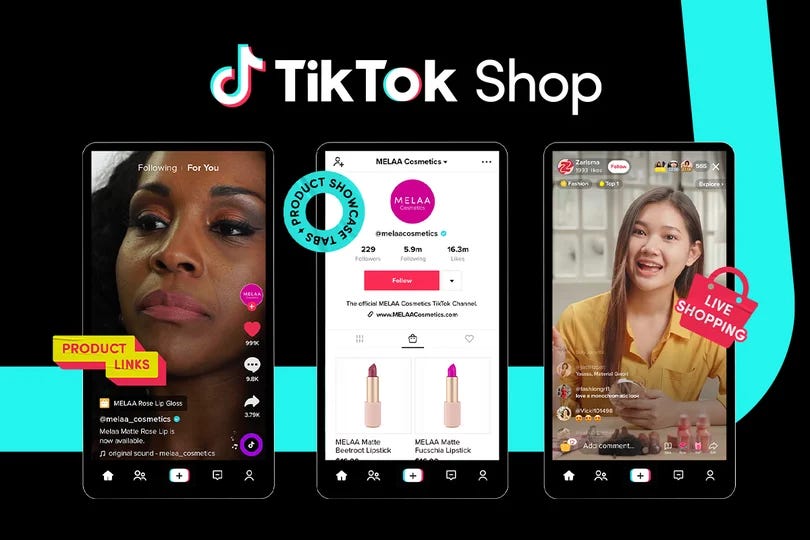
This is a slightly different post than usual. Every founder I talk to right now is getting the same pitch from every growth agency, every consultant, every LinkedIn post: TikTok Shop is the channel. Get on it before it’s saturated. Look at the growth numbers.
And the growth numbers are genuinely staggering. But before you redirect your Q4 budget, there’s a question nobody in the “rush to TikTok Shop” conversation is asking with any rigour:
After the fees, the ads, the creator commissions, and the returns, is anyone actually keeping the money?
The gap between “TikTok Shop did $50 billion” and “your brand made money on TikTok Shop” is one of the widest, least-discussed gaps in consumer commerce right now.
The Headline Numbers
TikTok Shop moved $50.3 billion in goods worldwide during the first half of 2026, a 92% increase over the same period last year. The US led every market with $11.8 billion, roughly double its year-ago pace. Momentum Works projects the platform will close 2026 near $123.5 billion, up from under $1 billion five years ago.
70% of US social buyers say they made a purchase on TikTok Shop in the past 12 months more than on any other platform. These are the numbers driving every founder’s FOMO right now.
But GMV (gross merchandise value) is the least useful number in this entire conversation if you’re trying to figure out whether you should sell there. GMV tells you how much stuff moved through the platform. It tells you nothing about what sellers kept.
TikTok Shop Itself Was Built on a Half-Billion-Dollar Subsidy
Before we get into your P&L, you need to understand the platform’s P&L.
TikTok Shop was expected to lose over $500 million in the US in a single year a loss reflecting parent company ByteDance’s significant investments to hire staff, build a fulfillment network, and incentivize sellers by offering free listings, free shipping, zero commissions, and warehousing space.
The “cheap channel” reputation that’s driving founders to TikTok Shop right now was manufactured. ByteDance deliberately subsidised the seller experience to build volume, exactly the way Uber subsidised rides and DoorDash subsidised delivery for a decade before either business had to show real unit economics. And the subsidies are now visibly ending.
The days of TikTok subsidising every aspect of the sale to get merchants on board are fading. As the platform matures, it is moving closer to the Amazon model monetising every touchpoint. As of late 2025, TikTok is phasing out Co-Funded Free Shipping subsidies, meaning sellers now absorb $3 to $5 more per order to keep the Free Shipping badge. TikTok
TikTok even tried, in February 2026, to force every US seller off self-managed shipping and onto TikTok-controlled logistics. Brands objected on cost and reliability grounds, Grande Cosmetics’ CMO warned that carving out inventory for a TikTok warehouse risked fast stockouts, and August founder Nadya Okamoto flagged low trust and framed the choice around margin impact. TikTok pulled the mandate on February 18, 2026, emailing sellers that “Seller Shipping remains unchanged.” Sellers won that fight. But the direction of travel is unmistakable.
The channel you’re being pitched as “the cheap alternative to Meta CPMs” is a channel that was artificially cheap by design, and is now actively repricing toward extraction. Every fee guide published in the last six months says some version of the same thing: what TikTok publishes and what you actually pay are two very different numbers.
The Real Fee Stack: What TikTok Doesn’t Put on the Landing Page
Here’s every layer of cost between a sale on TikTok Shop and money in your bank account.
Layer 1: The Referral Fee (5-8%, category-dependent)
Fashion has the highest commission at 8%, while Food & Beverage enjoys the lowest at 4%. Electronics and Home & Living sit in the middle at 5%. Most categories land between 5-6%. This is the number in every ad for TikTok Shop.
Layer 2: Payment Processing (1-3.78%)
In many US transactions, a payment processing service fee of 1.02% to 3.78% is charged on top of the referral fee. For standard transactions, this means your true marketplace take-rate is closer to 7.02% before fulfillment, affiliate commissions, or ad spend. Already, the “6% platform” is a 7%+ platform. And we haven’t touched anything else yet.
Layer 3: Fulfilment (FBT)
FBT fulfilment starts at $3.58 per unit, dropping to roughly $2.86 for orders of 4+ units. If you self-fulfil instead, you’re now charged a “Shipped by Seller” fee per order on a low-ticket item, that fee plus commission can wipe out 10-15% of gross margin before you’ve even packed the box.
Layer 4: Affiliate/Creator Commissions (5-30%, seller-set)
TikTok lets sellers set commission anywhere from 1% to 80%. Open collaboration, where any creator can promote your product at a publicly posted rate clusters around 10-13% across most categories.
There’s a structural trap here most sellers don’t know exists: sellers can set a separate, lower commission rate for orders generated through paid ads using a creator’s content. A creator’s video starts selling organically, the brand requests their Spark code, turns it into an ad, and the creator notices their effective commission drops. It’s not fraud, it’s a structural mechanic that most creators don’t understand at signup.
Layer 5: Shop Ads / GMV Max (15-25% of revenue)
The most variable cost and often the largest.
Layer 6: The Refund Admin Fee
On a $40 product with a $2.40 referral fee, the refund admin fee is 20% of that $0.48 plus roughly $3 in FBT return handling, giving $3.48 lost per returned unit before you even count the product cost.
Layer 7: Returns
This is the one that destroys models that looked fine on a spreadsheet. TikTok Shop’s platform-wide return rate averages 10-15%higher than Amazon. Every 10 points of return rate eats 4-6% points of net margin.
The category spread is brutal: Fashion 18-25%, home & garden 12-16%, electronics 8-12%, pet products 9-14%, food and consumables 3-6%. Seasonal spikes in November December reach 25-35%.
Size/fit issues drive 42% of fashion returns, defective/spec-mismatch drives 38% of electronics returns, and shade mismatch drives 55% of beauty returns.
And on every one of those refunds, the seller not TikTok eats the loss: the seller typically bears the product cost and shipping on refunded orders, even though platform fees are usually reversed.
Fraud compounds this further: roughly 9% of all returns industry-wide are confirmed fraudulent, and around 45% of consumers admit to some form of return fraud or policy abuse.
The Real Math: What’s Actually Left
Now let’s put every layer together, using the two most rigorous published models available.
Model 1: The $40 Product, Base Case
The all-in take on a first-year $40 product lands between 38% and 52% of GMV before a dollar of product cost. In the base case (6% referral fee, $3.58 fulfilment, 13% affiliate commission, 15% ad spend, 3.7% blended returns), only about 53 cents of every dollar survives to cover COGS and profit.
At $12 COGS on that $40 product: 23% contribution margin. At $16 COGS: it compresses to about 13%.
The average active US TikTok Shop seller nets about 18.4% but the spread runs 5% to 49%, depending almost entirely on creator strategy and return rate. And here’s the number that should reframe your entire creator strategy: Five to ten creators typically drive 80%+ of monthly GMV. The “recruit 1,000 affiliates” strategy is a distraction. Concentration wins on efficiency, and it’s the single biggest lever on your take rate.
Model 2: The Fully Worked $50,000/Month Example
Referral fee (8%): $4,000. Transaction fees: $375. Payment processing (2.0%): $1,000. Shipping and fulfilment (~10%): $5,000. Affiliate commissions (~10% blended): $5,000. TikTok Shop Ads (~20%): $10,000. Content production: $4,000. Returns and chargebacks (~5%): $2,500. Operational overhead: $2,000. Total monthly cost: $33,875, 67.75% of revenue.
That leaves $16,125 to cover COGS. If product cost is 30% of retail ($15,000), you’re left with $1,125 in profit on $50,000 in revenue. That’s a 2.25% net margin. On $50,000 in monthly sales the kind of number that would make any founder feel like they’ve “made it” on TikTok Shop the actual take-home is $1,125.
The good news: the math genuinely improves at scale. A $200K/month seller in the same category benefits from lower per-unit content costs, better ad efficiency, and stronger creator relationships. Their cost percentage might compress to 45-50% of revenue, yielding 15-20% net margins.
This is the entire strategic reality of TikTok Shop in one sentence: the channel is structurally unprofitable at small scale and genuinely attractive at real scale and most brands never survive the gap between the two.
The Average Seller Reality Check
Here’s the number that should temper every “TikTok Shop changed our business” testimonial you read:
The average TikTok Shop store generated approximately $6,062 in monthly revenue in 2025. At a 12% net margin, that equals about $727 per month. $727 a month. That’s not a business. That’s barely a hobby with inventory risk.
Some brands are building 7-figure revenue streams on the platform. Most are barely breaking even.
The Winners
Now let’s look at the brands who cracked it with real numbers, not vibes.
Divi: $4.7M GMV in 9 Months
Divi executed a hero SKU strategy focusing exclusively on their scalp serum as the primary product. They built a massive creator army, used compelling before-and-after content, and ran consistent LIVE selling.
Don’t launch your full catalogue. Pick the one product with the most visually obvious transformation and build the entire creator program around it.
Loop Earplugs: $60K to $450K per Month
Consumer electronics is a harder category on TikTok Shop the content isn’t as inherently visual as beauty, and the purchase consideration cycle is longer. Loop cracked the code by reframing their product from “consumer electronics” to “lifestyle essential.” Nobody on TikTok cares about decibel reduction ratings. They care about sleeping better, focusing at work, surviving concerts without ringing ears. Loop’s creator content focused entirely on scenarios: “I wore these to a concert and here’s what happened,” “These saved my sleep when my partner snores.”
Their paid results were exceptional too: nearly double the average ROAS in the first month, sustained ROAS over 30% above Loop’s average benchmarks for seven months, with sales from the campaign accounting for 13% of total UK sales 10 times higher than what other campaigns typically generate and a CPA 26% lower than Loop’s UK average.
If your product isn’t inherently visual, make the use case visual. Show the problem, show the solution, show the reaction.
Made by Mitchell: £1 Million in 12 Hours
The British brand Made by Mitchell perfectly illustrates the DNA of success on TikTok Shop combining the extreme recurrence of live shows (up to 7 per week and megalives of 12 hours), a strong visual identity, proximity embodied by the founder and his ambassadors, and a catalogue designed specifically for the channel: exclusive bundles, limited quantity drops. The brand exceeded 1 million euros in only 12 hours of live, and multiplied its subscriber base by 4 in three months.
LIVE selling cadence, not one-off events, is the mechanic. Founder-led authenticity compounds. Build SKUs specifically for the drop format, not your general catalogue.
Blissim: €280,000 From One Sampling Campaign
With over 700 sample shipments during their highlight campaign, the French beauty brand generated 1,000 videos, 7,000 sales, and more than €280,000 in turnover. Result: a micro-creator with 15,000 subscribers can generate more than 300 sales and 2 million views proof that TikTok connects on the relevance of the content more than on the size of the community.
Gifting to micro-creators (not paying for reach) can outperform paying macro-influencers, if the content is genuinely relevant.
The Amazon Halo Case
Here’s one that most “TikTok Shop vs. Amazon” thinking completely misses. One CPG brand’s TikTok Shop content drove branded search on Amazon up 3x from 5,600 to 17,134 searches per week through 7,800+ videos in 90 days, ultimately lifting Amazon profit by 53%. GMV came 89.8% from creator-driven content, with videos alone contributing 86.9% of total GMV.
TikTok Shop’s value isn’t only the direct sale. For some brands, the platform’s real ROI shows up as a halo effect on Amazon meaning “is TikTok Shop profitable” sometimes has to be measured across your whole ecosystem, not in isolation.
The Losers: What The Category Data Warns You Away From
TikTok Shop is worth it in 2026 for sellers with ≥30% gross margins, viral-friendly SKUs under $40, and capacity for 10x demand spikes. Thin-margin or heavy/bulky products often lose money after FBT fees and creator commissions.
Winning categories: beauty, home-gadgets, snacks, pet high impulse, low AOV. Losing categories: apparel with heavy returns, bulky items (FBT cost eats margin), commodity electronics.
Apparel is the cautionary tale. With 18-25% return rates and size/fit issues driving 42% of those returns, a brand with a healthy-looking 20% gross margin can watch that compress to 11% real margin once returns are fully costed.
Sweet spot AOV: $30-80. Products priced under $25 rarely survive the math.
The Framework: How to Actually Build TikTok Shop Profitability
If you’re serious about this channel and for the right category, it can genuinely work here’s the operating framework the data actually supports:
Pick one hero SKU, not your catalogue. Divi didn’t launch 12 products. They launched one scalp serum and built the entire creator machine around it.
Model your true cost of sale before you launch, not after. Your profit on TikTok Shop is not determined by how viral your content gets. It is determined by how accurately you modelled your costs before you launched.
Concentrate your creator spend, don’t spread it. Five to ten creators drive 80%+ of GMV in most successful shops. Stop chasing affiliate headcount.
Reframe the product, don’t just describe it. Loop didn’t sell decibel reduction. They sold “sleep better,” “survive concerts,” “manage sensory overload.” Sell the scenario.
Choose categories with structurally low return rates. Food, beauty, and pet products sit at 3-8% returns. Apparel sits at 18-25%. That gap alone can be the difference between profit and loss.
Build a LIVE cadence if your category supports it. Made by Mitchell’s 7-times-a-week, 12-hour megalive model isn’t a stunt, it’s a discipline that compounds subscriber growth and gives creators consistent inventory of content to work with.
Track net margin per SKU weekly, not GMV monthly. Tracking real net profit per SKU is critical to avoid scaling unprofitable products. A brand that scales an unprofitable hero SKU just loses money faster.
Don’t confuse the platform’s subsidy era with the current fee environment. The version of TikTok Shop your friend’s brand won on in 2023 free shipping, zero commission, warehousing thrown in is not the version you’re launching into in late 2026.
The Verdict
Is TikTok Shop profitable? For the platform itself, historically: no it was built on a $500M+ annual subsidy specifically designed to make sellers believe it was cheap.
For the average seller today: barely $6,062 in monthly revenue and $727 in monthly profit is the median reality, not the case study reality.
For a disciplined operator with the right category, the right hero SKU, concentrated creator spend, and a return-rate-aware product: genuinely yes 15-20% net margins at real scale, with case studies like Divi, Loop, and Made by Mitchell proving it’s achievable and repeatable.
The gap between those two outcomes is not luck. It’s whether you modelled the real fee stack before you launched, or whether you launched because a growth agency showed you a $50 billion headline number and let you assume the rest.
Are you modelling your TikTok Shop unit economics against the real fee stack — or against the number in the press release?
P.S. The number that should be in every founder’s TikTok Shop deck, and almost never is: brands keep roughly 67% of gross GMV after platform commission, sample seeding, returns management, and payment processing before a dollar of ad spend or COGS is even counted. When reading any case study, multiply the headline GMV by 0.67 before you get remotely excited. Apply that single discount factor to every “we did $X on TikTok Shop” post you see this quarter, and most of them stop looking quite as extraordinary.
P.P.S. The audience-ageing data buried in the article you sent deserves its own line, because it changes how every consumer brand should be staffing creator rosters. 36.5 million Americans aged 25-34 visited TikTok in May, versus 24.5 million aged 18-24 and 47% of the 25-44 group went on to buy something they first discovered on the platform, the highest conversion rate of any age group. Meanwhile 63% of Gen Z say they’ve stopped buying through TikTok Shop specifically, even though 62% still use it to browse. Translation: if your entire creator roster is 22-year-olds because “that’s who’s on TikTok,” you’re optimising for the demographic that discovers and leaves, while under-investing in the demographic that’s actually converting. Split the creator budget by funnel stage, not by who’s easiest to book.