


Before we begin, a quick ask
I’m running the London Marathon for Able Child Africa, supporting children with disabilities across Africa to access education, healthcare, and the opportunities they deserve. Every child, regardless of disability, deserves the chance to reach their full potential.
My goal is to raise £2,200.
If you can support with a donation of any size, or share this with someone who might, I’d be deeply grateful.
Donate here: https://ablechildafrica.enthuse.com/pf/dolusegun
Thank you for helping me make every mile count.
Three exits. Six years. Nine figures each.
One man. Almost nobody outside beauty knows his name.
Last week TSG Consumer a $14 billion private equity firm announced it had signed a definitive agreement to acquire a majority stake in Saltair, the body care brand founded by Iskra Lawrence.
Saltair’s sales are expected to be in the region of $150 million for 2026 as a whole. The same TSG Consumer that acquired Phlur the fragrance brand exactly one year ago, in July 2025.
Phlur, co-owned by Chriselle Lim and Ben Bennett, was acquired by TSG Consumer Partners, with the brand on track to top $150 million in retail sales in 2025.
And the same company behind Naturium the ingredient-led skincare brand that sold to e.l.f. Beauty in 2023 for $355 million. In 2023, with Naturium nearing $100 million in annual revenue, e.l.f. Beauty acquired it for $355 million.
Three brands. Three exits at or approaching nine figures. All built using an identical playbook. All connected to one person.
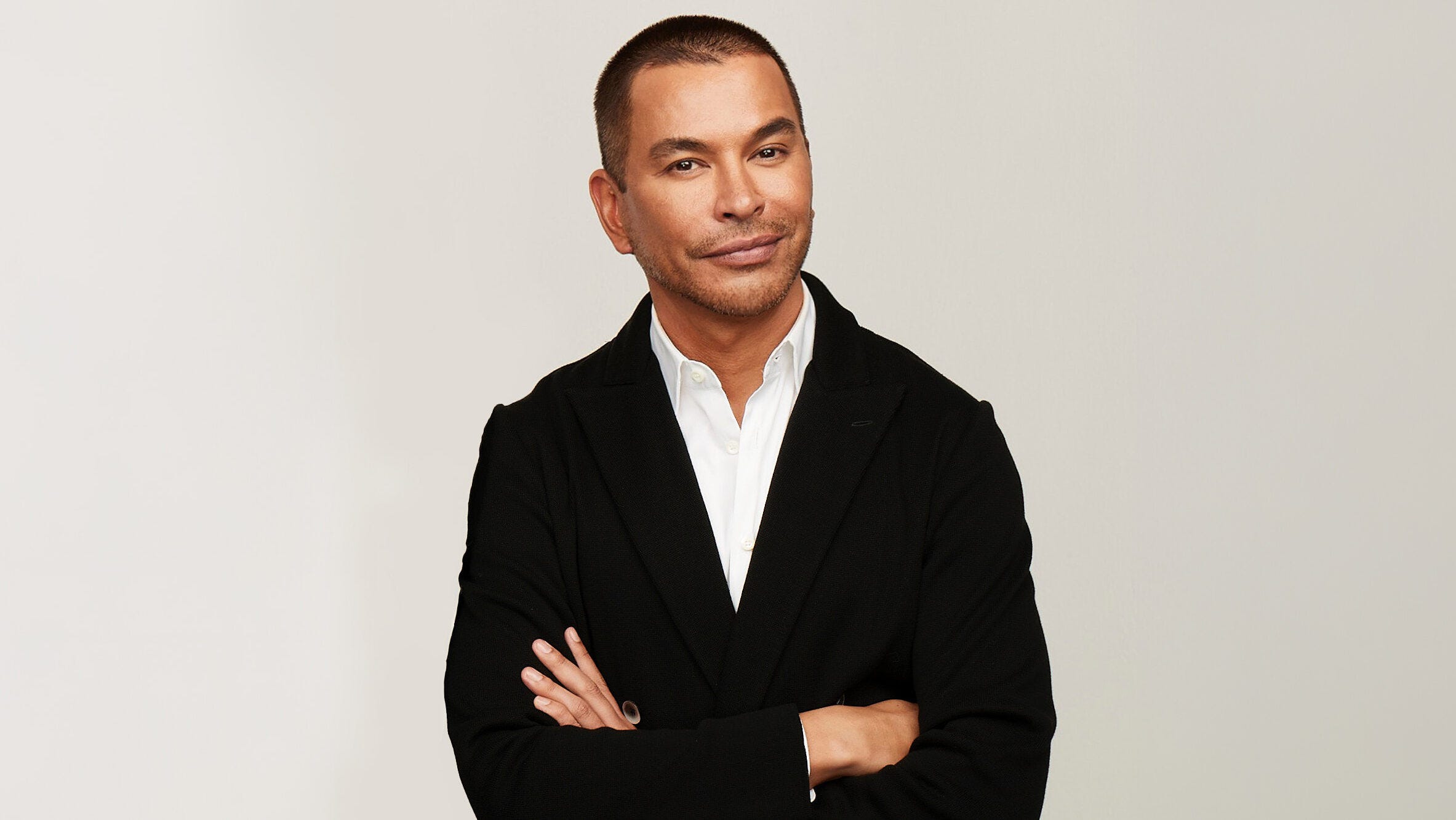
His name is Ben Bennett.
And he is one of the most successful beauty executives you’ve never heard of. “He’s very private. He likes to keep himself out of the narrative,” said a person familiar with his business. And yet, everyone in the industry knows his work.
This is the story of the man behind the brands everyone’s been talking about and the most disciplined brand-building system operating in beauty right now.
The Origin: From Bath & Body Works to Building the Playbook
Before Ben Bennett built The Center, he spent two decades learning exactly what he needed to know.
Early in his career, Bennett worked on 14 different apparel businesses at Limited Brands, but it was his time helping to conceive Bath & Body Works that got him hooked on beauty. “I’d never considered developing fragrances or personal care products,” he said. “I looked at Bath & Body Works like this was another specialty business that I was brought in to help influence seasonality and trend.” Bath & Body Works. In the 1990s, when body wash was just beginning to displace bar soap. When the category was wide open. When Limited Brands was figuring out what American consumers would buy if you made the experience exciting enough.
Bennett absorbed that lesson deeply: the right category, at the right moment, with the right format, is the entire game. After Limited Brands, he spent years building branding capabilities:
2002-2005: Owner/Creative Director at Bennett Kreative (his own branding firm)
2005-2009: VP Creative Director at Pure Beauty
Then, in 2009, Bennett co-founded Hatchbeauty with Tracy Holland, an incubator and agency that counted Dollar Shave Club, Unilever, Lancer Skincare, Goldfaden MD, and eSalon among its clients. Under his direction, Hatchbeauty created lines for hairstylist Orlando Pita and makeup artist Kristofer Buckle, as well as private label brands for retailers, including a clean makeup and skin-care line for Walmart called Found. During his Hatchbeauty tenure, the portfolio generated $150-200 million in annual retail sales.
In 2019, Bennett sold his stake in Hatchbeauty to Lion Capital the PE firm behind Jimmy Choo and AllSaints. He exited. Then immediately started building again. But this time with a completely different model.
The Center: The Most Disciplined Brand Factory in Beauty
The Center launched in 2019 - 2020 out of 9200 Sunset in West Hollywood the former offices of Estée Lauder. The address wasn’t accidental. Neither was anything else about how Bennett designed the business.
The Center’s business model is split into two functions brand incubation and brand acceleration under The Center Holdings, the company’s investment arm. But the real insight was philosophical:
Bennett calls himself “the birth parent,” not “the forever parent.” He considers The Center a brand accelerator, not an incubator as that implies The Center owns the brand, not the founder. He hopes that these brands can and will exit with a strategic buyer eventually.
Most beauty incubators exist to build brands they intend to own forever. They want the ongoing royalties, the long-term equity, the growing enterprise value sitting on their balance sheet. Bennett designed The Center specifically to build brands and sell them. Not because he doesn’t care about the brands. But because he understood something most people in beauty miss:
The moment you’re most valuable to a brand is the first 3-5 years. You’re identifying the white space. You’re making the creative decisions. You’re building the community. You’re getting it into Sephora. You’re proving the model.
Once a brand is at $80-150M revenue with proven retail velocity and an identifiable community, the expertise required to scale it further isn’t what Bennett and The Center provide. It’s what TSG Consumer and e.l.f. Beauty provide.
Bennett says: “I know that I’m better at that stage, and my team is built to be better at that, than we are at the long-term growth of the business.”
This is the most honest thing a brand builder can say about themselves. And it’s the insight that makes The Center’s playbook so repeatable.
The Playbook: Six Steps That Have Produced Three Nine-Figure Exits
Every brand The Center has successfully exited follows the same six-step model:
Step 1: Find the White Space, Not the Trend
Bennett identifies structural gaps in the market categories where consumer desire exists but supply is inadequate.
Naturium: In 2019, ingredient-led skincare existed at either the drugstore level (basic formulas) or the prestige level (Estée Lauder pricing). Nobody had created high-performance, ingredient-transparent skincare at an accessible price point with real clinical backing.
Phlur: In 2021, fragrance was bifurcated between mass (cheap, synthetic, low prestige) and luxury (Chanel, Maison Margiela, expensive). The middle category “masstige” fragrance with genuine emotional storytelling at $80-120 price points was virtually empty.
Saltair: In 2022, body care was the last category in the bathroom to be “premiumised.” Skincare had Clean Beauty. Haircare had Olaplex and K18. Body care was still largely Dove and Nivea territory. The opportunity for treatment-forward, fragrance-led, clinically supported body care at accessible price points was enormous.
The pattern: Bennett consistently identifies categories that are either premiumising (body care) or democratising (prestige fragrance, clinical skincare) at the exact moment when consumer behaviour is shifting.
A beauty veteran said that Bennett knows exactly when to exit, which is often before brands traditionally go to market. He’s not waiting for the $1 billion sale, an ego trap that many founders fall into.
Step 2: Find the Creator Who IS the Category
This is where Bennett’s model diverges from every other beauty incubator.
Most celebrity/influencer beauty brands find a famous person and build a brand around their fame.
Bennett finds a person who is the living embodiment of the problem the brand solves.
Susan Yara + Naturium: Yara was a beauty journalist turned YouTube skincare educator with a million subscribers. She had spent years teaching her community about active ingredients — retinol, niacinamide, vitamin C. She wasn’t famous in a general sense. She was the definitive authority on exactly what Naturium was selling: ingredient-led, accessible, science-backed skincare.
“Ben was straightforward with me about his goal and what The Center could do. And I was very clear about building a legacy brand,” said Yara.
Chriselle Lim + Phlur: Lim was a lifestyle and fashion creator who had publicly documented her divorce. The emotional rawness of that experience rebuilding identity, finding yourself again, the comfort of scent was exactly the emotional territory Phlur’s fragrance narrative lived in.
Phlur’s hero product, Missing Person, was literally built around the emotional experience of missing someone. The fragrance that started as a post-divorce passion project became a major beauty buyout.
Iskra Lawrence + Saltair: Lawrence is a British model and body positivity advocate with a deeply established community built around inclusive beauty and body acceptance. She created Saltair right after the pandemic, having her first child, being postpartum, trying to navigate those feelings of isolation, and trying to figure out how to reconnect with herself after not taking care of herself.
The body care brand built on “every body is welcome here” the exact message of her entire platform, for her entire career.
In every case: the creator didn’t endorse the brand. The creator was the brand’s origin story.
Step 3: Build the Product Around Clinical Credibility
Every Center brand is positioned on functional efficacy, not just aesthetics.
Naturium: Driven by the belief that high-performance skincare should be clinically effective, skin-compatible, and affordable. Known for powerful ingredient-led formulas.
Phlur: Mindfully formulated, responsibly sourced, developed with master perfumers. Not just pretty bottles.
Saltair: Pairing clinically supported, treatment-forward skincare actives with elevated, transportive fragrances at accessible price points.
The positioning formula: Clinical efficacy + accessible price point + premium presentation. This is the sweet spot that makes brands work at scale:
Clinical efficacy builds trust and drives trial
Accessible price point removes the barrier to purchase
Premium presentation justifies the price premium over drugstore
Bennett describes this as “better-for-you beauty” the consumer gets something that actually works, at a price they can justify, in packaging that feels aspirational.
Step 4: Get Prelude Growth Partners In Early
Here’s a structural detail that almost nobody is writing about: Prelude Growth Partners has invested in Naturium, Phlur, and Saltair appearing in all three Center exits as the institutional capital partner that bridges early incubation to PE acquisition.
Prelude’s role in each deal:
Naturium: Minority investment in 2021, exited 2023 at $355M
Phlur: Investment prior to TSG acquisition 2025
Saltair: Investment prior to TSG majority acquisition 2026
Prelude Growth Partners seeks to make investments of $15 million to $100 million in each company, across branded consumer categories.
This is the institutional flywheel: The Center builds brand to early proof-of-concept → Prelude provides growth equity to scale retail distribution → TSG or e.l.f. acquires at peak velocity → Prelude exits cleanly → cycle repeats.
The same three entities — The Center, Prelude Growth Partners, and TSG Consumer have now transacted three times together.
This isn’t coincidence. This is a repeatable system. They know how each other works. They’ve done the due diligence on each other’s approaches. The trust infrastructure is already built. Each deal gets easier because the parties already understand the playbook.
For founders raising capital: this is the beauty industry equivalent of the PayPal Mafia. The same network recycling capital and expertise through consecutive winning deals. If you’re in the orbit, the next deal comes faster. If you’re outside it, you’re competing against relationships built across hundreds of millions in shared exits.
Step 5: Sephora as the Distribution Proof Point
Every Center brand was built specifically for Sephora. Not as an afterthought. As the primary strategic objective.
Naturium in Sephora: Net sales growing at approximately +80% CAGR over the last two years before acquisition.
Phlur in Sephora: Triple-digit growth across retailers including Sephora and Space NK. The brand reportedly ranks as the second-fastest-growing fragrance label at Sephora in North America and has risen into the top 10 of fine fragrance sales.
Saltair in Sephora: Now expanding to the UK through Space NK. TSG Consumer signed after a period of significant retail expansion for Saltair, including its UK launch through Space NK in October 2025.
Why Sephora specifically: Sephora is the prestige beauty retailer with the highest shopper basket in specialty beauty. Getting into Sephora doesn’t just give you distribution, it gives you the Sephora “seal of approval” that tells every other retailer, every press contact, and every consumer: this brand is at a certain quality level.
A beauty veteran noted that Bennett knows exactly when to exit often before brands traditionally go to market. He gets the brand into Sephora, proves velocity, generates the Earned Media Value data that shows the brand is resonating, and exits before the category saturates.
Step 6: Exit at Velocity Peak, Not Revenue Peak
This is Bennett’s most counterintuitive strategic insight and the one that most founders get wrong. Most founders exit when revenue is at its absolute peak. Bennett exits when growth velocity is at its peak even if revenue could still grow substantially.
Naturium: Sold at ~$90M revenue on +80% CAGR. Could it have gotten to $200M? Probably. Would it have been worth more than $355M? Possibly. But would the growth rate have been +80%? Almost certainly not.
Phlur: Sold at $150M revenue projection with year-on-year sales doubling. Doubling at $150M is extraordinary. A buyer pays for the trajectory, not just the number.
Saltair: $150M projected revenue for 2026. Growing fast enough for TSG to pay a meaningful multiple for majority control.
He’s not waiting for the $1 billion sale, an ego trap that many founders fall into.
The mathematical logic: If you sell at 4x revenue on $100M growing 80% annually, you get $400M.
If you wait to $200M revenue and the growth rate has slowed to 30% annually, you might get 3x revenue = $600M. That’s more absolute dollars, but:
You’ve waited 2-3 more years
IRR for your investors is lower
Integration risk for the buyer is higher (larger organisation to absorb)
The operational complexity you had to manage for those 2-3 years was significant
You didn’t get to deploy the $400M into the next brand for those 2-3 years
Bennett would rather take the $400M now and start building the next brand. Because compounding across multiple brands over the same time horizon is more valuable than maximising one brand’s exit.
The Exit Scorecard: Three Wins in Six Years
Let’s put the numbers in one place:
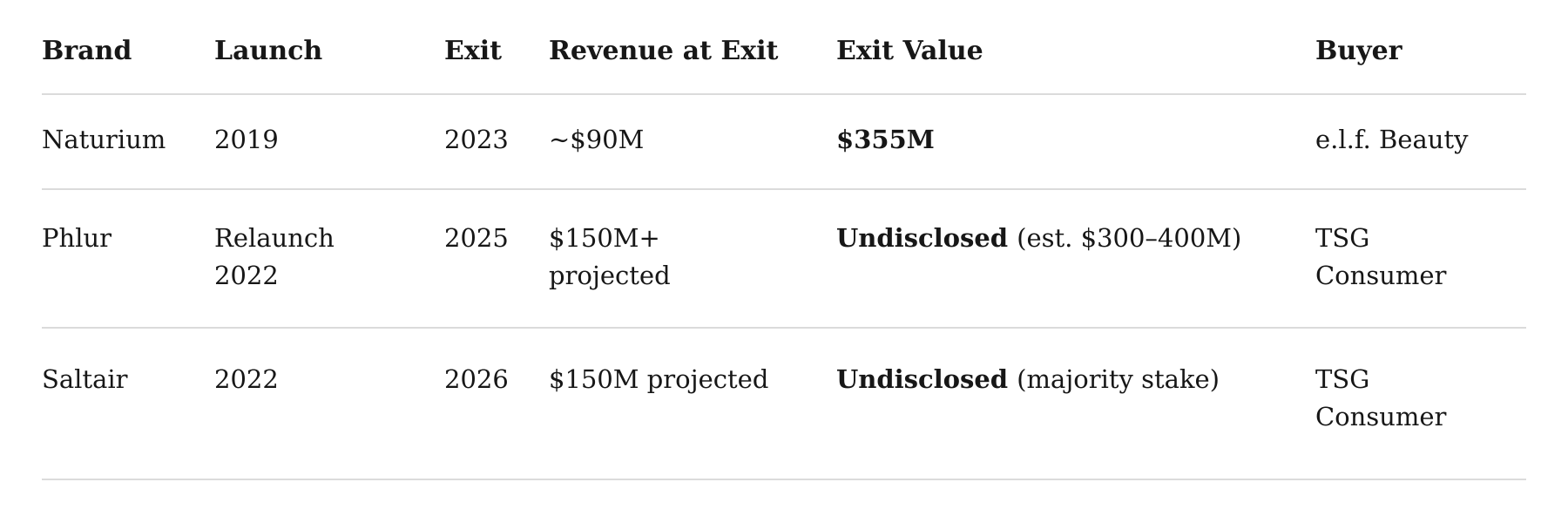
Estimated total exit value generated: $800M - $1B+ across three transactions. In six years. From a 13-person team in West Hollywood. The revenue multiple comparison:
Naturium: $355M on $90M revenue = 3.9x revenue (with $17M EBITDA = 20.9x EBITDA)
Phlur: Estimated $300-400M on $150M = 2-2.7x revenue (premium for growth trajectory)
Saltair: Undisclosed on $150M 2026 projected revenue = premium majority stake
Traditional CPG beauty brands exit at 2-3x revenue. Bennett is consistently achieving 3-4x revenue for brands under four years old. The premium comes entirely from the growth velocity and community depth his model generates.
The Brands Still in the Portfolio (What’s Coming Next)
The Center’s current portfolio extends beyond the three big exits: Its portfolio includes standout brands such as Prequel, CYKLAR, MAKE Beauty, and Proper all still under The Center’s umbrella.
Prequel: Ingredient-led skincare positioned around skin barrier function. Specific, clinical, community-driven.
CYKLAR: Newer launch, details limited but consistent with Bennett’s pattern of identifying emerging wellness categories before they mainstream.
MAKE Beauty: Originally launched by Ariana Mouyiaris in 2013, acquired by The Center in 2020 after founder Nikos Mouyiaris’ death. The minimalist makeup line was stocked at Barneys New York, Net-a-Porter, Revolve, and Selfridges.
Proper: Early-stage brand in Bennett’s portfolio.
At any given time, The Center has 4-6 brands at different stages of the pipeline. While Naturium, Phlur, and Saltair were graduating to exits, Prequel and CYKLAR were being built. By the time Prequel is ready to exit, there are two more behind it. This is the portfolio approach to brand building that most people in beauty haven’t figured out yet.
Not building one brand and hoping it’s the one. Building the system that creates multiple brands simultaneously, at different stages, so the exits compound.
The Prelude Growth Partners Piece: The Capital Architecture Nobody’s Analyzing
Let’s give Prelude Growth Partners their proper credit, because they’re the silent infrastructure that makes all of this work.
Prelude Growth Partners is a leading consumer-focused growth equity firm. By partnering with founders and CEOs, Prelude Growth Partners provides deep category experience, value-added operational support, and a broad network to power high-potential, fast-growing consumer businesses. Prelude Growth Partners seeks to make investments of $15 million to $100 million in each company.
Their investment thesis: Prelude identifies brands at the inflection point past early product-market fit ($10-30M revenue), pre-institutional scale ($100M+). They invest $15-100M to fund the retail expansion, the team build-out, and the marketing infrastructure needed to get from “promising brand” to “acquisition target.”
Their The Center relationship: Prelude has now invested in and exited Naturium, Phlur, and Saltair all three major Center exits. They’ve returned capital to their LPs three times from the same source.
For Prelude’s fund economics:
Naturium: Minority investment 2021, exit 2023 at $355M. Approximately 2-year hold.
If Prelude invested $20M for a 15% stake at $130M valuation (2021), their shares at exit ($355M): $53M. 2.6x MOIC, 61% IRR.
Phlur: Similar timeline and structure.
Saltair: Third time through the same machine.
Each exit makes the next one easier: After Naturium, Prelude and The Center have a proven playbook to show the next creator. After Phlur, that playbook has been validated twice in different categories. After Saltair, it’s a repeatable system that any sophisticated investor can evaluate.
The Center + Prelude is the most efficient beauty brand factory operating today.
TSG Consumer: The Exit Partner Who Keeps Showing Up
One more underreported dimension: TSG Consumer has now bought two Center brands in two consecutive years.
July 2025: TSG acquires Phlur (~$150M revenue)
July 2026: TSG acquires majority of Saltair (~$150M revenue)
TSG’s $14 billion portfolio of beauty brands includes E.l.f. Cosmetics, IT Cosmetics, Summer Fridays, and Phlur.
TSG has been building a portfolio of creator-founded, Sephora-proven, community-driven beauty brands. Summer Fridays (influencer founders Marianna Hewitt and Lauren Ireland). Phlur (Chriselle Lim). Now Saltair (Iskra Lawrence). Every Center brand they’ve acquired fits exactly this profile:
Influencer or creator as authentic founder (not just endorser)
Proven retail velocity at Sephora
Community that genuinely cares about the brand
Clinical or functional differentiation that justifies premium positioning
Accessible pricing that maximises addressable market
TSG is essentially co-investing in Bennett’s thesis. They’ve done the diligence once (Phlur). The second deal (Saltair) was faster, cheaper to diligence, and more certain because they already understand the model. This is the network effect of the beauty PE ecosystem applied to brand incubation.
What Bennett Said and What It Reveals
Bennett: “The kind of young scrappy risk that you have to take to try something new and the willingness to be nimble, to be flexible and to shift that’s my favourite part of the business. I know that I’m better at that stage, and my team is built to be better at that, than we are at the long-term growth of the business.”
He knows what he’s good at. He builds his business around it. He doesn’t try to be the forever parent of brands that need a different kind of parent. Bennett is not precious about The Center owning these brands in perpetuity.
In an industry full of founders who are emotionally attached to their brands, Bennett treats brand building as a craft and exit timing as a discipline.
He loves the brands. He’s good at building them. And he’s equally good at knowing when to hand them to someone better equipped for the next phase.
The Lessons for Every Brand Builder
1. System beats individual brand
Most founders pour everything into one brand and one exit. Bennett built a system that generates multiple exits from the same playbook, running simultaneously.
Three brands at different stages of development at all times means: when one is exiting, another is in the Prelude growth phase, and another is just launching. The cash flows are staggered. The team’s expertise is continuously deployed. One successful brand is a win. A system that produces successful brands repeatedly is a business.
2. Know your stage
Bennett is explicit about what stage of brand building he excels at: 0-$100M revenue. The white space identification, the creative positioning, the community building, the Sephora distribution.
He’s not trying to scale Naturium to $500M. He’s not trying to build Phlur into the next Chanel. He hands off at the exact moment when different expertise is required and by doing so, maximises the value of what he does well.
Most founders try to be the right leader at every stage. The best builders know their stage and build exit mechanisms into the model from day one.
3. Pick creators who ARE the category, not creators who are famous
Susan Yara: the definitive authority on ingredient-led skincare
Chriselle Lim: a woman rebuilding her identity post-divorce, for whom Missing Person was literally her story
Iskra Lawrence: a body positivity advocate whose community IS Saltair’s “every body is welcome here”
None of these are “famous person endorses beauty brand.”
All of these are “this person’s actual life created the need for this product, and their community is the exact audience that will buy it.” The authenticity isn’t manufactured. It’s structural.
4. Exit velocity, not revenue
The temptation is to wait for the billion-dollar exit. Bennett is not waiting for the $1 billion sale, an ego trap that many founders fall into.
Three exits at $300 - 400M each, across a 6-year period, deployed into building the next generation of brands compounds faster than one $1B exit that took 12 years and left the team exhausted. IRR compounds. Patience has a cost. Know when your brand is at maximum velocity.
5. Build the network that makes exits predictable
The Center + Prelude + TSG is now a repeating transaction network. Each deal makes the next one cheaper, faster, and more certain for all three parties.
The best exits aren’t won in negotiations. They’re built through relationships where both parties have already proven trust across previous transactions.
The Final Reality
TSG Consumer bought Saltair.
Saltair’s sale represents the third major beauty exit for The Center and its founder, Ben Bennett, and the second involving TSG Consumer.
The beauty press is writing about Iskra Lawrence’s next chapter. About Saltair’s $150M revenue. About TSG’s growing portfolio.
Nobody’s writing about the man who identified body care as the next frontier in 2022, found the creator whose entire career had been building to this brand, partnered with the same institutional capital partner for the third consecutive time, and sold to the same PE firm that bought his last brand 12 months ago.
Ben Bennett built Bath & Body Works from inside Limited Brands in the 1990s. He built Hatchbeauty into a $150-200M retail portfolio and sold it to Lion Capital in 2019. Then he founded The Center in 2020 with 13 people, in Estée Lauder’s former offices, on Sunset Boulevard and produced three nine-figure beauty exits in six years. Using the same playbook every time:
Find the white space before the market does
Find the creator who is the category
Build clinical credibility at accessible price
Partner with Prelude for institutional growth capital
Prove velocity at Sephora
Exit at peak growth rate, not peak revenue
Start building the next brand while the last one exits
$355 million. $300-400M. And now Saltair.
The man who is most private in an industry full of people who want attention is quietly running the most productive brand-building machine in beauty.
Are you building a brand or building a system? The difference is what you do on the day after your first exit.
P.S. A beauty veteran said that Bennett “knows exactly when to exit, which is often before brands traditionally go to market.” That phrase “before brands traditionally go to market” deserves a full stop. Most beauty brands wait until they’ve maxed out their Sephora velocity, launched into Target, expanded internationally, and built every possible revenue stream before selling. By then, the growth rate has moderated, the complexity has compounded, and the buyer pays a lower multiple for a harder integration. Bennett sells before that. While the growth rate is still extraordinary. While the operational complexity is still manageable. While the acquirer can see 3-5 years of runway ahead. The premium multiple isn’t just for the revenue. It’s for the optionality that revenue represents. The best exits aren’t at peak revenue. They’re at peak optionality.
P.P.S. The most underreported number in the entire Saltair story: Saltair was founded in 2022. Sales are expected to reach $150 million in 2026. That’s $0 to $150M in four years. In body care a category historically dominated by billion-dollar CPG incumbents (Dove, Nivea, Jergens). Against brands with 50-year retail relationships and eight-figure marketing budgets. Built by a 13-person team in West Hollywood operating from a playbook that Bennett refined across two previous companies. When a startup achieves $150M revenue in a category that incumbents have owned for decades in 4 years that’s not luck. That’s a system that works. And the fact that the same system just did this for the third consecutive time is the signal that everyone in beauty should be paying attention to.
I used to work for him, he was brilliant!
Wowwwww 🤯🤯