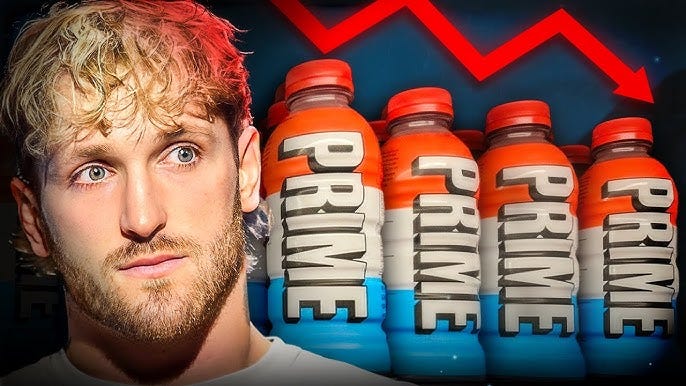
From $1.2 Billion to Clearance Bins at 31 Pence. The Complete Autopsy of How Prime Hydration Destroyed One of the Fastest-Growing Beverage Brands in History.
Let me give you a number that will ruin your day. 31p.
That’s the clearance price British retailers were selling Prime Hydration cans for in mid-2025.
The same cans that were selling on eBay for £100 in 2022. The same brand that generated $1.2 billion in revenue in 2023. The same product that surpassed Gatorade as the number one selling hydration drink at Walmart.
Locked in anti-theft cabinets at Aldi. Bottles reselling for over £1,000 on secondary markets. Stampedes at store openings. Schools banning it. A US Senator calling it a “cauldron of caffeine.”
Then: clearance bins. Grocery store sale shelves. 31 pence.
From 2023’s $1.2 billion peak, Prime Hydration crashed to a projected $300 million in 2025, a 76% decline in two years.
This is the most spectacular, instructive, preventable collapse in consumer brand history. And almost every single lesson was ignored.
Let me take you through the full autopsy.
The Origin: Two Rivals, One Deal, and 60 Million Reasons It Worked
January 4, 2022.
Logan Paul and KSI announced they had founded a new drink company called Prime Hydration. Interestingly, both of them had fought in 2018 and 2019. Since both are some of the most famous YouTubers of all time, their fight was promoted heavily as “the biggest internet event in history.” After seeing the success of the fight event, both of them decided to team up and become business partners.
The ownership structure: The Prime brand is owned by Prime Hydration LLC, a subsidiary of Congo Brands a product development firm run by Max Clemons and Trey Steiger, who own a controlling 50% of the brand, while Logan Paul and KSI own 20% each.
Congo Brands is the operational engine most people don’t know about. Louisville, Kentucky-based, founded by two high school friends. They manufacture, distribute, handle operations. KSI and Logan Paul are the marketing machine.
The product: Bottles featured ingredients like electrolytes, B vitamins, branched-chain amino acids, and about ten percent coconut water. Zero sugar and bold, bright packaging helped the product appeal to a younger audience already attuned to social media trends.
Positioned explicitly as the healthier Gatorade alternative. Zero sugar. “Hydration” as the core claim. Neon packaging. Fruit-forward flavours. 200mg caffeine in the energy variant.
The distribution strategy: Launched exclusively through limited drops online and in select retailers. Leveraged KSI’s 40M+ YouTube subscribers and Logan Paul’s 23M+ to create immediate viral demand without a single traditional advertising dollar spent.
The result was immediate and extraordinary.
The Meteoric Rise: 18 Months That Changed Beverage History
By 2023, Prime Hydration achieved what took Gatorade decades, hitting $1.2 billion in global sales.
Year one alone generated $250 million. The brand sold its 1 billionth bottle in under two years a milestone even industry giants struggle to match.
The UK chaos specifically: Retailers couldn’t keep it on shelves. In the UK, bottles of strawberry watermelon were being secured with anti-theft tags. Aldi UK locations sold out in 30 minutes, with stampedes inside stores and theft serious enough for retailers to lock the bottles in cabinets. Bottles were reselling on eBay for £100. Outlier listings reached £1,200 ($1,500).
The market share peak: Prime’s share in the sports drink market reached 41.2% at peak.
41.2% sports drink market share. Surpassing Gatorade a 60-year-old brand with Pepsi’s entire distribution network as the number one selling hydration drink at Walmart.
Prime Hydration’s valuation rose to $3.2 billion by end of 2023.
The sponsorship machine:
The brand secured:
UFC official sports drink (February 2023, Dana White personally endorsed)
Arsenal FC official partner (July 2022)
Barcelona official partner (summer 2023)
Bayern Munich official partner (summer 2023)
WWE centre-ring sponsorship
LA Dodgers official drink
LA Lakers official drink
Juventus FC official drink
Patrick Mahomes endorsement
Erling Haaland endorsement
Aaron Judge endorsement
Kevin Durant endorsement
IShowSpeed partnership (April 2024)
Three of the world’s biggest football clubs simultaneously. The UFC. Two major US sports franchises. The world’s best footballer at the time (Haaland). The NFL’s most marketable player (Mahomes).
Logan Paul publicly called it “the fastest-growing hydration beverage in history.”
At the time, this was not a boast. It was a measurable fact.
The brand had pulled off something genuinely unprecedented: building a $1.2 billion beverage brand in under two years, with no legacy brand backing, no traditional advertising spend, and purely through the parasocial relationships two YouTubers had built with a generation of young consumers.
Then it all collapsed.
The Fall: What the Numbers Actually Show
Turnover crashed from £112.2 million to £32.8 million, a 71% decline. Net profits collapsed 91.6% to just £312,393.
The market share collapse: Prime’s share in the sports drink market dropped from a peak of 41.2% to 10.4% by 2024, and its presence in the energy drink market is now a mere 0.31%.
Peak: 41.2% sports drink share. By 2024: 10.4%.
In the energy drink category which Prime Energy specifically targeted they never broke 0.31%. In a category where Monster and Red Bull have combined share above 80%, Prime Energy couldn’t establish a foothold at all.
The Google Trends signal: Google search data shows weekly searches fell to one-tenth of peak levels, with this decline in consumer interest preceding the sales collapse by months.
Search interest always an early warning signal fell off a cliff months before the revenue numbers caught up. The demand destruction was visible in consumer intent data long before it appeared in the P&L.
The retail humiliation: By June 2025, British retailers like Tesco were selling Prime Hydration for 31p in clearance bins bottles that months earlier resold for £100 among schoolchildren.
A clearance price of 31 pence on a product that was a status symbol. That’s a brand death.
The repeat purchase rate: By 2024, repeat purchase rates had fallen to around 12% even as brand awareness remained close to 100%, the kind of split that signals trial-driven sales rather than habitual purchase.
100% brand awareness. 12% repeat purchase rate.
This single statistic tells you everything you need to know about what went wrong.
Seven Reasons Prime Failed: The Full Autopsy
Failure #1: They Built a Hype Machine, Not a Product
The fundamental question you must ask about any consumer brand:
Why would someone buy this again without being reminded to?
Prime’s honest answer: most people wouldn’t. The brand excelled at generating initial sampling but failed to create repeat purchase behaviour. “A brand cannot live on hype alone,” explains Andrea Hernández of food-and-beverage newsletter Snaxshot.
The product itself coconut water base, electrolytes, B vitamins, BCAAs, zero sugar is fine. But it’s not exceptional. It doesn’t taste dramatically better than Gatorade. It doesn’t perform better. It doesn’t feel better.
What it had was cultural cachet. A status signal for 13-year-olds who watched KSI on YouTube. But cultural cachet is rented, not owned. It requires constant renewal through cultural relevance. And for a beverage brand, cultural relevance cannot substitute for the one thing that builds a $10 billion beverage business:
Daily habitual consumption. People drink Coke every day because it satisfies a daily craving. People drink Gatorade during workouts because it solves a physical performance need. People drink water because biology.
People drank Prime because their favourite YouTuber told them to and they wanted to show it off at school. When the novelty faded, the habit wasn’t there to sustain purchases.
Compare this to the brands we’ve covered in this newsletter:
Poppi: Positioned as the daily soda replacement daily occasion
AG1: Daily morning ritual daily habit
IM8: 200,000 servings per day across 43 countries daily consumption
Prime had zero daily occasion ownership.
Failure #2: The Scarcity Model Was the Business And They Killed It
The initial genius of Prime was the drop model. Limited availability. Urgency. FOMO. Bottles locked in Aldi cabinets. Selling out in 30 minutes. Reselling for £100. School hallways buzzing with whoever got the new flavour.
That scarcity created perceived value. When something is hard to get, it feels more valuable than its actual product quality justifies. Then they scaled distribution.
Widened distribution: As Prime’s distribution expanded, the initial scarcity that fuelled demand disappeared. This led to a drop in perceived value and price. By 2024, Prime was available in every supermarket, every corner shop, every petrol station. Everywhere.
The moment you can buy it anywhere, the scarcity premium evaporates. You’ve taken a product whose entire perceived value was built on exclusivity and made it as available as Lucozade.
And then the product has to justify its price on actual merits. Which it couldn’t.
Several retailers in the UK had to clear excess inventory in late 2024, with some discounting Prime products well below standard shelf prices.
They went from “locked in cabinets at Aldi” to “clearance bins at Tesco” in 18 months.
The Trapstar parallel is instructive here: Trapstar’s founders explicitly understood that the drop model requires scarcity discipline. You don’t put Trapstar in every Topshop. Prime did the opposite they put Prime everywhere, and in doing so destroyed the scarcity dynamic that made the brand valuable.
The Salt & Stone comparison is even more instructive: Salt & Stone launched deodorant in 1,700 locations. Prime launched in what felt like 170,000.
One is still commanding 3x premium pricing and sold for $500M. The other is clearing for 31 pence.
Failure #3: The Audience Was the Wrong Age
Prime’s most loyal customers were 10-16 year olds. This is simultaneously the reason for their explosive initial growth and the structural flaw at the heart of the business model.
Why pre-teens drove the growth: Gen Alpha consumers cycled through fads with unprecedented speed. The brand excelled at generating initial sampling through FOMO among younger demographics.
Pre-teens have two characteristics that made them perfect early Prime customers:
Extreme susceptibility to peer influence and social signalling
Zero brand loyalty, they’ll switch to the next thing immediately
The first characteristic drove the viral adoption. The second characteristic caused the collapse.
Teenage fandom is the most powerful and the most temporary force in consumer marketing. Getting a generation of 12-year-olds excited about your brand can generate $1.2B in 12 months. It can also evaporate completely the moment the next thing arrives.
And the parental backlash: Senate Majority Leader Chuck Schumer wrote a letter to the FDA to investigate Prime Energy for its high levels of caffeine and marketing toward minors. “PRIME is so new that most parents haven’t a clue about it, but it is born from the reels of social media and the enigmatic world of influencers. Kids see it on their phones or as they scroll, and they actually need it and the problem here is that this product has so much caffeine in it that it puts Red Bull to shame, but unlike Red Bull, this product has one true target market: children under the age of 18, and that is why I am sounding the alarm.”
A US Senator publicly calling your product a “cauldron of caffeine” targeting children is not a marketing problem. That’s a brand-existential problem.
Schools across the UK banned Prime after reports of hyperactive children consuming multiple cans during school hours.
When your primary customers’ parents and schools are actively working against your product being consumed — you don’t have a customer retention issue. You have a customer base that is being systematically removed from your reach.
Failure #4: The Product Had No Functional Differentiation
Everything else about the drink the health benefit claims, questionable hydration formulation, and branding doesn’t seem to offer anything better than what bigger and more established brands already provide. And so, for all its hype, PRIME did not live up to the promise of being the “better for you” drink.
The sports drink market is brutally competitive with deeply entrenched players: Gatorade led the market with over $7.5 billion in sales from April 2024 to April 2025, nearly six times the sales of the second-placer, Bodyarmor.
$7.5 billion for Gatorade. In a single year.
For Prime to sustainably compete in this category, the product needed to be meaningfully better on at least one functional dimension: taste, hydration, recovery, energy, health benefits.
It wasn’t.
Independent nutritionists noted that Prime’s formulation was broadly similar to Gatorade and other electrolyte drinks. The coconut water base, B vitamins, BCAAs none of these are proprietary. None create meaningful switching costs.
Jon Evans of System1 told Marketing Week that Prime’s decline proves you can’t “cheat the fundamentals.”
The functional beverage brands that have built durable businesses:
Poppi/Olipop: Prebiotic fibre a functional benefit Gatorade doesn’t offer, with clinical evidence behind it
AG1: 90+ ingredients at clinical doses a comprehensive nutritional profile that goes far beyond any sports drink
IM8: 92 ingredients with NASA research backing, defensible scientific formulation
Liquid I.V.: Cellular transport technology (CTT), a specific proprietary hydration mechanism
Prime’s functional differentiation: Zero sugar and KSI’s face on the label.
Zero sugar was a meaningful benefit in 2022. By 2024, every major sports drink had a zero sugar variant.
KSI’s face is not a functional benefit.
Failure #5: The PFAS and Caffeine Controversy Destroyed the “Healthy” Positioning
The single most dangerous thing for a brand positioned as “healthy” is evidence that it isn’t.
A class-action lawsuit against Prime Hydration alleged that its products contain toxic “forever chemicals” (PFAS) at three times the limit of what a human should consume in an entire lifetime.
Testing determined that the product had nearly three times the lifetime limit of the chemical PFOS (Perfluorooctane sulfonic acid), an ingredient often used in non-stick or stain-resistant products.
PFAS per and poly-fluoroalkyl substances are the chemicals linked to:
Liver damage
Immune system disruption
Hormonal interference
Increased cancer risk
Prime’s response: denied all allegations, stated products are safe and compliant with federal standards. The legal outcome: Most lawsuits were dismissed or are ongoing. No regulatory agency declared Prime unsafe.
The brand damage outcome: Irreversible.
When a product marketed as “healthy” and “clean” becomes associated with “forever chemicals” in mainstream media even through unproven allegations, the brand’s core positioning is fatally undermined.
The parent who was already nervous about the caffeine levels in Prime Energy is now reading “forever chemicals” headlines. The school that was already debating banning it now has legal ammunition. The “healthy alternative to Gatorade” narrative collapses the moment PFAS and FDA investigation become associated with the brand name.
Prime built its brand on the “healthy sports drink” position. And then the media attached “toxic chemicals” to that brand name. You can’t recover from that with a new flavour launch.
Failure #6: Too Many Celebrity Deals Diluted the Core Relationship
Prime’s founding insight was brilliant: Two YouTubers with combined 60 million followers and genuine parasocial intimacy with their audience could deploy that relationship to launch a product.
The intimacy was real. KSI and Logan Paul weren’t celebrities in the traditional sense, they were people their fans had followed for years, felt they knew personally, trusted as authentic. Then they started doing what every brand does when it gets big:
Kevin Durant, IShowSpeed, Erling Haaland, Patrick Mahomes, Aaron Judge, Tyreek Hill, Central Cee, Peso Pluma, the LA Lakers, Juventus FC.
Every new endorsement deal diluted the original value proposition. The original Prime: Two guys we genuinely follow made this for us.
By 2024 Prime: A corporate brand with the same celebrity endorsement strategy as Gatorade and PowerAde, just with more famous influencers.
When a brand built on parasocial intimacy starts buying Super Bowl spots, the underlying engine has shifted. The first three years of Prime ran on Logan and KSI showing up on YouTube. The fourth year started running on the same playbook everyone else uses. The moment you start competing like a traditional brand, you lose the unfair advantage that made you different.
KSI and Logan Paul’s value wasn’t as celebrity endorsers. It was as founders who had genuine relationships with their fans. Once the brand started treating itself like a traditional CPG brand, with a sponsor portfolio, with traditional athlete endorsements, with conventional marketing spend — it lost the only thing that differentiated it.
They tried to become Gatorade whilst abandoning the one thing they had that Gatorade didn’t: authentic founder-fan relationships.
Failure #7: The Unit Economics Were Never the Point
This is the most structural failure of all and it’s the one that explains why the collapse was so violent.
At its peak, Prime generated $1.2 billion in revenue.
But the business model was fundamentally based on repeat purchases from customers who didn’t have a functional reason to keep buying.
The IM8 comparison:
IM8 subscription rate: 80% of new customers
IM8 LTV:CAC: 3x+
IM8 CAC payback: 3.4 months
IM8 June 2026 revenue: $17M (record)
Prime:
By 2024, repeat purchase rates had fallen to around 12% even as brand awareness remained close to 100%.
12% repeat purchase rate. 100% brand awareness.
If 100% of people know your brand but only 12% buy again, you have a trial business not a brand. Every month, Prime needed to generate new trial customers to replace the 88% who didn’t come back. When the novelty faded and the cultural moment passed, trial dropped. Revenue collapsed.
A business with a 12% repeat rate is not a consumer brand. It’s a marketing campaign that has to restart every month.
Compare this to what makes successful subscription beverage brands work:
AG1 subscription rate: 50%+
Poppi DTC subscription: 35-40%
IM8: 80%
The metric that matters in DTC beverages is not sales volume. It’s what percentage of trial customers become habitual subscribers. Prime never solved this problem. And when you have 100% awareness and 12% repeat purchase, there’s no new demographic to trial into. You’ve already reached everyone. And they’re not coming back.
The Strategic Mistakes: A Summary of What Should Have Been Done
Looking at this chronologically, here are the decisions that created the collapse:
Decision 1 (2023): Expanding Distribution Too Aggressively
Should have done: Maintained scarcity in key markets (UK, US). Limited to 500 - 1,000 retail locations. Protected the “hard to find” positioning that created the secondary market premium.
Did: Flooded every supermarket in every market simultaneously. Killed the scarcity that created the value.
Decision 2 (2023): Targeting Children Without a Safe Product Strategy
Should have done: Explicitly positioned Prime Energy as adult 18+ and built Prime Hydration with demonstrably clean formulations, transparently tested and certified.
Did: Marketed high-caffeine energy drinks through channels saturated with children, attracted FDA investigation and Senate scrutiny, created “PFAS forever chemicals” liability exposure.
Decision 3 (2023-2024): Adding Celebrity Endorsements Instead of Building Habit
Should have done: Used the $1.2B revenue peak to invest in product reformulation, something actually differentiated on taste, function, or health. Build the subscription model. Solve repeat purchase.
Did: Signed Mahomes, Haaland, Durant, Judge, IShowSpeed. Added sponsorships with Lakers, Juventus, WWE. Spent money on awareness for a brand with 100% awareness.
Decision 4 (2024): Not Addressing the Repeat Purchase Crisis
By mid-2024, the data was clear: UK revenue was down 71%, repeat rates at 12%, Google search interest at 10% of peak.
Should have done: Complete strategic pivot, reformulate product, launch subscription model, address regulatory concerns head-on, reposition away from children’s market.
Did: Launched Prime Ice hydration line in early 2025 to re-ignite product relevance.
A new flavour. When you’re at 31 pence in clearance bins, a new flavour is not a strategy.
Where It Stands Now
The brand is currently undergoing a strategic review to establish a sustainable long-term presence. Congo Brands continues to run the operational backbone, and Logan and KSI remain attached as the public face. No public statement has confirmed whether Prime is being repositioned or wound down.
Current estimated position:
2025 revenue: ~$300M (projected, down 76% from $1.2B peak)
UK revenue: £33M (down from £112M peak)
Market share (sports drinks): ~10% (down from 41.2%)
Market share (energy drinks): 0.31%
Valuation: Significantly below $3.2B peak — private so unconfirmed
Legal status: Multiple lawsuits ongoing (PFAS, caffeine claims)
What recovery would require:
Complete product reformulation addressing PFAS concerns with independent testing and transparency
Launch of subscription model with genuine repeat mechanics (daily ritual positioning)
Strict age-gating of all caffeine-containing products
Distribution reduction, pull from mass market, concentrate in sports/fitness channels
Either rebuild the founder authenticity (KSI and Logan Paul visibly back in product development) or acknowledge that the brand needs to stand alone on product merits
The honest assessment: The recovery path exists in theory. But executing it requires the brand to simultaneously:
Shrink distribution (counterintuitive)
Raise the bar on product quality (expensive)
Rebuild trust with parents and regulators (slow)
Find a new audience to grow into (difficult)
And do all of this whilst competitors grow and the cultural moment that created the brand has definitively passed.
The Lessons Every Founder Must Take From This
1. Hype is rented. Habit is owned.
$1.2 billion in revenue built on hype can collapse in 18 months.
$1.2 billion in revenue built on daily habitual consumption is the foundation of a generational brand.
Gatorade has $7.5 billion in annual sales because people drink it before, during, and after exercise as a reflex. Not because they saw a YouTuber hold it.
The question for every consumer brand founder:
Why will someone buy this on a Tuesday at 8pm when they’re not thinking about our content or our celebrity partners?
If you can’t answer that, you have a marketing campaign, not a brand.
2. Scarcity is a moat, but only until you flood the market
The drop model works. Trapstar proved it over 20 years. Supreme built an empire on it.
But scarcity requires discipline that is almost impossible to maintain under financial pressure.
When you’re growing 300% and every retailer wants your product, the temptation to take every deal is overwhelming. Each individual distribution deal seems rational. The cumulative effect destroys the scarcity that made you valuable.
If you build a brand on exclusivity, maintaining that exclusivity is the most important operational decision you make. Every new door is a decision with brand equity consequences.
3. Marketing spend on awareness for a brand with 100% awareness is money set on fire
By mid-2024, Prime had 100% awareness in its core demographic.
Every pound spent on Patrick Mahomes, Erling Haaland, and IShowSpeed was a pound spent on the one metric Prime didn’t need to improve.
Awareness was never the problem.
Repeat purchase was the problem. Subscription mechanics were the problem. Product differentiation was the problem. Regulatory trust was the problem.
Solve the actual problem. Don’t spend on the metric that looks good in your deck.
4. The unit economics reveal everything before the revenue does
A 12% repeat purchase rate at the height of the Prime hype cycle (2023) was the canary in the coal mine.
If you know that 88% of your customers are not coming back, you know you need to find new trial customers every single month to maintain revenue.
And you know that when the viral moment fades, you have no business.
The brands that last Poppi, IM8, Huel, AG1 all have subscription rates above 50%, LTV:CAC above 3x, and payback periods under 12 months.
The brands that collapse Prime have high revenue and terrible retention.
Revenue hides retention problems until the viral moment fades. Then both collapse simultaneously.
Know your retention data from month one. It’s the most important number in your business.
5. Never market a “healthy” product you aren’t certain is healthy
The PFAS allegations, whether ultimately proven or not inflicted irreversible damage on a brand whose entire positioning was “healthy sports drink.”
Plaintiffs argue that Prime falsely advertised its beverages as “clean” and “safe” despite alleged lab findings of trace PFAS levels.
When “healthy” is your brand promise and “toxic forever chemicals” is the media headline, you don’t recover by issuing a denial.
The brands built to last in the better-for-you category invest in supply chain transparency, third-party testing, and clinical validation before launch, not after lawsuits.
Huel publishes full ingredient sourcing. AG1 is NSF Certified. IM8 has NASA research backing and third-party certification. These aren’t marketing decisions. They’re the insurance that protects the “healthy” positioning when it gets tested.
Prime had celebrity partnerships. It didn’t have product certification.
When the lawsuits came, they had no evidence base to protect themselves.
The Final Reality
Prime Hydration built the fastest-growing hydration brand in history.
$0 to $1.2 billion in revenue in 18 months. 41.2% sports drink market share. The 1 billionth bottle in under two years. Outselling Gatorade at Walmart. A $3.2 billion valuation.
And then: Clearance bins in British supermarkets now carry Prime for as little as 31 pence a can quite a fall for a product once worth more than a round-trip plane ticket from New York to Paris.
The tragedy of Prime isn’t that KSI and Logan Paul built something that failed. The tragedy is that they built something that genuinely worked and then made every decision designed to destroy what made it work.
They killed the scarcity. They chased the wrong age demographic. They added more celebrity deals when they needed repeat purchase mechanics. They positioned as healthy without the product integrity to support that claim. They had the most powerful consumer launch in beverage history. And they turned it into a commodity in 18 months.
Jon Evans of System1 told Marketing Week that Prime’s decline proves you can’t “cheat the fundamentals.”
You can’t. You can delay the reckoning with enough hype, enough celebrity, enough scarcity marketing, enough viral moments. But eventually, every consumer brand faces the same question:
Why will someone buy this again without being reminded to?
Prime never had a good answer. And 31 pence in a clearance bin is what happens when the question finally gets asked.
Are you building habitual consumption or a viral moment that’s going to need the next viral moment to survive?
David
P.S. The number that haunts me most from this analysis: repeat purchase rates had fallen to around 12% even as brand awareness remained close to 100%. 100% awareness. 12% repeat. This is the exact opposite of what a great consumer brand looks like. Great brands have lower awareness amongst a specific community but extremely high repeat rates within that community. AG1 doesn’t have 100% awareness but the people who use it subscribe for years. Poppi doesn’t have 100% awareness but the people who found it replaced their soda habit entirely. Prime had 100% awareness and 88% of people who tried it never came back. That’s not a brand. That’s a very expensive sampling campaign. And the lesson is permanent: your repeat purchase rate at 90 days tells you whether you’re building a business or a moment. If you don’t know yours right now, stop reading this and go find out.
P.P.S. The most painful comparison in this entire story: Prime Hydration had $1.2 billion in 2023 revenue, a $3.2 billion valuation, deals with Arsenal, Bayern Munich, Barcelona, the UFC, the LA Lakers, the LA Dodgers, Juventus, Patrick Mahomes, and Erling Haaland and ended up worth a fraction of that, selling for 31 pence in clearance bins. Meanwhile, IM8 launched in December 2024 with David Beckham, spent 18 months building subscription economics with 80% retention, 3.4-month payback, and $1.44 gross profit per marketing dollar and just secured $1 billion in non-dilutive growth financing from General Catalyst. Both used celebrity. Both targeted health-conscious consumers. Both launched with enormous hype. The difference: IM8 solved repeat purchase from day one, priced premium and maintained it, and built unit economics that compound. Prime solved viral launch and let the repeat purchase problem solve itself. It didn’t. The lesson between these two stories, read side by side, is the most complete masterclass in consumer brand building I’ve seen in a decade.


