


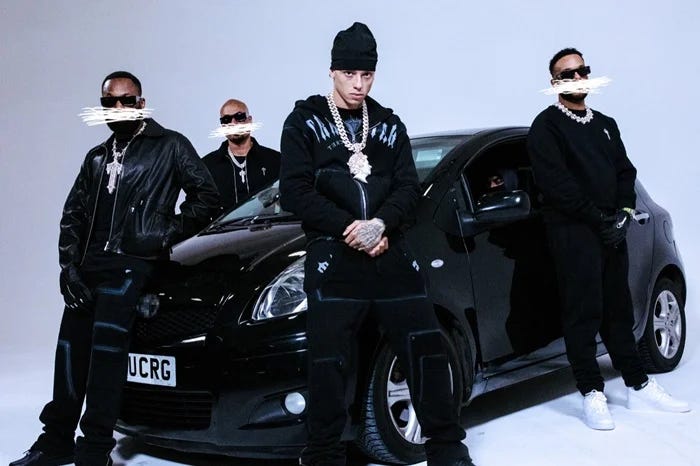
Let me tell you a story about three boys from West London.
They didn’t have investment capital. They didn’t have retail relationships. They didn’t have a business plan.
What they had: A shared obsession with style. A printer. And a philosophy they hadn’t yet articulated but would eventually distil into four words:
“It’s A Secret.”
Mikey, Lee, and Will surnames largely irrelevant because the culture knew them by first names only, started making T-shirts in 2005. Not to build a company. Not to raise a venture round. Just to out-do each other in the school of self-expression.
The three childhood friends shared a common interest in style, sneakers and music during the late ‘90s house and garage era, when brands like Versace and Moschino were heavily intertwined into the culture. They originally began to make their own customised tees in an effort to “out-do one another” and “inject a sense of individuality” into their garments.
And then word got out.
In the early stages, around 2005/2006, Mikey says no one wanted to stock Trapstar. “They thought we were going to be here today, gone tomorrow.” But what started as an obstacle played out to their advantage. “They just made us go back to our same roots, keep it a little bit more close knit for people who understand who you are and what your brand is about.”
So they built differently.
Customers needed to contact them via MySpace to place orders. Items were hand-delivered in pizza and detergent boxes. “We always wanted to disguise packaging,” says Mikey. “We sort of had this seen everywhere, found nowhere mentality.”
Merchandise could be purchased via a simple direct message or a text to the brand’s “trap phone” a nod to the easily disposable burner phones.
Pizza boxes. Burner phones. MySpace DMs.
That was the logistics infrastructure of what would become one of the most culturally significant streetwear brands Britain has ever produced.
And on 29 May 2026, Trapstar Collective Limited entered administration.
This is the full story the rise, the collapse, and the rescue and what every founder in fashion, consumer, and streetwear should take from it.
The Name. The Philosophy. The Foundation.
Before we get to the numbers, you have to understand what Trapstar actually is. Because “streetwear brand” undersells it. And “fashion company” misses the point entirely.
The name “Trapstar” came from a conversation with Lee’s stepdad. He said: “You all think you’re some sort of fly boys, but you’re just trapped. Let’s see you make something of yourselves.” Mikey responded by saying: “We may be trapped, but there’s a star trapped in everybody.”
And it explains why Trapstar resonated with a generation in a way that most brands never achieve.
Jay-Z, Rihanna, Stormzy, Central Cee, A$AP Rocky, and Drake have all been spotted in Trapstar pieces. These were not paid partnerships or forced brand deals. They were genuine endorsements artists wearing what they actually loved. That authenticity is something money simply cannot buy.
Think about what it means that Jay-Z wore Trapstar before they had a PR team.
That Rihanna wore it organically. That Stormzy’s Trapstar underwear was visible during his iconic Glastonbury headline performance arguably the most watched moment in UK music that decade and nobody at Trapstar paid for that placement.
An investment from Jay-Z’s Roc Nation, a stint as the official merch designers for Rihanna’s Monster tour, a Puma collaboration all helped to catapult the brand.
This is what cultural authenticity looks like at its peak. No algorithm. No media spend. No ambassador fees.
Just three boys from Shepherd’s Bush making something so real that the biggest names in music wanted to be part of it.
The Numbers: From Pizza Boxes to £40 Million
Trapstar was founded in West London in 2006 since then, the brand has evolved to become a well-established, globally recognised name in streetwear, receiving high-profile celebrity endorsements and strategic collaborations under its direct-to-consumer retail model.
The timeline:
2005-2009: Underground era
Selling from car boots, Portobello Market, and MySpace DMs
Delivery in pizza boxes and detergent cartons
No stores, no wholesale, no advertising
Revenue: Near zero. Cultural capital: Priceless.
2010: First flagship store Trapstar would eventually be stocked at Supra on Portobello Road in London, where they now have a flagship store. “It was like we got signed to a label,” says Mikey. By then, the brand had its own buzz and built its own fanbase.
2015-2016: Puma collaboration The brand completed a notable collaboration with Puma in 2015-16. This is the moment Trapstar stepped from cult status to mainstream credibility.
2019: World Fashion Awards In 2019 they were awarded Best Streetwear Brand at the World Fashion Awards Supreme, Palace and Stussy were among the nominees in that category.
2022: The Peak
Revenue reached £40 million.
2022 saw a peak year for Trapstar, when its revenue reached £40 million due to demand for hoodies and tracksuits during the pandemic.
The “drop” model was perfectly suited to pandemic consumer behaviour:
People at home, shopping online
Limited edition scarcity driving urgency
No travel, no holidays clothing became the treat
Social media amplification at peak
At £40 million revenue, a 57-person team, Selfridges partnership, global celebrity endorsements, Roc Nation investment, Puma collaboration under the belt, and a retail model that generated hysteria with every product release...
Trapstar looked like a British streetwear institution in the making.
The Collapse: How £40M Became £17.7M in Two Years
2023 accounts: Turnover of £29.5m and pre-tax profits of £1.67m.
2024: Revenue fell to £17.7 million.
The brand saw a decline in sales, with 2024 seeing a turnover of £17.7 million, representing a 55% drop in sales in two years.
55% revenue decline in 24 months.
From the peak of British streetwear to struggling to make payroll.
What happened?
The company’s own advisers gave the official line: Management have advised that “recent revenue decline has primarily been driven by working capital constraints impacting inventory availability, rather than any underlying demand or brand performance.”
Translation: They ran out of cash to buy stock. No stock = no sales. No sales = less cash. Less cash = even less stock.
This is the death spiral of working capital-intensive brands.
And it’s a particularly brutal trap for brands built on the “drop” model because the entire business depends on having the right product available at the exact moment consumer demand peaks. Management also talked of a “challenging” time in which customers and suppliers felt the impact of inflation. Average order values and customer numbers were both down, while the operating margin plunged.
The streetwear segment has faced a wider correction following the unwinding of pandemic-era demand, with consumer spending under pressure and persistent cost inflation continuing to squeeze margins across the sector.
Every streetwear brand faced those headwinds. Not every streetwear brand went from £40M to £17.7M in two years.
The demand was still there. The community was still loyal. The cultural resonance hadn’t collapsed. The working capital had. This is an operational failure, not a brand failure. And that distinction matters enormously for what happens next.
The Administration: 57 Jobs, One Month, and a Race Against Time
Interpath Advisory was appointed administrators, just two months after Trapstar attempted to find new financial backing. The administration covers Trapstar International Limited and associated entities, which together employed 57 people at the time of filing.
The transaction was overseen by Will Wright, Howard Smith and Rebecca Makaruk from Interpath who were appointed joint administrators to Trapstar Collective Limited on 29 May 2026.
At the point of administration:
57 employees (jobs immediately at risk)
Revenue: £17.7M (2024) and declining
Working capital: Exhausted
Inventory: Insufficient to maintain drop model
Creditors: Unpaid
Outstanding: Unfiled 2024 accounts (six-month extension sought)
Potential buyers circling: Including Mike Ashley’s Frasers Group and Footasylum
Interpath said it was hoping a sale will happen quickly. Will Wright, UK CEO at Interpath, added: “We hope to wrap up a sale of the business in short order.”
The immediate challenge: Administration is a race against time. Brand equity depreciates fast in fashion. Every week without clarity is a week where retail partners hedge, employees look elsewhere, and cultural relevance fades.
For a brand built on mystery and exclusivity, public insolvency is the most damaging possible signal. Will Wright, UK CEO of Interpath and joint administrator of Trapstar Collective Limited, said: “This homegrown streetwear label has developed something of a cult following over the years, using A-list celebrity endorsements and strategic collaborations to grow the brand into a global name.”
The key question the administrators needed to answer quickly: Is this a demand problem (brand is dead) or an operational problem (brand is alive, business needs rescue)?
The evidence strongly suggested the latter:
Consumer demand for streetwear remained strong
Trapstar’s cultural brand equity intact
Celebrity endorsements ongoing
Working capital, not brand, was the constraint
This meant there was something to save. And two buyers understood that.
The Bidders: Ashley vs Aurelius
Mike Ashley’s Frasers Group was reported as a potential bidder. Frasers’ track record in administration purchases: They’ve acquired Sports Direct, House of Fraser, Game, JACK & JONES, and dozens of other brands in distressed situations.
Their model: Acquire cheap, leverage existing retail infrastructure, extract margin.
The concern with Frasers: Frasers operates at mass scale. Their value proposition is volume pricing and distribution breadth. The brands that have gone through Frasers have generally lost the premium positioning that made them culturally valuable in the first place.
For a brand whose entire equity sits in exclusivity, authenticity, and cultural credibility a Frasers acquisition could have been the thing that finally killed the brand.
The community that queued for 2am drops didn’t queue to get into Sports Direct.
Then Footasylum moved. And it became immediately clear why this was the right outcome.
The Rescue: Why Footasylum Is The Right Partner
Footasylum, Rochdale-based sports-fashion and lifestyle retailers, has won the scramble to rescue pioneering British streetwear brand, Trapstar. The three co-founders, Mikey Aryee, Lee Langaine, and Will Thomas, will continue to lead the creative and strategic direction of Trapstar, maintaining full ownership of the brand’s identity, vision, and cultural voice.
The deal structure: The transaction comprised a sale of the company’s business and assets, meaning Footasylum bought the operational entity out of administration, not a simple investment. The founders’ exact equity position in the restructured business wasn’t disclosed.
But the most important term is this: Mikey, Lee, and Will stay. As CEO, CMO, and CBO respectively. Maintaining “full ownership of the brand’s identity, vision, and cultural voice.”
For a brand where the founders ARE the culture, this is non-negotiable.
The moment Trapstar loses Mikey, Lee, and Will’s creative direction is the moment it becomes just another brand in a retailer’s portfolio.
Now let’s look at who Footasylum is, because this matters:
Footasylum by the numbers (FY2025):
Footasylum has posted record full-year results, with revenue rising 9.4% to £349.5m and underlying EBITDA jumping 26% to £28.2m for the year to 25 January 2025. Operating profit more than doubled to £21.7m, while profit after tax surged 625% to £19.9m, up from £2.8m the prior year.
625% profit growth in a single year.
Exclusive brand sales were up 101% to £33.7m, now accounting for 10% of group revenue. The retailer said sales in the first 21 weeks of FY26 are also up 10.5% year-on-year.
This is a retailer in aggressive growth mode with both the financial firepower and the operational infrastructure to solve exactly the problem that killed Trapstar.
The Footasylum comeback story: Back in 2019, Footasylum was a struggling business in which the much larger JD Sports held a stake and they agreed to a takeover valuing it at just over £90 million. But the UK competition authorities (the CMA) weren’t happy about the combo and after a long process that saw JD Sports trying to change the CMA’s view, it was forced to sell it in 2022. JD Sports divested Footasylum for £37.5 million in August 2022.
They bought for £90M. Sold for £37.5M. Classic distressed asset.
Since then Footasylum has mounted a major comeback, opening and upsizing a raft of UK stores and also expanding in Europe and the Middle East. It’s now a company that’s taking over other businesses rather than being a takeover target itself.
Acquired for £37.5M in 2022. Generating £349.5M revenue and £19.9M net profit in 2025.
That is an extraordinary operational turnaround. And it was delivered under Aurelius Group’s ownership, the same European PE firm that now backs the Trapstar acquisition.
The infrastructure Trapstar gets access to: Footasylum has more than 60 stores in the UK. The business employs about 2,500 staff across the UK.
The company also saw same store sales increase 3 percent to 172.6 million pounds, and online sales increased 6 percent to 143.1 million pounds. Exclusive brand sales were also up 101 percent to 33.7 million pounds, which now accounts for 10 percent of company’s revenue. Brand recognition, particularly among the core 16–24 demographic, continues to grow, supported by distinctive content and social strategy.
A 16-24 demographic. In 60+ UK stores. Growing internationally across Europe and the Middle East. This is almost the perfect distribution match for Trapstar’s community.
What Both Sides Said And What It Actually Means
Hannah Mercer, CEO of Footasylum: “Trapstar is one of the most iconic names to have come out of British streetwear. For more than two decades it has shaped culture, built a distinctive identity and earned a loyal following that extends far beyond the UK. It sits at the heart of fashion, music and culture, and its relevance to the consumers we serve made it a natural fit for Footasylum.”
What this means: Footasylum’s core customer 16-24, streetwear-literate, culturally engaged, IS Trapstar’s customer. This isn’t a stretch acquisition. It’s a portfolio deepening.
“Through labels such as Monterrain and Zavetti Canada, we have demonstrated our ability to build and scale brands that resonate with our audience.”
What this means: Footasylum has already built in-house brands at scale. Exclusive brand sales were up 101% to reach £33.7m. They know how to develop and scale brand within retail infrastructure. Trapstar gets access to that expertise.
Mikey Aryee, CEO and Co-Founder: “This is the right partnership at the right time. Hannah and the Footasylum team understand what we’re building. We’re focused on growing our product range, scaling our footwear collection which launched this year, and using Footasylum’s retail network to get it in front of the right people.”
What this means: The founders have a growth agenda. Footwear is explicitly called out, which is strategically interesting because footwear is where the highest-margin streetwear business lives. Supreme, Palace, and Off-White all built their most significant commercial revenue through footwear collaborations.
Lee Langaigne, CMO and Co-Founder: “From the back of car boots in London to partnering with Aurelius and Footasylum, this is a key turning point. Their retail and e-commerce expertise opens up real opportunities globally. We share the same vision. Our priority is simple: make better decisions, raise our standards and deliver the products our community deserves.”
What this means: “Make better decisions” is an admission. This is a founder who knows the operational execution failed. And who is committing publicly to a different approach.
Will Thomas, CBO and Co-Founder: “Trapstar is the culture. Partnering with Footasylum to take it global better reach, bigger platform. This one’s for everyone who’s been here from the start and everyone who’s about to find out.”
What this means: The aspiration is international. The community comes first. And new customers are the growth thesis.
The Real Lessons: What Every Founder Should Take From This
This isn’t just a Trapstar story. It’s a story that plays out in fashion, streetwear, and CPG brands every single cycle.
Here are the five lessons that matter:
Lesson 1: Working Capital Constraints Kill Brands That Brand Failures Don’t
The most important sentence in this entire story is this one from Trapstar’s advisers:
“Recent revenue decline has primarily been driven by working capital constraints impacting inventory availability, rather than any underlying demand or brand performance.”
This is not a brand that died because people stopped loving it. People still loved Trapstar. The community was still there. The cultural equity was still intact. The business died because it ran out of cash to buy the stock that would have fed the demand. This is the cruellest failure mode in fashion. And it’s almost entirely preventable with proper financial discipline.
The drop model is particularly vulnerable: When your entire sales strategy depends on releasing limited-edition product at precise moments of peak demand, your inventory management and working capital position is mission-critical.
If you have the stock, you generate the drop revenue, you generate the cash, you buy more stock. If you run out of cash to buy stock, you can’t generate the drop revenue. No revenue means less cash. Less cash means less stock. The spiral is fast and violent.
What to do instead: Model your working capital requirements 12 months forward. Know exactly how much cash you need to fund the inventory required to meet demand projections. Maintain a cash buffer of at least 3-6 months of peak inventory cost. And raise capital before you need it, not when you’re in crisis.
Lesson 2: The Drop Model Is Brilliant, Until It Isn’t
Trapstar’s “seen everywhere, found nowhere” philosophy was genuine and it was brilliant.
Limited drops create urgency. Scarcity creates desire. Exclusivity creates cultural value.
But the drop model requires perfect operational execution:
Enough working capital to fund inventory ahead of drops
Reliable supply chain that delivers on precise timelines
Sufficient demand forecasting to order the right quantities
Marketing infrastructure to generate drop buzz on demand
When working capital dries up, inventory becomes unavailable, drops get delayed or cancelled, and the community, conditioned to expect reliable drops starts to drift.
Inconsistency kills exclusivity brands faster than anything else. Because the whole value proposition is “you missed it last time, don’t miss it this time.” The moment customers learn there’s nothing to miss, the urgency evaporates.
Lesson 3: Cultural Equity Doesn’t Pay Creditors
Trapstar had extraordinary cultural equity at the point it entered administration. Rihanna wore it. Jay-Z’s Roc Nation invested in it. Stormzy wore it at Glastonbury. It won Best Streetwear Brand over Supreme.
None of that paid the creditors. This is the brutal truth of operating a brand: cultural equity and financial performance are two different things.
You can have extraordinary cultural equity and still run out of cash. Sentiment doesn’t pay creditors.
The Uncle Nearest lesson from last month applies here too: the mission, the culture, the brand story, these are the reason the business deserves to exist. But they are not a substitute for the financial infrastructure that allows it to survive.
What protects a brand isn’t its cultural position. It’s its cash position.
Lesson 4: Choosing the Right Rescue Partner Is Everything
Trapstar had at least two serious bidders: Frasers Group and Footasylum.
The difference between these two outcomes is enormous.
Frasers model: Scale, volume, mass distribution. Brands that go to Frasers tend to get rationalized into the portfolio rather than elevated.
Footasylum model: Cultural proximity, 16-24 demographic, exclusive brand expertise, e-commerce + stores omnichannel. Brands that go to Footasylum get infrastructure while maintaining identity.
For a brand like Trapstar, whose entire value sits in exclusivity and cultural credibility, the distribution partner has to understand and protect those things, not dilute them.
The fact that the founders are staying, maintaining creative direction, and that Footasylum explicitly cited Trapstar’s cultural identity as the reason for the acquisition...
This is the best possible outcome for a brand in administration.
Lesson 5: The Founder Stays or the Brand Dies
Mikey, Lee, and Will are staying. Maintaining creative direction. Keeping the brand’s identity, vision, and cultural voice.
This is non-negotiable for culture-driven brands.
The pattern in streetwear is clear:
When founders stay → brand maintains credibility → community stays loyal → growth is possible
When founders leave → brand becomes generic → community moves to the next authentic thing → the brand becomes an empty vessel
Supreme without James Jebbia is not Supreme. Palace without the Palace founding team is not Palace. Trapstar without Mikey, Lee, and Will is not Trapstar.
The deal is structured correctly. The founders maintain creative control. The infrastructure problem (working capital, distribution, retail reach) is solved by Footasylum. The brand problem (identity, culture, community) is solved by keeping the founders in place.
What Happens Next
The three growth vectors Mikey explicitly identified:
1. Growing the product range
Trapstar has historically been concentrated in hoodies and tracksuits. Category expansion into adjacent streetwear — outerwear, accessories, lifestyle is the natural next step with distribution infrastructure behind it.
2. Scaling the footwear collection (launched this year)
This is the most commercially significant announcement. Footwear is where streetwear brands generate their highest margins and their most culturally significant drops. A Trapstar trainer collaboration with the right partner could generate more buzz than any hoodie.
With Footasylum’s footwear expertise and 60+ store network, the launch and distribution potential is substantial.
3. Using Footasylum’s retail network for discovery
The retailer’s brand recognition, particularly among the core 16–24 demographic, continues to grow, supported by a distinctive content and social strategy.
16-24 year olds in Footasylum stores across 60+ UK locations + Middle East + DACH expansion. Every one of those locations is a discovery point for a potential Trapstar customer who might never have found the brand through the drop-only model.
The global opportunity: Footasylum has recently signed a strategic partnership with Apparel Group to establish Footasylum stores across the Gulf Cooperation Council region, including the UAE, Saudi Arabia, Qatar, Kuwait, Bahrain and Oman.
Trapstar in the GCC. In the UAE. In Saudi Arabia.
Markets with enormous appetite for premium British streetwear and relatively limited brand competition at Trapstar’s cultural level.
This is the international expansion the brand was never operationally equipped to pursue independently.
The Final Reality
In 2005, Mikey, Lee, and Will delivered T-shirts in pizza boxes. By 2022, they were generating £40 million in revenue and had been worn by Rihanna, Jay-Z, and Stormzy. In May 2026, they entered administration with 57 jobs at risk and a 55% revenue decline from peak. In June 2026, Footasylum completed a rescue acquisition with the founders staying at the creative helm.
This is not a story about a brand that failed.
This is a story about a brand that was mismanaged operationally and ran out of working capital, but whose cultural equity was so strong that a £350M-revenue retailer chose it over every other distressed asset in British fashion.
That’s not a failure. That’s evidence of what the brand actually is.
Lee Langaigne: “From the back of car boots in London to partnering with Aurelius and Footasylum this is a key turning point. Our priority is simple: make better decisions, raise our standards and deliver the products our community deserves.”
“Make better decisions.” Those three words are the entire lesson.
The brand was never the problem. The decisions around financial management, working capital planning, inventory strategy, and operational discipline were the problem.
Footasylum solves the operational problem.
Mikey, Lee, and Will protect the brand.
And the community that’s been here from the start and everyone who’s about to find out gets Trapstar back.
From pizza boxes to a £350M retail partner. The brand survived. Now the real chapter begins.
P.S. The most important number in this story is not £40M (peak revenue) or £17.7M (administration revenue). It’s £100M+. Trapstar reportedly generated more than £100 million in revenue since it was founded. A brand that generates £100M+ over its lifetime without institutional capital, without a PE backer from day one, without a JD Sports or Footasylum behind it from the start built entirely through cultural authenticity, celebrity endorsement that wasn’t paid for, and a community that believed is an extraordinary achievement. The administration wasn’t the end of Trapstar’s story. It was the end of Trapstar without infrastructure. The next chapter, with Footasylum’s £350M retail machine behind it, could be the biggest chapter yet.
P.P.S. Footasylum’s exclusive brand sales were up 101% to £33.7m and now account for 10% of group revenue. That exclusive brand growth rate doubling in a single year is the signal that Footasylum knows how to build and scale brands within their retail infrastructure. Monterrain and Zavetti Canada proved the model. Trapstar is a significantly bigger cultural asset than either of those. If Footasylum can do with Trapstar what they’ve done with their own exclusive labels, this deal could be transformative for both businesses. Watch the exclusive brand revenue figure in their next filing. That’s where you’ll see the Trapstar impact.