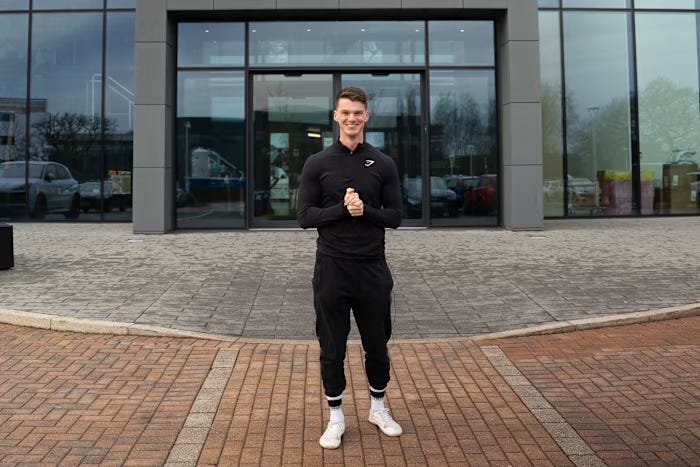
General Atlantic Bought Gymshark at the Top. Now Ben Francis Is Buying It Back at Half Price. Here's the Brutal Math Behind One of the Most Instructive PE Deals in British Business History.
Let me give you a number. £867 million.
That’s roughly how much enterprise value has been destroyed at Gymshark since General Atlantic invested in 2020 not because the business collapsed, but because the multiple the market puts on apparel earnings went from 33x to 10.8x whilst Gymshark’s margins were simultaneously getting cut in half.
Revenue up 150% in five years. Company worth roughly half what it was. Both things are true at the same time.
This is the most instructive PE deal in British business history right now and it’s playing out in real time.
News broke that Ben Francis, the 34-year-old founder who built Gymshark in his parents’ garage, is in talks to buy back part of General Atlantic’s 21% stake. The conversations cover both valuation and transaction size. He’s also speaking to banks about financing.
Gymshark and General Atlantic declined to comment. But the financial filings tell the whole story.
And the story has lessons for every founder who’s ever taken institutional money and every investor who’s ever paid a peak-cycle multiple for a consumer brand.
The Origin: A Kid From Solihull Who Bootstrapped to £1 Billion Without Asking Anyone
Before we talk about what went wrong, you need to understand what Ben Francis built.
Gymshark was founded in 2012 by Ben Francis when he was 19, in his parents’ garage, having been taught to sew by his mother. Not exaggerating. Francis was a pizza delivery driver whilst simultaneously building Gymshark. He’d deliver pizzas at night and design gym clothes by day, funding early production runs with tips.
The early Gymshark playbook was genuinely innovative: Influencer seeding before influencer seeding was a category. Francis identified fitness YouTubers with 100K-500K subscribers in 2013-2014 before “influencer marketing” had a name and sent them free product. The YouTubers wore Gymshark. Their audiences trusted the YouTubers. Gymshark exploded.
Limited drops creating scarcity. Gymshark used product drops to create urgency sell out in hours, drive social buzz, build community around the brand. The same mechanic Trapstar used. The same mechanic Supreme built an empire on.
Pure DTC from the start. No retail partnerships, no department store dependence, no margin-sharing with intermediaries. Gymshark sold directly to consumers online and kept ~60-65% gross margins.
Revenue: Up 150% from 2020 to 2025.
EBITDA margin: Down from 16% to 8% over the same period.
That divergence revenue climbing, margin compressing is the entire story of why General Atlantic’s investment hasn’t worked the way both parties hoped.
The 2020 Deal: What GA Paid and Why It Made Sense at the Time
General Atlantic invested £200 million in Gymshark in 2020 in exchange for a 21% stake, valuing Gymshark at £1 billion.
The deal terms:
Valuation: £1 billion ($1.3B)
GA stake: 21% via Series A Preferred Shares
GA investment: £200M (~$267M)
Revenue at time of investment: £258M
Revenue multiple: 3.8x
EBITDA multiple: 23x (on £86M adjusted EBITDA, converted from USD in the original document)
No coupon (preferred doesn’t pay interest)
No redemption rights (this is the key term more on this shortly)
Was 23x EBITDA expensive in 2020?
In the context of 2020-2021 markets genuinely, no.
GA paid 3.6x sales and 23x EBITDA on a business that at the time was growing 50% year-over-year with 16% EBITDA margins. Nike traded around 37x EBITDA, Lululemon around 40x, Adidas 44x.
For a 50% grower with a brand this strong in a zero-interest-rate environment, 23x EBITDA was not insane. It was arguably disciplined relative to the broader market.
GA was essentially underwriting the following thesis: If Gymshark maintains its growth trajectory and the apparel sector multiples hold anywhere near 2020 levels, the company is worth £4B in 5 years 4x their money at a 32% IRR.
The underwriting case:
2020 EBITDA: £86M
Required 2025 EBITDA for exit at 33x to return 4x: ~£121M
Growth needed in absolute EBITDA terms: £35M over 5 years
This seemed exceptionally conservative for a 50% revenue grower.
What actually happened:
2025 EBITDA: ~£53M (adjusted)
EBITDA grew £33M less than the underwriting case required.
…..because margin compression ate the growth.
What Happened to the Margins: The Four-Part Compression Story
Gymshark’s EBITDA margin waterfall (2020-2025): Starting EBITDA margin: 16%
Product margin compression: -7 percentage points
As Gymshark expanded its product range more SKUs, more seasonal product, more complexity product margins deteriorated. Wholesale channel entry and the shift away from purely digital-native basics into premium apparel changed the cost structure.
Marketing efficiency decline: -8 percentage points
This is the number that matters most. In 2020, Gymshark’s MER (Marketing Efficiency Ratio revenue divided by marketing spend) was approximately 6.55x. By 2025, it had fallen to roughly 4.44x.
The iOS 14.5 effect hit Gymshark as hard as any DTC brand.
In 2021, Apple’s App Tracking Transparency essentially destroyed Meta’s targeting precision for DTC brands globally. Gymshark which had built its entire customer acquisition model on precisely targeted Facebook and Instagram advertising suddenly found itself paying significantly more per customer whilst generating less reliable return on that spend.
Marketing expenses grew to £145M, whilst MER declined from 6.55x to 4.44x.
That 2-point MER decline on £145M in marketing spend represents £145M - (145 × 6.55/4.44) = roughly £70-80M in “lost” revenue compared to the 2020 marketing efficiency baseline.
Delivery cost improvement: +3 percentage points
One bright spot. Gymshark got materially better at logistics improving delivery economics as it scaled, offsetting some of the margin compression from product and marketing.
Omnichannel investment: Ongoing drag
Since opening its Regent Street flagship in 2022, the brand has added stores in Manchester, Amsterdam, Dubai, Long Island and a New York City flagship in Soho opened December 2025. Its first public gym the Gymshark Lifting Club in Miami, launched in April 2026.
Physical retail has higher fixed costs than DTC. The investment in these locations is deliberate, Francis has described the profit dip as “laying down the foundations for future growth” but the near-term margin impact is real.
This is what it looks like to build for the future whilst the present-day P&L absorbs the cost.
The Multiple Compression That Destroyed £867M (Without Gymshark Doing Anything “Wrong”)
Here’s the part that should genuinely concern every founder who took institutional money at a 2020-2021 valuation: Even if Gymshark’s EBITDA had hit the underwriting case exactly £121M by 2025 instead of £53M the deal still might not have worked for GA.
Because the sector multiple collapsed.
Just from multiple compression alone, if EBITDA had stayed perfectly flat at £86M but the multiple moved from 23x to 10.8x Gymshark’s enterprise value would have fallen from £1B to £929M.
But EBITDA didn’t stay flat. It fell from £86M to £53M.
The double whammy:
EBITDA down ~38% from 2020 levels
Multiple down ~67% from 2020 levels
Current estimated valuation: ~£643M
GA paid £1.27B implied valuation in 2020.
Estimated current fair value: ~£643M.
Enterprise value destroyed: ~£627M on a mark-to-market basis.
On GA’s proportional stake (21%): That’s roughly £131M in value destruction from their initial £200M investment.
GA is sitting on an investment that’s worth approximately 65 cents on the pound compared to what they paid.
And they have no redemption rights to force the company to buy them out.
The Missing Clause: Why GA Is Stuck
This is the most important structural detail in the entire story. When General Atlantic invested in 2020, the term sheet included:
✅ 21% stake via Series A Preferred
✅ Board seat
✅ Preferred participation in dividends (alongside ordinary)
✅ No coupon (doesn’t pay interest)
❌ No redemption rights
Redemption rights are essentially a put option, they give an investor the right to sell their shares back to the company at a specified price after a certain period.
If GA had negotiated redemption rights, they could say: “It’s been 5 years. We want our money back at the original investment price.” The company would be legally obligated to repurchase.
Without redemption rights, GA has only three ways out:
IPO: List Gymshark publicly, sell shares through the market
Trade sale: Find a strategic acquirer (Nike, Adidas, Inditex, etc.) to buy Gymshark
Secondary sale: Find a buyer willing to acquire GA’s stake at an agreed price
Founder buyback: Ben Francis buys some or all of GA’s stake
The IPO window is shut Gymshark met with Chancellor Rachel Reeves last October as she tried to encourage more British companies to list in London, but a buyback has emerged as the more likely path.
The trade sale at what valuation? At £643M fair value, a strategic would pay GA a fraction of what they invested for their 21% stake.
The secondary market reportedly not much of a queue at anywhere near the original price.
Which leaves: Ben Francis. And here’s where it gets interesting.
Ben Francis has all the leverage. GA can’t force a sale. They can’t force a redemption. They can’t force an IPO. They can’t force a dividend that gives them cash back.
They have a board seat and a 21% stake in a private company that they cannot easily liquidate.
Their only viable path to liquidity in any reasonable timeframe is: negotiate with Ben Francis.
What Does “Buying Back at Half Price” Actually Mean?
Let’s run the valuation math on what a transaction might look like:
Scenario 1: Francis buys back at current estimated fair value (~£643M)
GA’s 21% stake at £643M: £135M
GA invested: £200M
GA loss: ~£65M (32% loss on investment)
Scenario 2: Francis negotiates to fair value of partial stake
Reporting suggests Francis is more likely to repurchase only part of GA’s stake, thereby increasing his ownership above roughly 70%.
If Francis buys back 10% of the 21% (leaving GA with 11%):
10% of £643M: £64.3M
GA’s cost basis on that 10%: ~£95M
GA takes a £30M loss on the partial sale but retains 11% that could still appreciate
Scenario 3: The negotiated premium
Francis has leverage but GA knows this is probably the best exit they’ll get. In negotiations like this, expect Francis to pay somewhere between fair value and the original purchase price. Neither party wants to walk away.
A likely landing zone: £700-800M implied valuation a meaningful discount to the £1.27B GA implied in 2020, but a premium to today’s fair value that gives Francis certainty of closing.
On a partial buyback of ~10% stake at £750M implied valuation:
Francis pays: ~£75M
GA crystallises a loss on that portion but secures liquidity
Francis raises ownership from ~70% to ~80%
Francis buys his company back at a 40% discount to GA’s original entry
For Francis, this is an extraordinarily good trade. He’s effectively getting 10% of his company back at 40-50 cents on the pound relative to what GA paid.
The Financing Question: How Does Francis Pay For It?
Gymshark has described the profit dip as intentional, and that he was “laying down the foundations for future growth as a business.”
The challenge: Gymshark’s pre-tax profit is £6.9M in FY2025. That’s not a balance sheet that self-funds a £70-100M buyback.
Francis is reportedly meeting with banks to discuss financing for the transaction.
Most likely structure: Leveraged buyback Francis uses Gymshark’s cash flow and credit profile to raise debt, using the proceeds to purchase GA’s shares.
Gymshark’s credit profile for a leveraged buyback:
Revenue: £647M (stable, growing)
Adjusted EBITDA: ~£53M
At 3x leverage on EBITDA: ~£159M debt capacity
Sufficient to fund a partial buyback and leave runway for ongoing operations
This is standard practice for founder buybacks in PE-backed businesses. Use the company’s earnings power to finance the return of control to the founder.
The irony: Gymshark takes on debt to buy back shares that were originally purchased partly to provide capital for growth.
Ben Francis’s Strategic Rationale: Why He’s Doing This Now
Here’s what makes this genuinely interesting from a strategic standpoint: Francis resumed his role as CEO of Gymshark in 2021, after stepping aside in 2017 in favour of Steve Hewitt, a longtime veteran of the sportswear industry.
He’s been running the company operationally for 5 years. He knows the business inside out. He knows what the next chapter requires.
And the next chapter is omnichannel: Since opening its Regent Street flagship in 2022, the brand has added stores in Manchester, Amsterdam, Dubai, Long Island and a New York City Soho flagship in December 2025. In October 2025, Dick’s Sporting Goods became Gymshark’s first US wholesale partner, launching inside 12 Dick’s House of Sport stores. The brand’s first public gym the Gymshark Lifting Club in Miami opened in April 2026.
This transformation requires long-term investment that depresses near-term profits.
A PE investor with fund timelines, LP return expectations, and pressure to crystallise value by Year 5-7 is not the ideal capital partner for a 10-year omnichannel buildout.
Francis wants control back precisely because he’s making decisions that optimise for a decade, not for the next LP meeting.
Whether or not Francis increases his stake, the talks reinforce that Gymshark’s next chapter is being built around founder control and physical retail, moving away from the ecommerce-only model that built the business.
This is the Anastasia Beverly Hills pattern played out at a different scale: Anastasia Soare put money back into her business to buy out TPG at a distressed valuation after the PE firm had watched its investment underperform. Founder knows the business better than the investor. Founder has longer time horizon than the investor. Founder can buy the asset at a distressed price because the investor needs liquidity.
Francis is doing the same thing. Just voluntarily, before any formal distress.
The Lessons: What Every Founder and Investor Should Take From This
Lesson 1: Multiple Compression Is the Risk Nobody Prices In
When GA invested in 2020, the risk discussion was probably about: execution risk, competition, macro headwinds, key-person risk. Nobody seriously modelled the scenario where the apparel sector EBITDA multiple goes from 33x to 10.8x.
Because that scenario two-thirds multiple compression in five years felt like a tail risk. Something that might happen to distressed businesses, not to strong brands growing 50% annually.
But it happened. The entire apparel category re-rated simultaneously.
Lululemon went from 40x EBITDA to 5.5x. Nike went from 37x to struggling. Adidas had similar challenges.
Gymshark’s underperformance is partly relative to 2020-era expectations. In absolute terms, the business is substantially larger and still growing. The risk was the environment.
For every founder taking institutional money: understand the multiple embedded in your valuation at entry. If you’re valued at 15x revenue in 2024, ask yourself what happens if the category re-rates to 5x. Can you still make the investor whole? What does that require from your EBITDA growth?
For every investor writing cheques in 2024-2025: the apparel sector multiple lesson is not unique to apparel. Consumer brand multiples are cyclical. Paying 2024 multiples assumes 2024 macro conditions persist. They won’t.
Lesson 2: Redemption Rights Are The Clause That Changes Everything
GA invested £200M and has been stuck for nearly 7 years because there’s no redemption right. If that clause had been negotiated, this story doesn’t exist.
GA could have exercised their redemption after Year 5, the company would have had to find the money to buy them out, and the negotiation would have happened on GA’s timeline with GA’s leverage.
Without redemption rights: GA has to negotiate with the founder on the founder’s timeline. For institutional investors: never invest in a private company without redemption rights. They exist for exactly this situation — providing a mechanism to exit when the IPO and M&A paths are closed.
For founders: understand what you’re agreeing to when you accept redemption rights. They’re a put option the investor holds against your business. Every scenario where you don’t exit cleanly, that put option creates pressure.
In this case, the absence of redemption rights is the reason Ben Francis has leverage in this negotiation.
Lesson 3: Revenue Growth and Margin Compression Are Not Mutually Exclusive
Gymshark grew revenue 150% in five years. And the business is worth less than when it started. This is the lesson that most DTC founders are still processing. Revenue is not value. Revenue at contracting margins, on a compressed multiple, can destroy enterprise value whilst the top-line charts keep going up and to the right.
The value drivers that actually matter:
EBITDA dollars (absolute amount)
EBITDA margin (percentage)
Revenue growth rate (supports higher multiple)
The multiple the market puts on those earnings
If any two of these deteriorate simultaneously, value destruction is severe.
If all three deteriorate simultaneously as happened at Gymshark (EBITDA up only modestly, margin halved, multiple collapsed) value destruction is catastrophic.
Lesson 4: The Founder’s Leverage in a Negotiation With a Trapped Investor
General Atlantic has one board seat and 21% of a private company.
They cannot:
Force a dividend (no redemption right, no forced payment)
Force an IPO (Francis controls the company)
Force a trade sale (Francis controls the company)
Force a secondary sale (no buyer queue at original price)
The only thing GA can do is wait and hope Francis decides to buy them out voluntarily.
Which is exactly what’s happening. Francis is buying back at his price, on his timeline, with his financing. This is founder leverage in its purest form.
The lesson for anyone taking PE money: understand your investor’s fund timeline, their LP return expectations, and their exit mechanisms. The investor who has no exit mechanism is the investor who has no leverage.
Lesson 5: The Omnichannel Transition Is Expensive and Slow Don’t Rush It with a PE Fund on the Clock
Gymshark’s margin compression is partly structural (apparel sector-wide), partly DTC-specific (CAC inflation, iOS 14.5), and partly strategic choice, the cost of building physical retail infrastructure.
Opening stores is capital-intensive. Running stores creates fixed cost base. Training staff, building visual merchandising, paying Regent Street rent none of these show up on the P&L as investments. They show up as costs.
Under a PE fund with a 5-7 year timeline, this omnichannel buildout creates a structural conflict:
Investor wants: Near-term profit maximisation for a clean exit
Founder wants: Long-term infrastructure for competitive positioning
These aren’t the same objective. They’re frequently in direct conflict.
Francis’s buyback if it completes removes that conflict. He can invest in Miami gyms and New York flagships without a PE partner asking when the margin returns.
This is why founder control matters more at transition moments than at growth moments.
The Final Reality
Who won? Ben Francis.
….because GA invested at a premium for a business that kept growing and didn’t collapse. They lose money on the partial buyback but free up capital.
Francis wins because:
He took capital when he needed it (2020, to buy out a co-founder, to fund international growth)
He maintained 70%+ ownership throughout
He’s buying back at a meaningful discount to entry
He retains full operational control during the omnichannel transition that requires exactly the kind of patient, long-term decision-making that PE fund timelines discourage
The lesson from the document’s financial model: Gymshark as a business is not broken. It’s growing. It’s profitable. It’s building physical retail infrastructure. It’s entering US wholesale.
The issue was never the business. The issue was the price paid for a stake at peak-cycle multiples in 2020. And now the founder is buying that stake back at the price the market has decided it’s worth in 2026. That’s not failure. That’s capitalism doing exactly what it’s supposed to do.
Are you building for a PE fund’s 5-year timeline or your own 20-year vision? The answer changes every decision you make.
David
P.S. The most instructive number in this entire analysis isn’t the £643M valuation or the £200M GA investment. It’s the MER (Marketing Efficiency Ratio) decline from 6.55x to 4.44x. That single metric tells you more about what changed at Gymshark than any other data point. In 2020, Gymshark could spend £1 on marketing and generate £6.55 in revenue. By 2025, that same pound generates £4.44. The customer acquisition machine that built the business precisely targeted Facebook advertising, influencer seeding at low cost has become structurally more expensive and less efficient. This happened to almost every DTC brand simultaneously after iOS 14.5. It’s not a Gymshark-specific failure. It’s the DTC era ending. And any brand still modelling growth using 2020 CAC economics is building on a foundation that no longer exists.
P.P.S. Ben Francis built Gymshark to £1B revenue from his parents’ garage without taking a single pound of external capital for 8 years. Then he took £200M, grew to £647M revenue, and is now buying back control at a fraction of the entry price. His absolute worst case: he spent 6 years having GA on his cap table, grew his business 150%, and is now reclaiming his company at a 40-50% discount to what GA paid. For a founder who kept 70%+ ownership the entire time even whilst taking £200M in external capital this is one of the most impressive capital structure outcomes in British consumer business history. The garage-to-billion story gets all the headlines. The PE buyback story is actually the more interesting chapter.


