


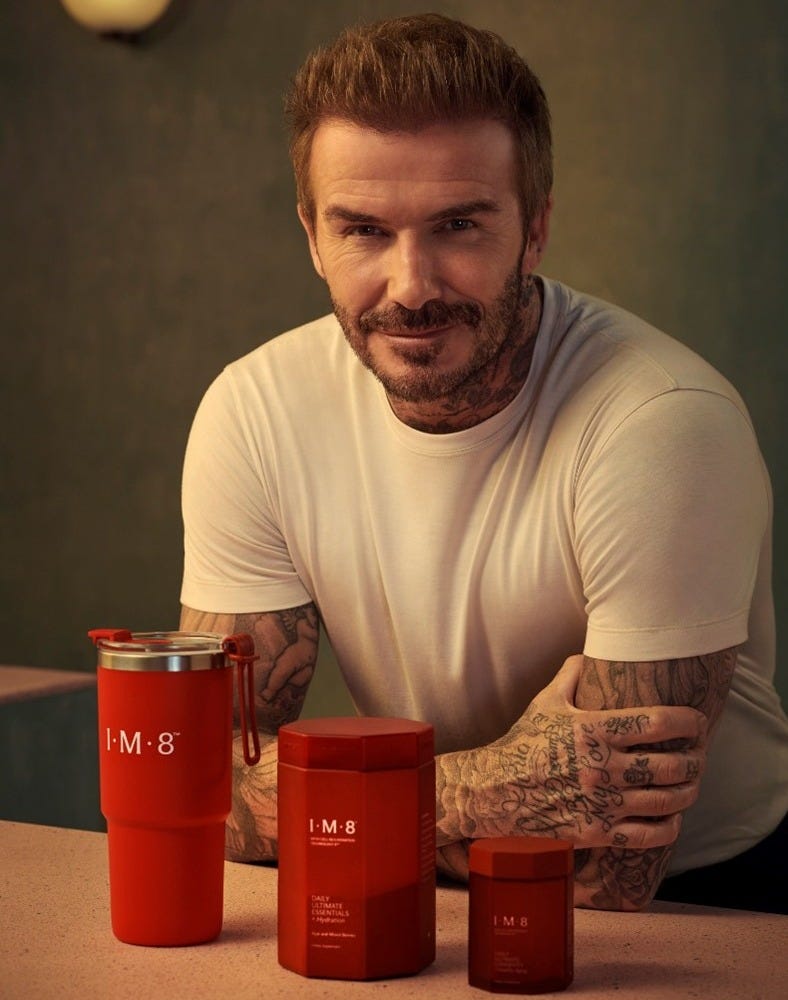
David Beckham and a Hong Kong health-tech company quietly built something that went from zero to $100 million in annualized recurring revenue in 11 months.
Not 11 quarters. Not 11 years. Eleven months.
The product: IM8 a red octagonal container with 92 ingredients in one powder that replaces your entire supplement cabinet.
The company: Prenetics, a publicly-traded health sciences company (NASDAQ: PRE) that pivoted from COVID testing to consumer wellness.
The result: One of the fastest-growing consumer health brands in history, now sold in 30+ countries, with Aryna Sabalenka (world #1 tennis player) as an investor-partner after becoming a fan of the product.
In February 2026, Prenetics sold its remaining non-IM8 assets (including a $70 million stake in Insighta to Tencent) to go all-in on IM8 with $171 million in liquidity and zero debt.
A company that was doing COVID testing 18 months ago just raised more cash than most supplement brands will see in their lifetime and they’re using it to come after AG1, Ritual, and every other premium supplement brand.
Let me show you what’s actually happening here because buried in this story is the blueprint for how to launch a premium consumable brand in 2026, and why the supplement industry is about to have its “Netflix vs. Blockbuster” moment.
The Numbers That Nobody Expected
Let’s start with what makes IM8’s trajectory remarkable:
IM8 Launch to $100M ARR:
Launch date: Early 2024
Revenue milestone: $100M+ annualized recurring revenue
Time to $100M ARR: 11 months
Countries: 30+ globally
Price point: $100-140 per month (varies by market)
Format: All-in-one powder, 92 ingredients
For context, compare to other premium supplement brands:
AG1 (Athletic Greens):
Founded: 2010
Time to $100M revenue: ~8 years (hit $100M around 2018)
Current revenue: $300M+ (2023)
Time to $100M: 8 years
Ritual:
Founded: 2016
Time to $100M revenue: ~6 years (estimated 2022)
Current revenue: $150M+ (estimated)
Time to $100M: 6 years
Seed Daily Synbiotic:
Founded: 2016
Revenue: ~$100M (2023)
Time to $100M: 7 years
IM8 hit $100M ARR in 11 months. That’s 7-9x faster than the closest competitors.
How is this possible?
Three reasons that everyone’s missing:
1. David Beckham isn’t just an endorser, he’s co-founder with equity
Unlike typical celebrity supplement deals (5-10% royalty), Beckham is actually building this company. He’s involved in product development, strategic decisions, and has meaningful equity.
His incentive: Build a $1B+ brand, not collect endorsement checks.
2. Prenetics had infrastructure ready to scale from day one
Most supplement startups:
Raise $5M seed
Spend 18 months on product development
Launch DTC-only
Burn cash trying to scale
Years to profitability
Prenetics had:
Public company capital ($171M liquidity post-asset sales)
Existing supply chain relationships
Global distribution infrastructure from COVID testing business
Data/analytics capabilities from DNA testing business
Launch at scale, profitable from month one
3. Premium all-in-one positioning = higher LTV, lower churn
Traditional supplement brand:
Sell single-ingredient products ($30-50/month)
Customer buys from 3-5 brands
Low switching cost
Churn: 40-60% annually
IM8 positioning:
Replace 16+ supplements with one product ($100-140/month)
Customer consolidates entire routine
High switching cost (would need to rebuild entire stack)
Churn: Likely 20-30% annually (estimated based on category leaders)
Lower churn = higher LTV = can afford higher CAC = faster growth.
But here’s what really matters: Prenetics just went all-in.
The Strategic Transformation: From COVID Testing to Consumer Health Empire
Let me show you what Prenetics actually did, because this is one of the most aggressive corporate pivots I’ve seen:
Prenetics Timeline:
2014-2019: DNA Testing Company
Founded by Danny Yeung (serial entrepreneur, ex-Groupon)
Focus: Personalized DNA testing for preventive health
Revenue: Small, venture-scale
2020-2021: COVID Testing Boom
Pivot to COVID-19 testing during pandemic
Scale: Processing 40,000+ tests per day at peak
Revenue: Exploded (exact figures undisclosed, but massive)
Became one of Asia’s largest COVID testing providers
2022-2023: Public Listing + Strategic Reset
Listed on NASDAQ (ticker: PRE)
COVID testing demand declining
Question: What’s next?
2024: The IM8 Bet
Launch IM8 with David Beckham as co-founder
Go hard on premium positioning (not another $30 greens powder)
Leverage Beckham’s global distribution (500M+ combined social reach)
Hit $100M ARR in 11 months
2025-2026: The All-In Move
This is where it gets interesting.
Asset sales to fund IM8:
December 2025: Ended Bitcoin Treasury Strategy
Prenetics had been converting revenue into Bitcoin (bold move)
Announced end of Bitcoin strategy to focus capital on IM8
Signal: We’re betting everything on consumer health
February 2026: Sold Insighta stake to Tencent for $70M
Insighta: Data analytics business (35% stake)
Buyer: Tencent (one of world’s largest tech companies)
Proceeds: $70M cash
Strategic rationale: Exit non-core, fund IM8 global expansion
Also divesting: ACT Genomics and other assets
ACT Genomics sale: ~$46M (in escrow, $6.3M shown on balance sheet)
Other non-core assets: Being divested
Message: It’s IM8 or nothing
Current financial position (February 2026):
Cash and equivalents: $99.3M
Financial assets: $29.3M
Escrow funds: $7.3M ($6.3M ACT + $1M Insighta)
Alternative assets: $35.2M
Total adjusted liquidity: $171.1M
Debt: $0
Prenetics has more cash than most VC-backed consumer brands will raise in their entire existence, zero debt, and one focus: IM8.
Danny Yeung (CEO) said it explicitly:
“Moving forward, it’s just going to be IM8 and bitcoin. A lot of the other stuff we’re looking [to divest]. But if we’re successful in this convergence of health and wealth, then I think that would be something that is like, ‘Oh, wow, you really put health and wealth together.’”
This isn’t diversification. This is all-in.
What Makes IM8 Different (And Why It’s Actually Working)
Most supplement brands fail because they’re “me-too” products with celebrity endorsements.
IM8 is different in five specific ways:
1. The Formula: 92 Ingredients at Clinical Doses (Not Window Dressing)
What most supplements do:
Include 10-20 ingredients
Use “fairy dust” doses (too small to be effective)
Focus on marketing, not formulation
Example: Many greens powders have 50mg of ingredient that needs 500mg to work
What IM8 does:
92 ingredients (vitamins, minerals, adaptogens, probiotics, electrolytes, amino acids)
Clinical doses (amounts shown in research to be effective)
Third-party tested (NSF Certified for Sport)
Full transparency: Manufacturer (VitaQuest) and formula disclosed
Why this matters:
Traditional supplement brand:
“Our greens powder has 75 ingredients!”
Doesn’t disclose amounts
Most ingredients at ineffective doses
Sounds impressive, doesn’t work
IM8:
“Our formula has 92 ingredients at clinical doses”
Full disclosure of amounts
Third-party tested to verify
Actually works (based on science, not marketing)
The risk: When you disclose everything, competitors can copy your formula.
IM8’s bet: Brand + distribution + trust will matter more than formula secrecy.
2. The Advisory Board: Actually Credible (Not Just Marketing)
What most supplement brands do:
Hire influencers as “advisors”
Maybe one doctor with questionable credentials
Advisory board is marketing, not oversight
No real scientific credibility
What IM8 did:
Advisory board includes:
Researchers from Mayo Clinic (one of world’s top medical centers)
Scientists from NASA (space nutrition expertise)
Academic researchers from leading universities
Medical professionals with actual clinical experience
Why this matters:
When you have Mayo Clinic and NASA scientists on your advisory board, you can’t bullshit the formula.
These people have reputations to protect. They won’t attach their names to garbage.
The result: IM8 has credibility that celebrity supplement brands can’t buy.
3. The Celebrity Structure: Co-Founder, Not Endorser
This is the move that changes everything.
Traditional celebrity supplement deal:
Structure:
Celebrity licenses name/image
Gets 5-10% royalty on sales
Maybe shows up for launch event
Posts on Instagram 3-4 times
That’s it
Economics example (traditional):
Brand revenue: $100M
Celebrity royalty (8%): $8M
Celebrity incentive: Post occasionally, collect checks
IM8’s structure with Beckham:
Structure:
Beckham is co-founder with equity stake (undisclosed %, likely 15-30%)
Involved in product development (testing formulas, providing feedback)
Involved in strategic decisions (distribution, partnerships, product roadmap)
Posts regularly, but also does long-form content, interviews, etc.
This is his company, not just an endorsement
Economics example (co-founder):
IM8 valuation at $1B (conservative if trajectory continues)
Beckham equity (20%): $200M
Plus board seat, influence over company direction
Beckham incentive: Build a generational brand
The difference:
Endorsement deal: Make $8M this year, done.
Co-founder deal: Make $200M+ over 5-10 years by building real value.
Beckham is playing the long game. That’s why this works.
4. The Distribution Strategy: Global from Day One
Most DTC brands:
Launch in US only
Focus on building US customer base
Eventually expand internationally (if successful)
Years to global scale
IM8 launched in 30+ countries simultaneously.
How?
1. Beckham’s global reach:
500M+ combined social followers (Beckham + IM8 channels)
Name recognition in every country
Instant international distribution via celebrity
2. Prenetics’ existing infrastructure:
Already operating in Asia (COVID testing, DNA testing)
Existing supply chain relationships globally
Regulatory experience (navigating health regulations in multiple countries)
Infrastructure to support global scale from day one
3. Premium positioning works globally:
$100-140/month is premium in every market
Targets same customer globally (health-conscious, affluent, 30-55 years old)
No need to localize positioning or price point
The result:
Most supplement brands (3 years in):
Revenue: $50M
Markets: US + maybe Canada/UK
Customer base: Regional
IM8 (11 months in):
Revenue: $100M+ ARR
Markets: 30+ countries
Customer base: Global
Global distribution from day one = 3-5x faster scaling.
5. The Subscription Model: High AOV, High Retention
Let’s break down IM8’s unit economics (estimated):
Average order value:
Price: $100-140 per month (varies by market, let’s use $120)
Subscription: Monthly delivery
AOV: $120/month
Customer acquisition cost:
Beckham’s organic reach (500M followers) = low paid CAC
Blended CAC (paid + organic): $80-120 (estimated)
Let’s use $100
Lifetime value (estimated):
Monthly revenue: $120
Average subscription length: 12 months (conservative for high-quality all-in-one)
LTV: $1,440
LTV/CAC ratio:
LTV: $1,440
CAC: $100
Ratio: 14.4x
For comparison:
AG1:
AOV: $99/month
CAC: $150-200 (heavily paid marketing)
LTV: $1,200 (12 months)
LTV/CAC: 6-8x
Ritual:
AOV: $30/month
CAC: $50-80
LTV: $360 (12 months)
LTV/CAC: 4.5-7x
IM8’s economics are 2-3x better than competitors because:
Higher AOV ($120 vs. $30-99)
Lower CAC (Beckham organic reach vs. paid ads)
Higher retention (all-in-one vs. single-ingredient)
This is why IM8 hit $100M ARR so fast. The unit economics are exceptional.
The Market Context: Why All-in-One Supplements Are Exploding
IM8 isn’t the first all-in-one supplement. But the category is exploding right now.
Global Dietary Supplements Market:
Current size: $163B (2024)
Projected size: $296B (2030)
CAGR: 10.5%
Growing fast, but traditional single-ingredient products dominating
All-in-One / Greens Powder Segment:
Current size: ~$2-3B (estimated, subset of total market)
Growth rate: 25-35% annually
Growing 2-3x faster than overall supplements
Why all-in-one supplements are winning:
Consumer problem:
Average person takes 4-6 supplements daily
Cost: $100-200/month across multiple brands
Hassle: Multiple bottles, pills, timing
“Pill fatigue” is real
All-in-one solution:
One product replaces everything
One subscription, one delivery
Mix with water, done
Simplicity wins
Category leaders and their approaches:
AG1 (Athletic Greens):
Positioning: “Comprehensive daily nutrition”
Price: $99/month
Formula: 75 ingredients
Distribution: DTC primarily, some retail
Revenue: $300M+ (2023)
Huel:
Positioning: Complete meal replacement
Price: $60-80/month
Formula: Macro-focused (protein, carbs, fats) + micronutrients
Distribution: DTC + some retail
Revenue: $200M+ (2023)
Ample:
Positioning: Meal replacement for busy professionals
Price: $100-130/month
Formula: Customizable macro/micro blends
Distribution: DTC only
Revenue: $20-30M (estimated)
IM8’s positioning vs. competition:
IM8 is the most premium positioning in the category.
They’re not competing on price. They’re competing on:
Scientific credibility (advisory board)
Formula comprehensiveness (92 ingredients)
Celebrity association (Beckham = trust + aspiration)
Premium perception
This is the luxury play in supplements.
The Risks: What Could Go Wrong
IM8’s growth is impressive, but let’s be realistic about risks:
Risk 1: Celebrity Dependency
The problem:
Beckham is 50 years old (still relevant, but aging)
If Beckham’s image suffers (scandal, etc.), IM8 suffers
Brand too tied to one person
The mitigation:
Added Aryna Sabalenka (world #1 tennis, female, younger demographic)
Building scientific credibility independent of Beckham
Diversifying celebrity association
But: Beckham is still the primary driver. If he exits, brand value drops.
Risk 2: Formula Complexity = Manufacturing Risk
The problem:
92 ingredients = complex supply chain
One ingredient shortage = can’t produce
Quality control harder with more ingredients
Manufacturing risk scales with complexity
The mitigation:
Using VitaQuest (experienced contract manufacturer)
Third-party testing (ensures consistency)
But still a risk
Risk 3: Premium Pricing Limits TAM
The problem:
$120/month limits addressable market
Only affluent consumers can afford
TAM smaller than mass-market products
The numbers:
US households that can afford $120/month supplements:
Household income $150K+: ~20M households
Willing to spend on premium health: ~30% = 6M households
TAM: 6M US customers
At 10% penetration:
Customers: 600K
Revenue: $864M annually
This is the ceiling in US alone
Add 30 countries with similar economics:
Global TAM: ~40M households
At 5% penetration: 2M customers
Revenue: $2.9B annually
So the TAM is actually huge, but only if they execute globally.
Risk 4: Competition Intensifying
AG1 (Athletic Greens) is already responding:
Increased marketing spend
Celebrity partnerships (Andrew Huberman, Tim Ferriss)
Product improvements
New entrants launching:
Wealthy celebrities see IM8’s success
Expect copycat brands in 2026-2027
Category getting crowded
IM8’s defense:
First-mover advantage (established brand)
Beckham’s unique credibility
Scientific advisory board
But competition will eat into growth
Risk 5: Regulatory Scrutiny
The problem:
Supplement industry is lightly regulated (FDA doesn’t pre-approve)
Claims must be substantiated
If IM8 makes aggressive health claims, FDA could intervene
Regulatory risk exists
IM8’s approach:
Third-party testing (NSF Certified for Sport)
Transparent about formula and manufacturing
Advisory board provides scientific credibility
Playing it safe, but risk remains
The Path Forward: Can IM8 Become a $1B Brand?
Let’s model IM8’s trajectory:
Current state (February 2026):
Revenue: $100M+ ARR (11 months in)
Countries: 30+
Liquidity: $171M, zero debt
Base case (conservative growth):
Year 2 (2026-2027):
Revenue growth: 50%
Revenue: $150M
Rationale: Distribution expanding, brand awareness growing
Year 3 (2027-2028):
Revenue growth: 40%
Revenue: $210M
Rationale: Entering retail (Target, Whole Foods), international acceleration
Year 4 (2028-2029):
Revenue growth: 30%
Revenue: $273M
Rationale: Maturation, but still strong growth
Year 5 (2029-2030):
Revenue growth: 20%
Revenue: $328M
Rationale: Approaching category leader (AG1 scale)
Valuation at Year 5:
Revenue: $328M
Multiple: 4-6x revenue (consumer subscription businesses)
Valuation: $1.3-2B
Bull case (aggressive growth):
Year 2: $180M (80% growth, product line extensions) Year 3: $324M (80% growth, retail explosion) Year 4: $518M (60% growth, international dominance) Year 5: $777M (50% growth, market leader)
Valuation at Year 5:
Revenue: $777M
Multiple: 5-7x (premium for growth)
Valuation: $3.9-5.4B
Bear case (growth stalls):
Year 2: $130M (30% growth, competition bites) Year 3: $156M (20% growth, churn increases) Year 4: $171M (10% growth, maturation) Year 5: $180M (5% growth, plateau)
Valuation at Year 5:
Revenue: $180M
Multiple: 2-3x (slow growth penalty)
Valuation: $360-540M
Most likely: Between base and bull case.
My estimate: $400-500M revenue by Year 5, $2-3B valuation.
Why?
IM8 has advantages AG1 didn’t have:
Global distribution from day one
Celebrity co-founder (not just endorser)
Public company capital ($171M to deploy)
Category validation (AG1 proved model works)
But IM8 faces challenges AG1 didn’t:
More competition (AG1 had clear field)
Higher price point (limits TAM)
Celebrity dependency risk
Outcome: IM8 becomes #2 player behind AG1, but at premium positioning with higher margins.
What This Means for Anyone Building Premium Consumer Brands
You don’t need David Beckham or $171M in liquidity to learn from IM8’s playbook:
Lesson 1: Premium Positioning Requires Premium Proof Points
IM8 didn’t just say “we’re premium.”
They proved it:
Advisory board (Mayo Clinic, NASA)
Third-party testing (NSF Certified)
Transparent formula (full disclosure)
Premium price ($120/month, no apologies)
If you’re charging premium, you need premium proof.
Lesson 2: Celebrity as Co-Founder > Celebrity as Endorser
Equity alignment changes everything.
Endorser (5-10% royalty):
Posts 3 times, collects checks
No long-term commitment
Brand dies when celebrity moves on
Co-founder (15-30% equity):
Actively builds the business
Long-term wealth creation
Brand outlives initial celebrity hype
Structure celebrity partnerships as equity, not royalty.
Lesson 3: All-in-One Positioning = Higher LTV
IM8’s $120/month price point works because they replace $150-200 worth of supplements.
Customer math:
Before IM8: $150/month across 5 brands
After IM8: $120/month, one brand
Savings: $30/month + massive convenience
When you consolidate customer spend, you can charge premium AND save them money.
Lesson 4: Global from Day One (If You Have Infrastructure)
IM8 launched in 30+ countries simultaneously because they had:
Celebrity with global reach
Existing operational infrastructure
Capital to support scale
If you don’t have these, don’t try it.
But if you do, global-first creates 3-5x faster growth than US-only.
Lesson 5: When You Find Product-Market Fit, Go All-In
Prenetics sold $100M+ in assets to focus entirely on IM8.
That’s conviction.
When you find something working, double down. Don’t diversify for safety.
IM8 hit $100M ARR in 11 months. That’s the signal to go all-in, not hedge.
The Final Reality
IM8 went from zero to $100 million in annualized recurring revenue in 11 months.
That’s faster than:
AG1 (8 years to $100M)
Ritual (6 years to $100M)
Almost every venture-backed supplement brand
How?
1. Celebrity co-founder structure (Beckham with equity, not royalty) 2. Premium positioning with proof (Mayo Clinic, NASA, NSF certified) 3. All-in-one replacement strategy (92 ingredients, clinical doses) 4. Global distribution from day one (30+ countries) 5. Exceptional unit economics (LTV/CAC of 14x vs. 6-8x for competitors)
And now Prenetics is going all-in:
Sold $70M stake to Tencent
Divesting all non-IM8 assets
$171M in liquidity, zero debt
100% focused on IM8 global expansion
The question isn’t whether IM8 will succeed.
The question is: How big can it get?
Conservative case: $328M revenue, $1.3B valuation by 2030
Bull case: $777M revenue, $5B valuation by 2030
Either way, IM8 is rewriting the playbook on how to launch premium consumer health brands.
And David Beckham the footballer who became a brand is proving that the right celebrity partnership isn’t about endorsements.
It’s about building generational wealth through equity ownership in real businesses.
Are you building a brand that consolidates customer spend, or competing for a slice of it?
Keep building,
David
P.S. Danny Yeung (Prenetics CEO) said he has “few, if any, hobbies” and his passion for work is “singular and all-consuming.” He sees the world as “one big case study.” That’s the founder mentality that goes from COVID testing to $100M supplement brand in 18 months. Most founders celebrate exits and retire. Danny sold $100M in assets to go harder on IM8. That’s real conviction.
Want to go deeper? Book office hours here - intro.co/DavidOlusegun
Great article however a lot of acronyms which could be expanded for beginners.
Wow such a beautiful analysis