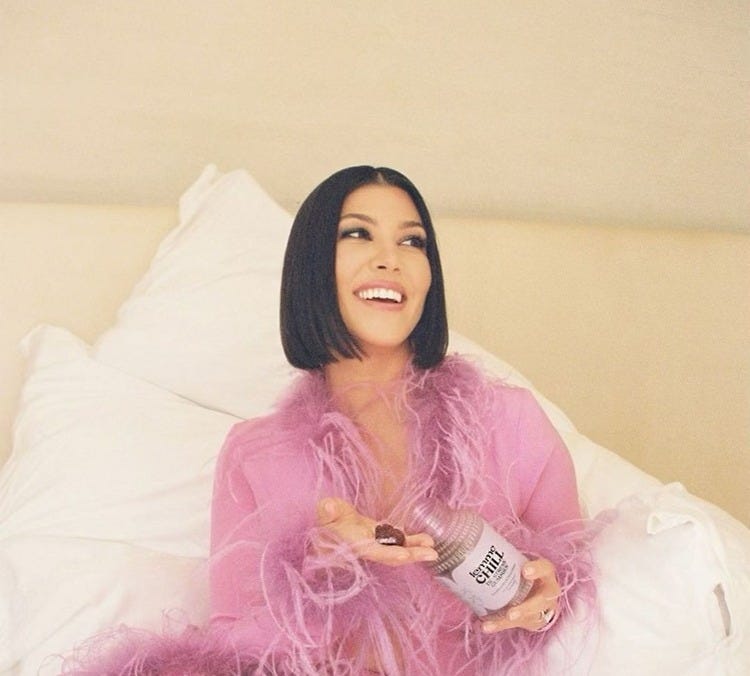
How Kourtney Kardashian Built a $30M Gummy Empire in 16 Months
Hey there,
Kourtney Kardashian is quietly built something that most consumer founders dream about.
Lemme her supplement brand went from zero to $30 million in revenue in 16 months.
Not 16 years. Not 16 quarters. Sixteen months.
And here’s what makes it even more impressive: In November 2025 alone, they drove $13 million through TikTok Shop. That’s $13M in a single month from a single sales channel.
By January 2026, Lemme is in 2,000+ Walmart stores nationwide, growing 25% month-over-month, and has generated 53,000+ creator videos from 13,000+ affiliates who actually wanted to promote the products.
Let me repeat that! Over 13,000 creators made content about gummy vitamins because they genuinely wanted to, not because they were paid to.
How does a Kardashian, someone most people assume just slaps their name on products build a $30M brand that’s actually growing whilst most celebrity wellness brands are dying?
The answer isn’t what you think. And the playbook is absolutely replicable.
Let me show you what Kourtney Kardashian and her co-founder Simon Huck actually did and why it’s one of the smartest consumer brand launches I’ve seen in years.
The Numbers That Nobody Expected
Let’s start with what makes Lemme’s trajectory unusual:
September 2022: Launch
Three SKUs (gummy supplements)
DTC + Erewhon (premium positioning)
Co-founders: Kourtney Kardashian + Simon Huck
Month 6 (March 2023):
Revenue: ~$5M (annualized)
Expanded to Ulta, Revolve, Amazon
Still primarily DTC
Month 12 (September 2023):
Revenue: ~$20M (annualized)
Entered Target nationwide
25% month-over-month growth rate established
Month 16 (January 2024):
Revenue: $30M+ total
Growing 25% MoM consistently
This is where most celebrity brands plateau or decline
November 2025 (Month 38):
$13M revenue in a single month from TikTok Shop alone
13,000+ affiliate creators
53,000+ organic creator videos
Still growing
January 2026 (Month 40):
2,000+ Walmart stores nationwide
Won WWD Beauty Inc’s Brand of the Year 2025
GLP-1 supplement won Product of the Year
Compare this to other celebrity wellness brands:
Gwyneth Paltrow’s Goop Wellness:
Launched 2008, took 10+ years to hit $50M revenue
Still primarily DTC, limited retail
Controversial positioning limits scale
Kourtney’s sister Kim’s SKKN:
Launched June 2022 (same time as Lemme)
Reportedly struggling to gain traction
Limited distribution, high price point
Jessica Alba’s Honest Company:
Launched 2012, hit $300M by 2016
Then collapsed: lawsuits, quality issues, revenue decline
Eventually sold to Unilever for $1.6B (down from $1.7B peak valuation)
Lemme’s trajectory looks more like a VC-backed startup than a celebrity brand. And that’s exactly the point.
What Most People Miss: This Isn’t a Celebrity Brand
The first thing you need to understand is that Lemme isn’t structured like a typical celebrity brand.
Typical celebrity brand:
Celebrity licenses name/image to manufacturer
Manufacturer makes product, handles distribution
Celebrity gets 5-10% royalty
Celebrity has minimal operational involvement
Lemme’s structure:
Kourtney co-founded (operational role, not just endorsement)
Simon Huck (Command Entertainment founder) is co-CEO
Raised $10M from Unilever Ventures, Coefficient Capital, Wittington Ventures
Real VC backing, real investors, real board
Result: Building actual enterprise value
Why this matters:
When you’re just licensing your name, you don’t care about LTV/CAC, retention curves, or contribution margin. You get paid whether the product succeeds or fails.
When you’re an actual founder with equity and investors, you have to build a real business. The economics have to work. The product has to be good. The operations have to scale.
Lemme is the latter. And you can tell by the decisions they made.
The Five Strategic Moves That Built $30M in 16 Months
Move 1: Build Credibility Before Scale (The Retail Sequencing Strategy)
This is the move most celebrity brands get backwards.
What most celebrity brands do:
Launch at Target/Walmart immediately (maximum distribution)
Hope scale drives awareness
What Lemme did:
Phase 1 (Month 0-3): Erewhon + DTC
Lemme launched exclusively at Erewhon (the $20 smoothie place in LA where celebrities shop) and their own DTC site.
Why Erewhon matters:
Erewhon is a credibility signal.
When your product is at Erewhon, you’re saying:
“This is premium, not mass”
“This is for people who care about ingredients”
“This is where Hailey Bieber gets her smoothies”
The economics were terrible (Erewhon has 10 stores, tiny reach) but the positioning was perfect.
Phase 2 (Month 3-6): Ulta, Revolve, Amazon
After establishing premium positioning, Lemme expanded to:
Ulta (beauty-focused retail)
Revolve (fashion-forward online)
Amazon (mass reach, credibility through reviews)
Each channel validated a different aspect:
Ulta: “This is beauty-adjacent wellness”
Revolve: “This is cool, not clinical”
Amazon: “Real people buy this and like it”
Phase 3 (Month 6-12): Target Nationwide
By the time Lemme hit Target, they weren’t “a Kardashian trying to make supplements happen.”
They were “a wellness brand that Erewhon carries, that has 4.8-star reviews on Amazon, that Ulta stocks, founded by someone famous.“
The celebrity became proof of quality, not a substitute for it.
Phase 4 (Month 12+): Walmart 2,000+ Stores
Walmart is the ultimate scale play—2,000+ stores, true mass distribution.
But Lemme didn’t go there until they had:
Proven retention (subscribers coming back monthly)
Proven product-market fit (Amazon reviews validating quality)
Proven brand equity (Erewhon/Ulta credibility)
Where your product sells first determines what customers think it’s worth forever.
Launch at Walmart, you’re a mass brand (low perceived value). Launch at Erewhon, you’re a premium brand (high perceived value).
Lemme started premium, then scaled to mass whilst maintaining premium perception.
That’s the genius of the sequencing.
Move 2: The “No Obligation” Gifting Strategy (How They Got 53,000 Organic Videos)
Most brands approach influencer marketing like this:
Traditional model:
Pay creator $5,000-50,000 for sponsored post
Creator makes 1-3 posts with #ad disclosure
Engagement is lower (audiences know it’s paid)
Brand gets content, but no authenticity
Lemme flipped this entirely:
The Lemme model:
Send product to creators (cost: $30/bottle)
Zero posting requirements
No contracts, no scripts, no pressure
Just free product and hope they like it
The Christina Kirkman case study:
TikTok creator Christina Kirkman received Lemme Sleep gummies unsolicited. She posted an unsponsored review showing her bedtime routine with Lemme.
The results:
48 million views
5.6 million likes
28,000 comments
100,000 shares
Cost to Lemme: $30 (one bottle of gummies)
Equivalent paid media cost: $200,000+ (conservative)
ROI: 6,600x
But here’s why it worked:
When creators are paid, audiences can tell. The energy is different. The enthusiasm is forced. The FTC requires #ad disclosure.
When creators genuinely discover a product they love, the content is different:
More authentic
More detailed (they actually use it)
More credible (no #ad)
Lemme bet on product quality being good enough that creators would organically want to post. And they were right.
The scale:
13,000+ affiliate creators
53,000+ videos generated
~4 videos per creator on average
This is systematic organic content generation at scale.
Move 3: The TikTok Shop Conversion Machine
TikTok Shop launched in the US in September 2023. Lemme was one of the first wellness brands to go all-in.
The structure:
Step 1: Affiliate program
Any creator can become Lemme affiliate
Earn commission on sales (likely 10-15%)
No minimum follower count required
No approval process (just sign up)
Step 2: Product seeding
Send free product to affiliates
No posting requirements (see Move 2)
Let them create authentic content
Step 3: Volume over polish
53,000 videos > 100 perfect brand videos
TikTok’s algorithm learns what works through volume
More creators = more A/B tests = better performance
Step 4: Conversion optimization
TikTok Shop has native checkout (no leaving app)
Impulse purchases are easy
Creators get commission, Lemme gets customer
Step 5: Subscription conversion
After TikTok Shop purchase, offer 15% off monthly subscription
One-time customer → recurring subscriber
The economics:
One-time purchase:
Customer acquisition cost: ~$50 (blended across channels)
Average order value: $30
Loss: $20 per customer
Subscriber:
CAC: still $50 (upfront)
Monthly subscription: $35/month
Average subscription length: 6 months
Lifetime value: $210
Profit: $160 per customer
The conversion rate from one-time purchase to subscriber: ~30-40%
This is why the unit economics work:
100 TikTok Shop customers:
Acquisition cost: $5,000
One-time revenue: $3,000 (100 x $30)
Loss on first purchase: -$2,000
But then:
35 convert to subscribers
35 subscribers x 6 months x $35 = $7,350
Total revenue: $10,350
Net profit: $5,350
ROAS: 2.07x
TikTok Shop is the customer acquisition for the subscription business.
That’s why they drove $13M in a single month, because every TikTok Shop sale feeds the subscription engine.
Move 4: Own a Taboo Category (The Lemme Purr Strategy)
Most wellness brands play it safe. They launch with:
Multivitamins (commoditized)
Vitamin C (competitive)
Probiotics (saturated)
Lemme launched with three products:
Lemme Sleep (melatonin gummies)
Lemme Focus (nootropic gummies)
Lemme Purr (vaginal probiotic gummies)
Everyone focused on #3.
Lemme Purr is a vaginal probiotic gummy. Pineapple flavored. Branded playfully (”Purr”). Backed by clinically-studied probiotics.
The results:
Sold out in week one
Sold out four more times in six months
Now the #1 vaginal probiotic gummy in the US
Generates outsized PR (every article mentions it)
Why this worked:
1. Category avoidance = less competition
Most brands won’t touch vaginal health because:
It’s “uncomfortable”
It’s “not brand-safe”
Retailers might push back
Lemme leaned in: “If competitors are scared, we have the category to ourselves.”
2. Taboo = memorable
When everything is vanilla, being provocative stands out.
Every article about Lemme mentions Purr. Every creator talks about it. It’s the hook that drives discovery of the entire line.
3. Underserved market
Vaginal health is a real problem for millions of women. Most solutions are clinical and uncomfortable (pills, suppositories).
Lemme made it approachable: Gummy format, playful branding, pineapple flavor.
They didn’t compromise efficacy, they just made it enjoyable.
Move 5: Make Supplements Feel Like Treats (Not Medicine)
Here’s the insight that powers the entire product strategy:
People have pill fatigue. Americans take an average of 4-6 supplements daily. All pills. All clinical. All boring.
Lemme’s insight: Make supplementation enjoyable.
The product formats:
Gummies instead of capsules (fun, tasty)
Lollipops for probiotics (novel, enjoyable)
Liposomals that double as vanilla creamer (ritual-embedding)
Clinical supplements = chore
“I need to remember to take this”
“I don’t want to, but I should”
Enjoyable supplements = treat
“I look forward to this”
“This is my nighttime ritual”
Compliance: 80-95% (people actually want it)
Higher compliance = better results = more retention = higher LTV
Products embedded in enjoyable rituals achieve more stable repeat sales than necessity-driven ones.
Example:
Lemme Sleep gummies:
Taste good (not “functional”)
Part of bedtime routine (ritual)
People look forward to them (like evening tea)
Result: 70%+ repurchase rate within 90 days
Compare to melatonin pills:
Taste like nothing
Functional only
No ritual
Result: 30-40% repurchase rate
The format drives retention, which drives economics, which drives growth.
The Credibility Stack (Why Kourtney Could Pull This Off)
Now let’s address the elephant in the room: This only worked because Kourtney’s a Kardashian, right?
Yes and no.
Yes: Kourtney has 200 million Instagram followers and 15+ years of cultural relevance. That helps.
No: Plenty of famous people launch wellness brands that fail. Fame alone doesn’t work.
What actually mattered:
1. Credibility Pre-Built Over 15 Years
Kourtney didn’t manufacture a wellness identity for Lemme.
The timeline:
2007-2022: 15 years of “Keeping Up With The Kardashians” showing her wellness journey
2019: Launched Poosh (lifestyle publication focused on wellness)
2022: Launched Lemme (natural extension, not pivot)
By the time Lemme launched, 200 million people had watched Kourtney:
Talk about clean eating
Try different supplements
Prioritize health over aesthetics
Be genuinely interested in wellness (not just selling it)
The brand wasn’t manufactured for Lemme. Lemme was built on 15 years of authentic positioning.
2. Co-Founder Who Actually Knows Business
Simon Huck (co-founder) isn’t just “Kourtney’s friend who got equity.”
Simon’s background:
Founded Command Entertainment (celeb-focused PR/marketing)
Worked with Kardashians for 15+ years
Understands celebrity brand building + pitfalls
Brings operational rigor, not just celebrity access
The division of labor:
Kourtney: Brand, product development, marketing face
Simon: Operations, retail partnerships, growth strategy
3. Real Investor Validation
Lemme raised $10M from:
Unilever Ventures (strategic investor, knows CPG)
Coefficient Capital (consumer-focused VC)
Wittington Ventures (experienced consumer investors)
These aren’t idiots writing checks to a celebrity.
They did diligence. They saw the unit economics. They validated the model.
When sophisticated investors back you, it’s a signal the business works.
4. Awards/Recognition Beyond Celebrity
WWD Beauty Inc’s Brand of the Year 2025
This isn’t “Celebrity Brand of the Year.” It’s “Brand of the Year” period.
They competed against every wellness brand (celebrity or not) and won.
Product of the Year: GLP-1 supplement
Their GLP-1 support supplement won industry recognition for innovation.
When you win awards based on product merit (not celebrity), it validates the entire approach.
What This Means for Anyone Building Consumer Brands
You don’t need 200 million Instagram followers to apply these lessons:
Lesson 1: Credibility Before Scale
Don’t launch everywhere at once.
Start where your credibility is highest (even if reach is lowest), then expand systematically.
For Lemme: Erewhon → Ulta → Target → Walmart
For you: Wherever your target customer trusts most → expand from there
Lesson 2: Product Quality Enables Organic Growth
Lemme got 53,000 organic creator videos because the product was good enough that creators wanted to post.
If your product isn’t good enough for people to organically recommend, no amount of paid ads will save you.
Test: Would people post about your product without payment? If no, fix the product.
Lesson 3: Subscriptions Are the Business Model
One-time purchases lose money. Subscriptions print money.
Lemme loses $20 on first purchase but makes $160 on subscribers.
If you’re in consumables (supplements, food, beauty), subscriptions are non-negotiable.
Lesson 4: Own Uncomfortable Categories
Lemme Purr (vaginal probiotics) drove outsized attention because competitors were scared to touch it.
What category is everyone avoiding in your industry? That’s where the opportunity is.
Lesson 5: Format Matters as Much as Formulation
Gummies > pills for compliance.
How you deliver the benefit matters as much as the benefit itself.
What’s the “gummy version” of your category? (Easier, more enjoyable, better ritual-fit)
Lesson 6: Distribution Sequence Is Strategy
Where you launch determines perception forever.
Launch premium, scale to mass (Lemme’s approach) = sustainable
Launch mass, try to go premium later (most brands) = impossible
The Future: Where Lemme Goes Next
Based on the current trajectory, here’s what’s probably coming:
2026: International Expansion
UK launch (Boots, Superdrug)
Europe launch (premium pharmacies first)
Asia launch (South Korea, Japan)
Revenue target: $75-100M
2027: Category Expansion
Men’s line (currently only women’s supplements)
Kids’ line (gummy vitamins for children)
Pets line (Kourtney has dogs, natural extension)
Revenue target: $150-200M
2028-2030: Strategic Options
Option 1: IPO
If revenue hits $200M+ with strong margins
Public comparable: The Honest Company ($300M revenue, $1.6B exit to Unilever)
Potential valuation: $1-2B
Option 2: Strategic Acquisition
Unilever (already an investor) acquires fully
Procter & Gamble enters wellness, buys Lemme
Nestlé (owns wellness brands) acquires
Potential price: $500M-$1.5B depending on revenue
Option 3: Stay Private, Keep Scaling
Raise Series B ($30-50M)
Build to $500M revenue
Remain independent, maximize long-term value
My prediction: Option 2 (strategic acquisition) by 2028-2029 for $750M-$1.2B.
Why? Because Lemme has exactly what big CPG wants:
Young, diverse customer base
High retention subscription model
Proven omnichannel distribution
Clean, modern branding
Celebrity founder who’s actually operationally involved
Your Takeaway
Kourtney Kardashian went from zero to $30 million in 16 months by doing five things most celebrity brands refuse to do:
Built credibility before scale (Erewhon → Target → Walmart sequencing)
Prioritized product quality over celebrity (53,000 organic videos prove it)
Owned uncomfortable categories (vaginal probiotics = less competition)
Made supplements enjoyable (gummies > pills for retention)
Built subscription economics (LTV > CAC through subscriptions)
And that’s exactly why it’s working whilst most celebrity brands fail.
The question isn’t: “Can I do this without 200 million followers?”
The question is: “What credibility do I have that I can convert into distribution?”
Kourtney had 15 years of wellness credibility and 200 million followers.
You might have 15 years in your industry and 5,000 followers.
The playbook still works. The scale is just different.
What credibility are you building today that converts to distribution tomorrow?
Want to go deeper? Book office hours here - intro.co/DavidOlusegun
P.S. Lemme drove $13M in a single month from TikTok Shop by getting 13,000+ creators to organically make content. Cost per creator acquisition: $30 (one bottle of gummies). That’s a $390K investment to generate $13M in sales. ROI: 33x. Sometimes the best marketing isn’t marketing at all it’s just making a product so good that people want to talk about it.


This is an incredible run down of this rise, thank you.
Great article! Thank you for sharing! ~ Nina