


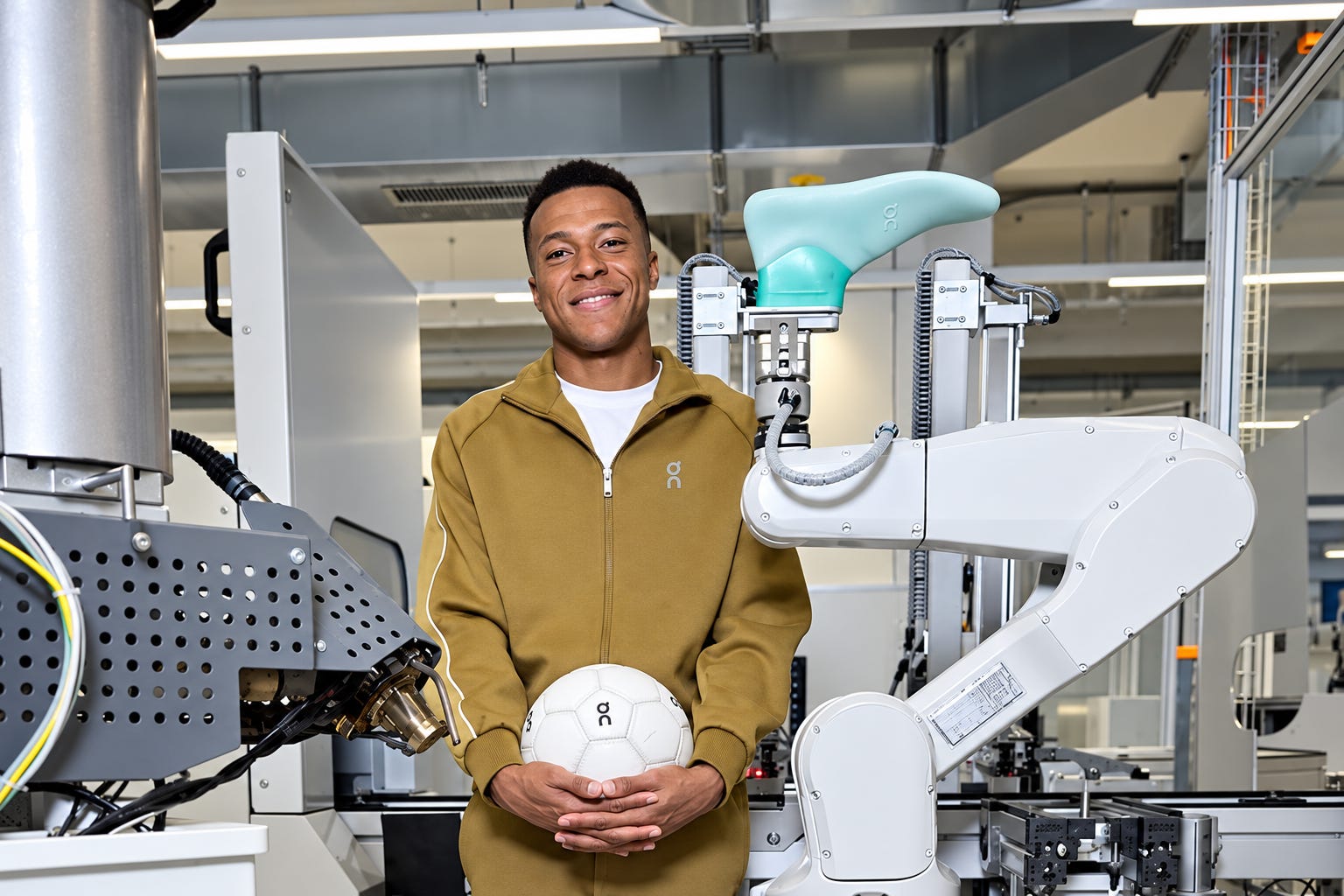
Kylian Mbappé has left Nike. Twenty years. He has worn the swoosh since 2006, when he was eight years old. He is now 27, and this summer his contract expired.
Adidas wanted him. Puma wanted him. New Balance and Skechers, both building aggressive football rosters, wanted him. He signed with On. A Swiss running shoe company that has never made a football boot.
The financial terms were not disclosed. But The Athletic reported one detail that reframes the entire deal:
Mbappé has been given equity in the company.
It is the same structure On used seven years ago with Roger Federer, and the Federer numbers explain exactly why Mbappé walked away from the biggest sportswear company on earth.
Let me show you the maths.
The Federer Case, In Full
In 2018, Nike wanted to reduce Roger Federer’s endorsement salary.
He had been with them for two decades. The RF logo was one of the most valuable marks in tennis. And Nike, consolidating around a smaller group of crown jewels, decided he was worth less than he had been. He left. His Uniqlo deal, signed that year, was worth $300 million and runs until 2028.
Then his wife started wearing a Swiss running shoe. Federer reached out to On’s founders directly. David Allemann, Olivier Bernhard and Caspar Coppetti. In 2019, he took an equity stake estimated at around 3%.
He did not treat it as a passive investment. He worked on product development, helped shape On’s first on-court tennis shoe, and contributed to the lifestyle apparel line. Marc Maurer, then On’s co-CEO, put it plainly: “Roger was the accelerator.”
What happened next: On revenue,
2020 ~$330M On IPO,
NYSE 2021 Raised $746M
On revenue, 2024 ~$1.8B
On net sales, 2025 CHF 3.01B, up 30%
On market cap, 2026 ~$13.6B to $15B
Federer’s 3% stake $375M to $500M
Now put that next to what he earned playing tennis.
Federer’s career ATP prize money across 24 years as a professional was approximately $130 million. His 3% stake in a shoe company he joined after his career peaked is worth three to four times everything he earned actually playing the sport.
Why On Could Do This: Nike’s Numbers Are Genuinely Bad
Look at where Nike actually sits right now.
Fiscal 2026 revenue: $46.4 billion. Flat reported, down 2% on a currency-neutral basis. Fiscal 2025 revenue had already fallen 10%, with profit down 44%.
The stock closed at $38.12 on 1 September 2026. That is the weakest finish since 2014 and roughly 78% below the November 2021 peak. JPMorgan has downgraded to underweight. The company is being removed from the S&P 100.
Greater China revenue fell from $7.55 billion to $6.59 billion, a 13% currency-neutral decline and the eighth consecutive quarter of falling China sales.
Global sports footwear market share fell to 22.9% in 2025, the third straight annual decline.
And the athlete roster has been leaking for years. Federer went to On. Harry Kane went to Skechers. Simone Biles went to Athleta. Josh Allen went to New Balance. Tiger Woods left to start his own brand.
Nike’s response to declining revenue was to consolidate around a handful of crown jewels. Mbappé, Cristiano Ronaldo, Erling Haaland. One of those three just left.
There is a strategic lesson buried in that. When you cut the mid-tier of your roster to protect spend on the top tier, you have no bench. Every departure from a concentrated roster is a structural loss, not a replaceable one.
The Detail That Tells You This Was Planned For Years
Buried in the announcement is the thing I found most interesting, On hired Thierry Henry as Director of Football. He has been working in the role secretly since 2025, and he played a role in convincing Mbappé to sign.
On hired a serious football operator, kept it quiet for over a year, built the category strategy internally, and used him to recruit the defining player of his generation.
They also extended their deal with Barcelona and Switzerland player Sydney Schertenleib, who joined in December 2025 for training and lifestyle apparel and will now work on boots. On is explicitly targeting the women’s market ahead of next summer’s FIFA Women’s World Cup.
Boots hit retail in 2027. Founder David Allemann says they will be premium.
His framing: “Football doesn’t need another sportswear brand to do more of the same. Football needs new ideas and a challenge to what is possible.”
So the sequence was: hire the operator, build the product capability, recruit the face, then announce.
Why Mbappé Said Yes
The best explanation of Mbappé’s decision did not come from Mbappé. It came from a 20-year-old American tennis player three years ago.
Ben Shelton, explaining why he signed with On rather than the obvious alternative: “I didn’t want to be one of 50 Nike guys.”
That is the entire competitive proposition.
Nike offers scale, the largest distribution network in sport, and a roster you share with hundreds of athletes.
On offers concentration. A small roster, personal attention, direct access to product teams, and in the right circumstances, ownership.
On’s statement says Mbappé “will work directly with On’s product teams, integrating his elite perspective into the development and testing of future football footwear and apparel.”
Mbappé’s own words: “What drew me to On was the opportunity to build something entirely new together.”
He is not the face of a boot. He is the founding athlete of a category.
That is a materially different asset. When On’s football business is worth something in 2032, he will have been there from before the first boot existed.
What Is Mbappé’s Stake Actually Worth?
Federer’s deal cannot be repeated, because On is no longer the company that could offer it. In 2019, On was a private Swiss running brand doing a few hundred million in revenue. Giving Federer 3% cost them very little in absolute terms and he delivered enormously.
Today On is a listed company with a market capitalisation of roughly $13.6 billion. 3% of On today is over $400 million. No public company hands that to an athlete. The board would not survive it.
Realistically, Mbappé’s equity is restricted stock or options in the tens of basis points. At 0.25% to 0.5% of a $13.6 billion company, that is $34 million to $68 million at today’s price, almost certainly vesting over the life of the deal and likely with performance conditions attached.
Meaningful. Career-defining alongside his Real Madrid salary. But not Federer money, and it never could be. The upside case is different, though, and it is worth modelling properly.
Global football boot sales are roughly a $3 billion to $4 billion market. If On captures even 5% to 10% over a decade, that is $150 million to $400 million of new revenue.
At On’s current sales multiple of roughly 4.5x, that is $675 million to $1.8 billion of market capitalisation created from a category that did not exist for them last week.
Mbappé’s stake appreciates on the whole company, not just the football line. But the football line is the part he can personally influence.
That is the bet. Not that On goes up, but that On’s football business works, and that he is visibly the reason.
What On Has Actually Built
Step back and look at what has happened here twice now.
Tennis, 2019: On had never made a tennis shoe. They recruited the greatest player in the sport’s history, gave him equity, put him in product development, and used him to enter the category. Then they signed Iga Świątek head-to-toe in 2023 when she was already world number one, and Ben Shelton when he was an unsponsored 20-year-old on the fringe of the top 40. Shelton reached the US Open semi-finals that summer.
Football, 2026: On has never made a boot. They hired Thierry Henry as Director of Football in secret, recruited the defining player of the generation, gave him equity, put him in product development, and are using him to enter the category. They have also secured Schertenleib for the women’s game ahead of a World Cup.
The system, written out:
Pick a category adjacent to your existing capability
Hire a genuine operator from that category and keep it quiet
Recruit one defining athlete, not a roster
Pay them in ownership rather than fees, so their incentive is the category succeeding rather than the campaign running
Put them inside product development so the association is real rather than performed
Launch premium
Every consumer brand thinking about a celebrity partnership should read that list twice. Because the reason most celebrity deals fail is that brands do step three and skip everything else.
What To Take From This
If you are a brand: Use talent for category entry, not awareness. On did not sign Federer to sell more running shoes. They signed him to legitimise a tennis business that did not exist. They did not sign Mbappé to sell more Cloudmonsters. They signed him to make a boot business credible before the first boot shipped.
That is a fundamentally better use of celebrity than “increase brand awareness,” and it is measurable. You either enter the category successfully or you do not.
Hire the operator before you sign the name. Thierry Henry was in place for over a year before Mbappé was announced. The operator makes the talent useful. Without one, you have a famous person attached to a product nobody inside the building knows how to build.
Equity aligns incentives in a way fees cannot. Mbappé now wants On’s football business to work in 2032. A fee-based ambassador wants the campaign to end so they can renegotiate.
If you are talent, or advising talent: The Federer model works and the numbers are not close. $130 million across a 24-year playing career versus $375 million to $500 million from one equity position. Equity in the right company, at the right stage, with genuine involvement, beats any endorsement cheque.
But understand that you cannot get the Federer deal from a $13 billion company. The meaningful equity is available when the company is small, private and needs you more than you need them. Federer joined On two years before the IPO. That timing was the whole deal.
And price the volatility honestly. Federer lost $52 million on a Tuesday morning in August because of a quarterly sales miss. Equity has a higher expected value and a much wider range of outcomes. Hold both if you can. He does.
The Thing Nobody Is Pricing
One final observation, and it is the risk in this deal. On missed its Q2 net sales expectations five weeks ago and the stock fell 19%.
This is a company guiding to at least 23% constant-currency growth in 2026 while entering the most competitive category in sportswear against Nike, Adidas and Puma, all of whom have decades of boot engineering, professional relationships and supply chain depth.
Football boots are genuinely hard. Stud configuration, upper materials, pitch surfaces, regulatory approval, and a customer base that notices everything. Running shoe expertise does not transfer cleanly. And the first product does not reach retail until 2027.
So On has just committed significant equity and the credibility of its most prominent signing to a category where it will not have a product on sale for over a year, while the market is already nervous about growth.
If the boots are good, this is the smartest sportswear move of the decade. If they are not, On has spent real ownership on a category entry that failed in public, with one of the most scrutinised athletes on the planet wearing the result every weekend.
Mbappé is expected to be seen in the new boots within weeks.
We will know fairly quickly.
Are you paying for attention, or buying into something? The gap between those two decisions is worth about $400 million if you ask Roger Federer.
P.S. Nike signed Mbappé in 2006, when he was eight years old. Twenty years of relationship, from a child in Bondy to a Real Madrid striker, and it ended at contract expiry with him walking to a company that has never made a boot. There is a lesson in that about how relationships actually get lost. Not in a dramatic falling out, but in a slow accumulation of feeling like a line item. Nike reportedly tried to reduce Federer’s money in 2018 and he built a half-billion-dollar position elsewhere. When your most valuable partners start to feel like costs to be managed rather than assets to be grown, you will not notice the damage until the contract comes up. And then it is already done.
P.P.S. For anyone tracking the wider pattern in this newsletter: this is the same structural story as the Kendall Jenner and TRIP piece, the Beckham and Authentic Brands deal, and the Steph Curry and Li-Ning contract. Talent has worked out that a fee is income and equity is an asset, and they are pricing accordingly. What separates the good versions from the bad ones is whether the talent is genuinely inside product development or merely photographed next to the product. Federer helped build the tennis shoe. Mbappé will work with the product teams. That involvement is what converts a famous face into a value-creating position, and it is the single clearest signal to look for when you are evaluating any of these deals from the outside.