


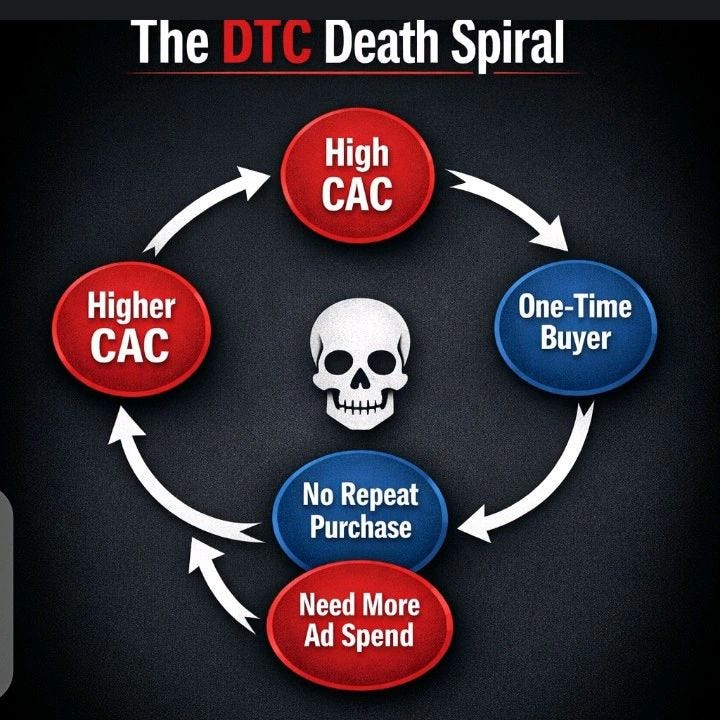
This one came in after a few of the recent exit stories, Gruns, Salt & Stone, Huel and I think it cuts right to the most important question in consumer right now:
“David, every brand you’ve covered recently either bootstrapped for years or had insane unit economics before they raised a penny. Meanwhile I’m watching my own DTC numbers and CAC is up something like 50% from two years ago. Is DTC just... over? Or is this a temporary squeeze? Genuinely trying to figure out if I should keep pushing or pivot to retail entirely.”
Here’s my honest answer: DTC isn’t dead.
But the version of DTC that built brands from 2015-2021 the one most operators are still running is dead. And it’s been dead for a while. We’re just now watching the bodies hit the floor.
Let me show you the actual numbers, because they’re more brutal than most people are admitting publicly, and then let’s talk about what’s actually working right now.
The Numbers: Why Your CAC Feels Broken (Because It Is)
Let’s start with what’s actually happening to acquisition costs, because the data is stark.
The median DTC brand now spends $130 to $156 to acquire a single customer in 2026. That’s roughly a 60% increase over the past five years.
Why?
On April 29, 2026, Meta reported Q1 2026 ad revenue of $55.02 billion, up 33% year-over-year. Average price per ad rose another 12% YoY, on top of every increase that came before. Net income hit $26.77 billion, up 61%. Operating margin sat at 41%.
For ecommerce brands specifically, Meta now commands 68.31% of total advertising budgets more than Google, TikTok, and every other channel combined.
Meta sold more inventory, charged more for it, and posted a 61% profit jump while the average DTC operator paying those bills watched ROAS continue to fall.
Across every category, every benchmark agrees on the direction even if the exact number varies:
Average DTC CAC up 40-60% from 2023 to 2025
DTC fashion CAC specifically up over 60%
CPMs (cost per 1,000 impressions) up 89% since 2020
Google Shopping CPCs up 33.72% year-over-year
Health and wellness CAC, once considered a bargain category up 38% in a single year
And here’s the part that should actually worry you: The average DTC brand now loses money on the first order. That’s not a crisis. That’s the baseline now.
Why This Isn’t “DTC Dying” It’s the Arbitrage Closing
DTC, as a go-to-market motion, was never the business model. It was an arbitrage.
From roughly 2012 to 2019, Facebook and Instagram had more ad inventory than advertisers who understood how to use it. CPMs were artificially cheap. Targeting was incredibly precise (pre-iOS 14.5). A founder with a decent product and a Shopify store could acquire customers for $15-25 and build a real business purely on paid social.
That was never going to last forever. It was a temporary mispricing of attention.
What’s happening now is the arbitrage closing:
Every brand on earth learned the Facebook ads playbook → competition for the same inventory exploded
Apple’s App Tracking Transparency (iOS 14.5, 2021) killed precision targeting → you’re now buying broad reach and hoping, not precise targeting
Meta and Google consolidated as the only two channels that scale → a duopoly with 41% operating margins doesn’t lower prices out of kindness
AI-driven bidding optimisation by the platforms themselves → Meta’s algorithm got better at extracting maximum value per auction, which is good for Meta’s shareholders and bad for your CAC
None of this is cyclical. This is structural. It is the new floor, not a temporary spike that reverts.
This inflation is not cyclical; it is the new normal, driven by platform saturation and signal loss.
So when you ask “is DTC dead” the more precise question is: is buying customers from Meta at ever-increasing prices, with no other strategy, a viable business model anymore?
The answer to that is unambiguously no. It hasn’t been for at least three years.
The Pattern You’re Actually Seeing (And Why It Connects to Everything I’ve Written About Recently)
Here’s why the brands I’ve covered recently Gruns, Huel, Salt & Stone, Poppi, MOSH all share a structural trait that protects them from exactly what you’re describing.
None of them were built as pure paid-acquisition machines.
Gruns managed to a specific 3.0x LTV:CAC ratio on a payback basis meaning even if CAC rose, the cohort economics were engineered with margin for exactly this kind of inflation.
Huel bootstrapped to £18M revenue before raising a penny, which meant the brand had to be capital efficient and develop organic demand (retail, word-of-mouth, vertical integration) rather than relying purely on paid acquisition.
Salt & Stone bootstrapped seven years before a single institutional round, building 1,700+ retail doors and 40% DTC meaning when CAC inflation hit, 60% of their revenue wasn’t exposed to it at all.
Poppi and Olipop built through DSD (Direct Store Delivery) retail distribution first, with DTC as a complement, not the foundation because both founders understood early that beverages specifically can’t survive on DTC-only economics (heavy products, low AOV, terrible shipping margins).
The brands succeeding right now structurally diversified their acquisition away from “100% dependent on Meta CPMs” years before this CAC crisis became undeniable.
The brands struggling right now are the ones who built their entire growth model on an arbitrage that has been closing since 2021 and who are only now, in 2026, being forced to confront it because the numbers have become impossible to ignore.
What’s Actually Working Right Now (The Real Answer to Your Question)
Here’s the practical playbook based on what’s actually keeping brands alive through this CAC environment:
1. Retention Is Now Your Primary Growth Lever, Not a Secondary Metric
60% of DTC brand revenue now comes from returning customers.
The math behind why this matters: loyal customers convert at rates of 60-70%, compared to just 5-20% for new prospects.
If CAC has gone up 50% and conversion on cold traffic has dropped, the only lever left that compounds in your favour is what happens after the first purchase.
This is exactly the Gruns cohort-stacking model I wrote about a few weeks back the brands winning right now are obsessing over months 2-12 of the customer relationship, not just the first conversion.
If you can’t tell me your repeat purchase rate at 90 days, that’s the first number to go find.
2. Price Increases Are Now a Legitimate Strategic Response, Not a Failure
87% of eCommerce merchants have raised US prices to counteract rising acquisition costs.
This used to be considered a defensive, almost embarrassing move. It isn’t anymore. It’s the rational response to a structural cost increase you can’t control.
If your AOV hasn’t moved in two years while your CAC has gone up 50%, you are voluntarily compressing your own margin to absorb a platform’s profit growth.
3. Own Channels (Email, SMS, Community) Are the Only True Hedge
If CAC is up 40% and ad costs are prohibitive, you cannot afford to “rent” your customers from Meta and Google anymore. You must own them.
The brands diversifying away from “100% paid acquisition” toward owned audiences email lists, SMS, community, organic content are the ones building a moat that doesn’t get more expensive every quarter Meta reports earnings.
This is the entire thesis behind why “brand” and “community” have become unavoidable buzzwords. It’s not vibes. It’s the only acquisition channel left that the platforms can’t tax.
4. Omnichannel Isn’t Optional Anymore, It’s the Survival Strategy
In my opinion, DTC is where you build brand awareness, but retail is where you scale.
This is precisely the lesson from Huel, Salt & Stone, Poppi, and Trapstar’s planned next chapter with Footasylum. DTC proves the concept and builds the cult following. Retail is where the volume and the margin protection from not paying Meta tax on every single sale actually comes from.
If 100% of your revenue still runs through a paid acquisition funnel into your own Shopify store, you have 100% of your business exposed to a platform duopoly with a 41% operating margin and no incentive to ever lower prices.
5. Know Your Actual LTV:CAC Not the Number You Want It To Be
A healthy Lifetime Value (LTV) to CAC ratio is now strictly benchmarked at 3:1.
The average DTC brand’s LTV:CAC ratio sits at roughly 3:1 which, as the data notes, is considered healthy but leaves little room for error.
With CAC up 50%+ and margin for error already thin, this is the moment to actually run the math honestly. Not the optimistic lifetime-value-if-everything-goes-perfectly math. The actual cohort retention curve, six months out, with real numbers.
If you haven’t recalculated this in the last quarter, your mental model of your own business is already out of date.
The Honest Answer to Your Actual Question
You asked whether to keep pushing or pivot to retail entirely.
Here’s my honest take: it’s not binary, and “pivot to retail entirely” is its own trap if you do it without fixing the underlying economics first.
The brands surviving and thriving through this CAC environment are doing three things simultaneously:
Treating DTC as a brand-building and retention engine, not a pure acquisition machine accepting that first-order economics may be break-even or negative, and building the cohort math to make that sustainable
Building retail distribution in parallel, not sequentially using DTC traction as proof points to negotiate retail placement, the way Poppi, Salt & Stone, and Huel all did
Investing in owned channels (email, SMS, community) as aggressively as they invest in paid because owned channels are the only acquisition cost that doesn’t inflate every time Meta reports record earnings
DTC isn’t dead.
The version of DTC where you spend $25 to acquire a customer, sell them one thing, and never see them again was always a temporary historical accident created by underpriced Facebook inventory between 2012 and 2019.
That version died. And honestly? It should have.
The version of DTC that survives owned community, retention-first economics, omnichannel distribution, disciplined unit economics was always the real business. We just didn’t have to build it properly while the arbitrage was still open.
Now everyone does.
What does your 90-day repeat purchase rate actually look like? That’s the number that tells you whether you’re building a brand or renting customers from Mark Zuckerberg.
Keep building, David
P.S. If anyone reading this is heading to Cannes for Cannes Lions this year, let me know would genuinely love to meet up with some of our readers in person. There’s something about consumer, culture, and brand-building conversations that just hits differently on the Croisette than over email. Drop a reply if you’ll be there.
P.P.S. The stat that should be circulating in every DTC founder’s Slack right now: Meta’s operating margin sat at 41% in Q1 2026, and capital expenditure guidance for 2026 was raised to $125-145 billion the bulk of which is going to AI infrastructure that advertisers are effectively financing through CPM inflation. Read that sentence again. You are not just paying for ad inventory anymore. You are functionally financing Meta’s AI buildout through your CAC. That’s not a complaint it’s just the honest mechanism of where your marketing budget is actually going. Plan accordingly.