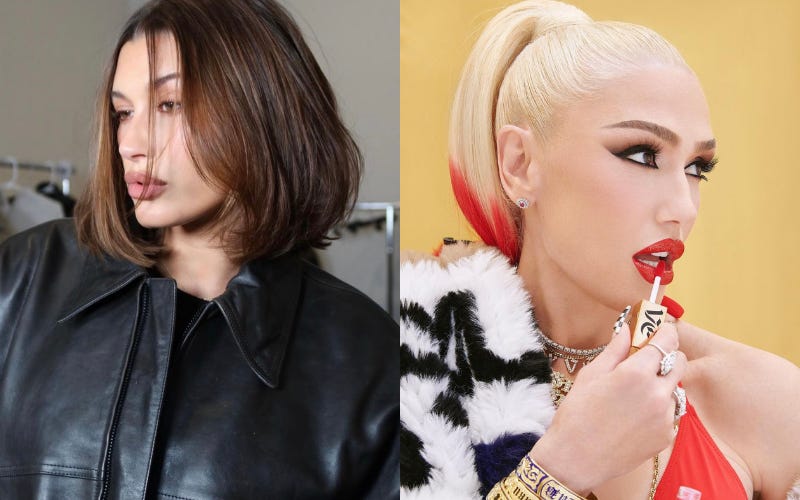
Reader Question: “Why Did Gwen Stefani’s Brand Just Die While Hailey Bieber Made $1 Billion With Ten Products?” (The Brutal Truth About Celebrity Brands That Nobody Will Tell You)
This one came in last week and I haven’t been able to stop thinking about it.
A reader, a brand manager at a mid-sized beauty company sent this:
“David, the contrast this year is insane. Gwen Stefani just quietly shut GXVE Beauty after four years. Drew Barrymore’s Flower Beauty closed after thirteen. Kate Moss’s brand liquidated. Meanwhile, Hailey Bieber just sold Rhode to e.l.f. for a billion dollars. Hailey isn’t more famous than Gwen Stefani. She’s not more talented. She doesn’t have a bigger following. So what actually separates the wins from the losses? I’m trying to pitch a celebrity partnership to my boss and I need a framework, not just vibes.”
One of the best question I’ve received all year. In the last twelve months:
Gwen Stefani’s GXVE Beauty shut down in February 2026, four years after launching with Sephora distribution and VC backing from New Theory Ventures, the same firm that funded Selena Gomez’s Rare Beauty.
Drew Barrymore’s Flower Beauty closed in September 2025 after thirteen years in business.
Kate Moss’s Cosmoss brand liquidated in July 2025.
Pat McGrath Labs, arguably the most critically acclaimed makeup brand of the last decade, filed for Chapter 11 bankruptcy in 2026.
And simultaneously:
Rhode, Hailey Bieber’s skincare brand was acquired by e.l.f. Beauty for $1 billion in July 2025. When Rhode launched at Sephora last fall, it sold three products per second, marking Sephora North America’s biggest brand debut ever, with $10 million in opening-weekend sales.
Rare Beauty (Selena Gomez) is valued at $1.1 billion.
Fenty Beauty (Rihanna) is still the standard against which all celebrity beauty is measured.
Same industry. Same era. Same celebrity formula. Completely different outcomes.
Before we get to the framework, here’s the thing everyone gets wrong about celebrity brands:
Fame is not the asset. Fame is the distribution mechanism.
The biggest mistake every failed celebrity brand makes is treating fame like it’s equity. Like Gwen Stefani’s 79 million Instagram followers is itself a reason for a beauty brand to exist. It’s not. Fame gets you:
First-order trial (people buy it once to see what Gwen’s makeup looks like)
Initial press coverage (launches generate articles)
Retail placement (Sephora takes a meeting because of the name)
Fame does NOT get you:
Repeat purchase (people don’t buy it again because Gwen is famous)
Word-of-mouth (nobody recommends a product because of who made it)
Retention (loyalty requires the product to earn it)
Fenty Beauty did not win because Rihanna is famous. Plenty of famous women have launched beauty brands. Most did not change the market. Fenty did. Because it arrived with a point to make. Forty foundation shades at launch was not a gimmick. It was a direct hit on an industry that had spent years ignoring huge numbers of consumers. It felt smart, overdue and impossible to dismiss.
The brands that win don’t use celebrity as a shortcut. They use celebrity as amplification for something that already deserves to be amplified.
Why GXVE Died (And Why Gwen Stefani’s Level of Fame Was Irrelevant)
When GXVE Beauty launched in 2022, the brand carried serious star power. Gwen Stefani, now in her 50s, positioned the line as her way of helping women “around her age” feel confident. The brand featured her signature red lipstick, vegan formulations, and was backed by New Theory Ventures, which also funded Selena Gomez’s Rare Beauty. Distribution spanned Sephora and Kohl’s, giving GXVE mainstream retail reach from day one. On paper, this looks right.
Credible VC. Major retail. Famous founder. Vegan positioning. Clear aesthetic. So what went wrong?
Problem 1: The Brand Was About Gwen, Not About the Consumer
Speaking to People in 2022, Stefani praised the new company as a sort of culmination of all her work: “In some ways, it feels like everything I’ve done has led up to GXVE.”
“Everything I’ve done has led up to GXVE.” That is a statement about Gwen Stefani. Not about the customer.
The successful celebrity brands bring more than fame to the table. They bring intention. The failures bring branding. Rare Beauty exists because Selena Gomez had a mental health crisis, went public about it, built a community around vulnerability, and then created products that served that community.
Rhode exists because Hailey Bieber had perioral dermatitis, couldn’t find products that worked for her skin condition, simplified her routine to almost nothing, and then built a brand around that simplification.
Both of these brands have a reason to exist that predates the business. GXVE exists because Gwen Stefani likes makeup. That’s not a reason for a brand. That’s a hobby.
Problem 2: “Women Around My Age” Is a Market of One
Stefani positioned GXVE for women in their 50s who want to feel confident.
The problem: That’s not a tribe. That’s a demographic.
Rare Beauty’s tribe: People who struggle with mental health and want beauty to feel inclusive and low-pressure.
Rhode’s tribe: People who want glazed, dewy, “clean girl” skin with minimal products.
GXVE’s tribe: Women who like Gwen Stefani’s makeup look and are also in their 50s.
One of these is a values-based community. The others are descriptors. Communities buy repeatedly because they feel seen. Demographics buy once because they were curious.
Problem 3: Sephora Is a Trap If Your Product Doesn’t Have Legs
Distribution spanned Sephora and Kohl’s, giving GXVE mainstream retail reach from day one. This looks like an advantage. It’s actually a deadline.
Here’s how Sephora works: Sephora gives a new brand shelf space based on the celebrity’s pull and the brand’s launch energy. Then they track velocity. If your products aren’t selling at a minimum threshold — typically 3-5 units per store per week, you get delisted within 12-18 months. The launch generates traffic. The product has to convert trial to repeat.
If you don’t have a hero product that people come back for specifically, Sephora distribution becomes a countdown clock.
Rhode’s hero product: The £16 Peptide Lip Treatment. Simple. Affordable. Replicable. Stackable. People bought it at Sephora, loved it, told their friends about the specific product, not “Hailey Bieber’s brand” but “that Rhode lip thing” and came back.
GXVE’s hero product: Signature red lipstick. Beautiful. Expensive. Occasion-based. How often does someone repurchase a specific red lipstick? Maybe once a year. Maybe never.
Repeat purchase rate is the metric that determines whether Sephora placement creates a business or kills one.
The Quiet Shutdown
No official announcement was made by Gwen Stefani or her team. Fans discovered the closure by noticing GXVE Beauty vanished from Sephora’s website and retail shelves. The brand’s social media accounts simply disappeared, leaving customers confused and concerned about existing products.
The quietness of the shutdown is telling. When a brand dies loudly a founder statement, a final sale, a heartfelt Instagram post it suggests the brand had a community that deserved a goodbye.
When a brand dies silently social accounts deleted, website pulled, no statement it suggests the community was never deep enough to require one.
Why Rhode Won (With Ten Products and Three Years)
Let me give you the complete Rhode breakdown, because this is where the framework lives.
The numbers:
Founded: June 2022
Products at launch: 3 (Peptide Glazing Fluid, Barrier Restore Cream, Peptide Lip Treatment)
Products at acquisition: ~10
Revenue: $212M net sales by time of e.l.f. acquisition
Exit: $1 billion to e.l.f. Beauty (July 2025)
Time from launch to billion-dollar exit: 3 years and 1 month
In a crowded celebrity beauty landscape, Rhode stood out in 2025 by answering a different, almost antediluvian call. With a clear focus on clean products and cheeky, sensual marketing, the company quickly grew into a juggernaut that e.l.f. Beauty acquired for $1 billion, with Bieber remaining on as chief creative officer and head of innovation.
So what did Rhode do differently?
1. The Product Had a Founder Problem to Solve
Hailey Bieber went public about having perioral dermatitis a skin condition causing redness and rash around the mouth. She was a model and public figure who couldn’t fix her own skin with what existed. So she created a simplified, 3-product routine that worked.
Rhode was not “Hailey Bieber’s beauty brand.” Rhode was “the routine that fixed Hailey Bieber’s skin, and might fix yours.” The difference is everything. One is ego. One is service.
2. The Hero SKU Had Daily Repeat Purchase Mechanics
£16 Peptide Lip Treatment. Why this SKU is genius:
Price point: £16 is an impulse purchase. It’s also a gift, a treat, a birthday idea.
Frequency: You use lip product multiple times per day. When it runs out in 4-6 weeks, you buy another.
Shareability: People photograph the tube because it’s beautiful. It photographs itself.
Stacking: You want it in multiple flavours, shades, formulations.
One hero SKU generating 10-12x annual repurchase per customer. That’s the economics of a subscription brand disguised as a single product.
3. DTC-First, Retail As Proof
Rhode launched DTC only. No Sephora, no Ulta, no retail. This meant:
Every sale was direct data (they knew exactly who was buying)
No slotting fees, no retailer margin
Controlled supply (scarcity created desire)
Velocity was already proven before retail conversations
When Rhode launched at Sephora eventually: It sold three products per second, marking Sephora North America’s biggest brand debut ever, with $10 million in opening-weekend sales. GXVE launched in Sephora on day one. Rhode launched in Sephora after having already proven it at scale. The order of operations matters enormously.
4. The Brand Wasn’t Dependent on Hailey
Rhode and Rare Beauty are great examples of successful creator brand trips that grew social chatter and a diversification of talent, not only reliant on the celebrity founders themselves.
This is the test that separates brands from celebrity merchandise: “Does this brand exist if the celebrity steps away?” Rhode: Yes. The Peptide Lip Treatment has its own following. People recommend it independent of Hailey. GXVE: No. Without Gwen Stefani actively promoting, there’s no reason for the brand to exist.
A brand is not a brand if it’s just a distribution channel for someone’s fame. A brand has to develop its own identity, community, and word-of-mouth independent of the founder.
The Framework: Six Questions That Separate $1B Celebrity Brands From 4-Year Shutdowns
Run any celebrity brand partnership through these six questions before you commit a dollar.
Question 1: “Does the celebrity have a problem the product solves or just a preference?”
Winning pattern:
Hailey Bieber → perioral dermatitis → simplified skincare routine → Rhode
Selena Gomez → mental health crisis + inclusivity frustration → Rare Beauty
Maria Shriver → father’s Alzheimer’s + no brain-health bar → MOSH
Patrick Schwarzenegger → saw better-for-you trend before it peaked → every investment he made
Losing pattern:
Gwen Stefani → likes makeup, wanted to make lipstick → GXVE
Drew Barrymore → thought affordable beauty was underserved → Flower Beauty
Kate Moss → thought “clean” luxury skincare was underserved → Cosmoss
The test:
Can the celebrity tell you about the moment they realised this product needed to exist not because it was a business opportunity, but because they personally couldn’t find it?
If yes: proceed.
If the answer is “I’ve always loved beauty and wanted to create something”: stop.
Question 2: “Does the hero product generate daily or weekly repeat purchase?”
Math on this:
A customer who buys once a year:
CAC: £25
Revenue: £35/year
LTV: £35 (1 purchase, then churns)
LTV:CAC ratio: 1.4x → loses money
A customer who buys monthly:
CAC: £25
Revenue: £35/month × 12 = £420/year
LTV: £420
LTV:CAC ratio: 16.8x → prints money
Hero SKU frequency determines whether you have a business or a PR stunt.
Products with daily/weekly repeat:
Lip treatment (Rhode) → multiple times daily
Skin serum → daily
Supplement bar (MOSH) → daily
Deodorant (Salt & Stone) → daily
Products with low/occasional repeat:
Signature lipstick colour → once every 3-12 months
Luxury fragrance → once a year
Designer handbag → once every 2-5 years
Rhode didn’t succeed because Hailey Bieber is famous. It succeeded because she built something with genuine substance and marketed it that way. In just three years, Rhode generated $212 million in net sales and became the number one skincare brand in earned media value globally in 2024, with 367% year-over-year growth. That growth rate is impossible without extremely high repeat purchase.
Question 3: “Can this brand survive six months without the celebrity posting about it?”
The rented audience problem: The other failure pattern is relying entirely on rented platforms and rented audiences. When the algorithm shifts or the cultural moment passes, there’s nothing left to hold the brand up.
Every celebrity has a finite amount of credibility they can deploy promoting their own brands before it feels like an ad.
When Hailey posts about Rhode:
Her followers trust it because they know she built it around her own skin condition
The recommendation feels earned
People buy without feeling sold to
When Gwen posted about GXVE:
Her followers saw a famous person promoting their product
The recommendation felt transactional
People bought once, then moved on
The test: Search for the brand’s products on TikTok without the celebrity’s name in the search. Are people talking about the product for its own merits? Or only in the context of the celebrity?
Rhode: Thousands of “glazed skin routine” videos that don’t mention Hailey Bieber.
GXVE at closure: Almost nothing that wasn’t tied directly to Gwen Stefani.
Question 4: “Is the celebrity’s audience actually the target market or just famous people looking at them?”
The follower trap: Gwen Stefani has 79 million Instagram followers.
But who are they?
A mix of:
Nostalgic No Doubt fans (35-55 year olds)
Blake Shelton fans who followed after The Voice
General celebrity watchers
People who follow her for music, not beauty
How many of those 79M are actively looking for new beauty products? How many are willing to pay Sephora price points?
Hailey Bieber has fewer followers.
But her followers are:
Primarily 18-28 year olds
Obsessed with skincare and beauty
The exact demographic buying prestige beauty products at Sephora
Follower count is vanity. Follower-to-customer conversion is reality. The metric that matters: What percentage of the celebrity’s audience would actually buy the product?
For Hailey → skincare-obsessed Gen Z/Millennial women: Very high overlap.
For Gwen → eclectic multi-decade fanbase: Much lower overlap.
Question 5: “Is the celebrity operationally involved or just putting their name on it?”
This is where most celebrity brand partnerships die. GXVE Beauty was developed by Allison Statter and Sherry Jhawar of Blended Strategy Group and initially funded by VC firm New Theory Ventures.
GXVE was built by an external development team, funded by external VC, with Gwen Stefani as the face. This is the “celebrity brand” model. Celebrity licences their name, gets equity, someone else builds the business.
Compare to Rhode: Hailey Bieber sat in formulation meetings. She personally tested every product on her skin. She retained creative control. She stayed on as chief creative officer even post-acquisition. Hailey Bieber launched Rhode Skin in June 2022, motivated in large part by her personal skin journey. Having previously shared her struggles with sensitive and acne-prone skin, including perioral dermatitis, Rhode is dedicated to simplifying many of the mysteries and complex narratives behind efficacious skincare.
One model: Celebrity as billboard.
Other model: Celebrity as founder.
One creates a brand worth licensing. One creates a business worth owning.
Question 6: “What happens to the brand equity when this celebrity has a bad week?”
This is the risk question your boss will ask. All celebrity brands carry key-person risk.
But the degree of risk varies enormously based on whether the brand has built independent identity.
High risk (celebrity dependency):
Revenue collapses if celebrity has scandal
No independent brand identity to fall back on
Retailer confidence shaken
Low risk (brand independence):
Revenue continues because people love the product
Community exists independent of the celebrity
Retailer relationship is about velocity, not celebrity
The test: Would the press release announcing the brand’s acquisition mention the product first or the celebrity first?
Rhode’s acquisition: “e.l.f. Beauty acquires Rhode, the skincare brand founded by Hailey Bieber.”
The products are named first. The celebrity is context.
A hypothetical GXVE acquisition: “Gwen Stefani’s makeup brand GXVE acquired by...”
The celebrity is named first. The products are irrelevant. That word order tells you everything about who owns the value.
The Three Things No One Will Tell You
This is the uncomfortable section that most industry analysis skips.
1. The celebrity is almost never the reason the brand works
Rare Beauty worked because it offered something more emotionally textured than the usual celebrity gloss. Selena Gomez did not just stick her name on a blush and call it a day. The brand built itself around vulnerability, self-acceptance and mental health in a way that felt coherent rather than cynical. The products mattered, yes. But the perspective mattered more.
Selena Gomez is famous. Selena Gomez is sympathetic. Selena Gomez has 400M Instagram followers. None of that built Rare Beauty. The mission built it. The Soft Pinch Liquid Blush built it. The 1% of sales going to mental health access built it.
Selena Gomez is the distribution. Rare Beauty is the brand.
2. Wide retail distribution before proving velocity is how brands die fast
GXVE → Sephora + Kohl’s from day one.
Drew Barrymore → Walmart from day one.
Rhode → DTC for 18 months, then Sephora.
The brands that launch into retail before proving DTC velocity are letting retailers set their timeline. The brands that prove DTC first are negotiating from a position of power when they finally talk to retail.
There’s a world where GXVE could have survived if it launched DTC, built a cult following, proven retention, THEN approached Sephora with velocity data. Instead it launched into Sephora - Sephora saw weak velocity and within 4 years the brand was gone.
3. The celebrity’s investment of time matters more than their investment of equity
When a celebrity is 10-15% equity and no operational involvement, they’re a marketing asset. When a celebrity is 30-50% equity and deeply operationally involved, they’re a founder.
The market rewards founders. The market slowly kills marketing assets.
The contrast tells you everything you need to know about where marketing authority actually comes from in 2026. Rhode didn’t succeed because Hailey Bieber is famous. It succeeded because she built something with genuine substance and marketed it that way.
The Scorecard (Print This and Bring It To Your Boss)
Run any celebrity brand partnership through this before you sign:
Score:
0-2 green flags: This is a PR campaign, not a business
3-4 green flags: Viable brand with risks, proceed with limits
5-7 green flags: Genuine brand opportunity, invest accordingly
You don’t need a celebrity. You need a point of view, a community, and consistency. Success comes from quality content, clear positioning, and strong audience relationships.
The celebrity is the match that lights the fire. But if there’s nothing to burn, the match goes out.
GXVE had no fire. Just a very famous match. Rhode had a bonfire already smouldering a million people with the same skin problem, no brand speaking directly to them, a hero product solving it at £16.
Hailey Bieber just brought the spark.
What celebrity brand do you think gets built next? And using this framework will it win or die? Hit reply and tell me.
P.S. The GXVE failure has a detail that haunts me: it was initially funded by New Theory Ventures, the same VC that backed Rare Beauty. Same investor. Same celebrity beauty category. Same era. Completely opposite outcomes. New Theory correctly identified the celebrity beauty opportunity they just backed the wrong celebrity for the wrong reason. Selena Gomez had a mission (mental health advocacy) that predated the brand by years and drove genuinely differentiated product decisions. Gwen Stefani had an aesthetic she wanted to express. Same VC, same sector, same bet size. The difference between a billion dollars and a quiet shutdown was entirely in the answer to one question: “Why does this brand need to exist?” One founder had a real answer. One founder had a good-looking one. The market eventually tells the difference.
P.P.S. The celebrity beauty space, once seen as an easy win for A-list endorsements, is now collapsing under market saturation and shifting consumer priorities. This is true but also misleading. The celebrity endorsement model is collapsing. The celebrity founder model is thriving. The distinction matters enormously for how you structure any partnership deal. If you’re paying a celebrity a fee and equity to put their name on your product you’re in the dying model. If you’re building a company with a celebrity who has genuine founder-level involvement, mission alignment, and product-development participation you’re in the model that keeps producing billion-dollar outcomes. The category isn’t saturated. The lazy version of the category is saturated. Build the real version.


