


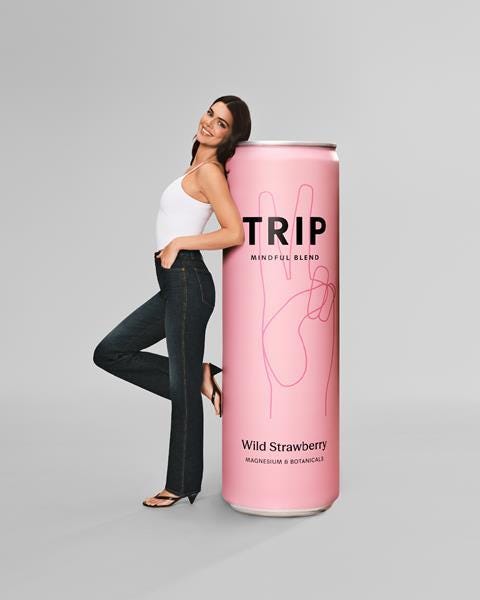
On 8 September, Kendall Jenner became a global ambassador and minority equity shareholder in TRIP, the London calming drinks brand.
Undisclosed stake. Undisclosed terms. The usual.
Most of the coverage treated it as a footnote. Another celebrity, another can, another campaign. But sit with the numbers for a second, because they raise the single most interesting question in celebrity business right now.
TRIP is forecasting roughly $200 million in revenue this year, up from about $100 million in 2025.
818 Tequila, the brand Kendall Jenner actually founded, spent three and a half years in development before it launched and has been on the market for five years.
Depending on which source you believe, it is doing somewhere between $25 million and $55 million. So here is the question this newsletter is about:
If you are famous, is it smarter to build your own brand from nothing, or to write a cheque into somebody else’s brand once it is already working?
Most people assume the answer is obvious. Build your own. Own more. Control everything.
I think that answer is wrong more often than the industry admits, and the Kendall Jenner comparison is the cleanest live case study we have ever had, because the same person is now running both strategies at once.
Let me do the actual maths.
Option One: Build It Yourself. What 818 Actually Cost.
Let me be clear before I start. 818 is a genuine success. Anyone dismissing it as a vanity project has not looked at the numbers.
The timeline, Jenner started developing 818 around 2017. She spent three and a half years on formulation before announcing the brand on Instagram in February 2021.
During that period she travelled to Jalisco, worked directly with distillers, and submitted the tequila to international competitions anonymously, winning awards before anyone knew whose brand it was.
That is not a celebrity slapping a name on a bottle. That is genuine product development.
The results: 818 sold 136,000 cases in its first seven months, making it the best-selling new tequila in the United States that year.
The revenue trajectory:
2021 (partial) ~$10M
2022 ~$25M
2023 ~$35-40M
2024 ~$45-50M
2025 (forecast) $55M+
In 2024 the brand grew volume 40% while the overall tequila category grew 2%.
One honest note on the numbers. Some recent reporting cites a Forbes figure of $25 million for 2026, which sits well below the 2025 forecast of $55 million. That is most likely a difference between gross and net revenue, or a stale figure being recycled. I cannot reconcile it, so I am giving you the range rather than pretending to certainty.
The ownership, Industry estimates put Jenner’s stake at 30% to 50%, reflecting her genuine founding role and her position as Chief Creative Officer.
Valuation estimates put the brand at $200 million to $400 million, which values her stake at $60 million to $200 million.
In April 2026, Sazerac, the Kentucky spirits giant behind Buffalo Trace, took a financial stake and exclusive US distribution rights. That deal is the reason her estimated net worth roughly doubled to around $150 million.
So the build-it-yourself route produced a stake worth somewhere between $60 million and $200 million.
Now here is what it cost.
Three and a half years of unpaid product development before a single bottle sold.
A cultural appropriation backlash in May 2021 over promotional imagery, serious enough that it dominated the launch news cycle.
A trademark lawsuit from Tequila 512 in February 2022, settled in November of that year.
A class action in January 2026 over 100% agave claims.
Five years of operating exposure in a category where she carries the reputational risk of every decision the company makes.
That is the real price of building. Not the capital. The time, the risk, and the fact that your name is permanently attached to every mistake.
Option Two: Buy In Late. What TRIP Actually Offers.
Now look at what she just walked into. TRIP was founded in London in 2019 by a married couple, Olivia Ferdi and Daniel Khoury. Seven years of building, none of it hers.
Where the business is now:
Revenue roughly $100 million in 2025, forecasting $200 million in 2026
Raised $40 million at a valuation above $300 million in November 2025
The UK’s fastest-growing carbonated soft drinks brand among those over £20 million, per Circana data for the 52 weeks to 8 August 2026
Fastest-growing sparkling drink in the US
Over one billion impressions across Instagram and TikTok in the past year
Repeatedly TikTok Shop’s number one food and drinks business
Ferdi has said the intention is to double again in 2027
And the pivot nobody is writing about. TRIP launched in 2019 as a CBD brand. CBD is now under 3% of sales.
They rebuilt the entire product proposition around magnesium and botanicals like ashwagandha and L-theanine, kept the brand equity, and grew into the fastest-growing soft drink in Britain. That is one of the most successful category pivots in drinks in the last decade and it deserves its own piece.
What Kendall had to do to participate, Take a meeting. Agree terms. Shoot a campaign for the wild strawberry flavour. That is it.
No formulation. No distillery visits. No three and a half year development cycle. No category launch risk. No lawsuits inherited. She is buying into a business that has already proven product-market fit, already built retail distribution, already cracked social commerce, and is already doubling.
The Maths: Which Stake Is Actually Worth More?
This is where it gets interesting, and where the intuitive answer is right but for the wrong reasons.
818, at the midpoint: Say 40% ownership of a $300 million brand. Her stake: roughly $120 million.
TRIP, at a realistic estimate: Ambassador equity in a scaled, later-stage business does not come in founder-sized portions. For a brand at a $300 million-plus valuation already doing $200 million in revenue, an ambassador equity stake typically lands somewhere between 0.5% and 3%.
At $300 million valuation, that is $1.5 million to $9 million.
If TRIP doubles again in 2027 and gets acquired at, say, 4x revenue on $400 million of sales, that is a $1.6 billion outcome, and her stake becomes $8 million to $48 million.
So on absolute value, building won. Comfortably.
$120 million versus somewhere between $8 million and $48 million on a good day. But absolute value is the wrong metric, and here is why.
The Metric That Actually Matters: Return Per Unit Of Risk And Time
Run it as an investor would.
818:
Time invested: 8.5 years (3.5 development, 5 operating)
Personal capital at risk: material, plus opportunity cost
Reputational exposure: total. Her name is the brand.
Operating involvement: continuous. She is Chief Creative Officer.
Number of lawsuits weathered: two, plus a major PR crisis
Outcome: $120 million stake
TRIP:
Time invested: weeks
Capital at risk: unknown, likely modest or nil if the equity is compensation for services
Reputational exposure: limited. She is an ambassador, not the founder. If TRIP fails, the headline is about TRIP.
Operating involvement: campaign work
Outcome: $8 million to $48 million potential
Divide the outcome by the years and the risk and the answer stops being obvious. 818 produced roughly $14 million of value per year of involvement, with her entire public reputation collateralised against it.
TRIP could produce a mid-eight figure outcome for a few weeks of work and almost no downside beyond an awkward news cycle. Building produces bigger absolute outcomes. Buying in produces better risk-adjusted ones.
And critically, you can only build one brand properly at a time. You can buy into ten.
The Scoreboard
One case study proves nothing. So let me widen it out, because the pattern is clearer than most people assume.
Celebrities who built from scratch and won big:
Rihanna, Fenty Beauty. Genuinely category-defining. Forty foundation shades at launch was a real product insight, not a marketing angle.
George Clooney, Casamigos. Built with two friends for personal use, sold to Diageo for up to $1 billion.
Hailey Bieber, Rhode. Founded 2022, sold to e.l.f. for around $1 billion in 2025 on roughly $212 million of revenue.
Kim Kardashian, SKIMS. Valued in the billions on genuine category creation around inclusive sizing.
Kendall Jenner, 818. As above.
Celebrities who built from scratch and lost:
Lionel Messi, Más+. The most marketable athlete alive. Launched June 2024 with Mark Anthony Group behind it. Discontinued January 2026. Official line: did not achieve all objectives. Eighteen months.
Logan Paul and KSI, Prime. $1.2 billion in revenue in 2023, 41.2% sports drink market share. Collapsed to a projected $300 million by 2025, with British retailers clearing cans at 31 pence.
Gwen Stefani, GXVE. Sephora distribution, VC backing, quietly shut down after four years.
Drew Barrymore, Flower Beauty. Walmart distribution, her own TV show as a promotional platform, closed after thirteen years.
Kate Moss, Cosmoss. Liquidated.
Now here is the part that should make you rethink the whole thing.
Ryan Reynolds is the most commercially successful celebrity operator of the modern era. And as far as I can tell, he has never founded a consumer company from scratch.
Aviation Gin was founded in 2006 by Christian Krogstad. Reynolds bought a stake in 2018. It sold to Diageo for up to $610 million.
Mint Mobile was founded by David Glickman and Rizwan Kassim. Reynolds acquired roughly a quarter of it in 2019. T-Mobile bought it for up to $1.35 billion.
He did not build either one. He identified existing businesses with real products and weak marketing, bought meaningful stakes, applied his specific skill, and exited both.
That is a private equity strategy executed by someone whose value-add happens to be attention.
So When Should You Build, And When Should You Buy?
Here is the framework I would actually use. It works whether you are the famous person deciding, or the founder deciding who to let onto your cap table.
Build from scratch when all four of these are true.
1. You have a genuine product insight the market is missing.
Rihanna had forty shades. Hailey Bieber had a skin condition she could not solve with existing products. Kendall Jenner spent three and a half years on formulation and won blind tastings before revealing her name.
Messi had fame and a hydration drink in a category that already had Gatorade, Prime, Liquid I.V. and Electrolit. No insight. No product edge. Eighteen months.
2. You are prepared to give it five to ten years.
818 took 8.5 years to reach a $120 million stake. Rhode took three, which is exceptional and rare. Fenty took years of development inside LVMH’s infrastructure.
If you are not prepared to still be doing this in 2034, do not start.
3. The category has genuine repeat purchase built in.
Look at that failure list again. Prime and Más+ are both beverages that people tried once because of who was attached and then did not buy again. Prime’s repeat purchase rate was around 12% at close to 100% brand awareness.
Awareness was never the problem. Habit was.
4. You can absorb the reputational risk.
818 weathered cultural appropriation accusations, a trademark suit and a class action. Jenner’s name is on all of it permanently.
Ask yourself honestly whether your brand can afford your worst year, and whether you can afford your brand’s worst year.
Buy into an existing brand when any of these are true.
The category already has entrenched winners with real product moats. You are not out-formulating an established leader. Buy into a challenger that already works instead.
You want portfolio exposure rather than a single concentrated bet. You can only found one brand at a time properly. You can hold stakes in a dozen.
Your genuine skill is distribution, not product. If what you actually bring is attention and cultural credibility, apply it to a product somebody else has already perfected. That is the Reynolds model and it has produced close to $2 billion in exits.
The brand is already growing and does not need you for awareness. This is the detail from the TRIP deal that almost everyone missed, and it is the most important line in the whole story.
Olivia Ferdi said TRIP wanted an ambassador who could extend the brand’s existing momentum rather than generate initial awareness. They did not need Kendall Jenner to make people aware TRIP exists. A billion impressions and the number one spot on TikTok Shop’s food and drinks ranking had already handled that. They wanted someone to extend momentum that already existed.
A brand that needs a celebrity to create awareness is a brand with a product problem. A brand that wants a celebrity to extend momentum is a brand with a scale opportunity. Those two situations look identical in a press release and are completely different businesses.
The Detail That Should Change How Founders Recruit Celebrities
One more thing from the TRIP story, because it is the most transferable lesson in this whole piece. On how the ambassador roster came together, Ferdi said: “Having these celebrity ambassadors, it was just something that happened around essentially them being customers and really big brand fans.”
Joe Jonas, Ashley Graham, Paul Wesley, Alessandra Ambrosio and now Kendall Jenner all came to TRIP as customers first.
Jenner’s own line: “I’ve been obsessed with TRIP for a while.”
Compare that to the standard model, where a brand’s agency builds a target list, approaches management, negotiates a fee and an equity grant, and manufactures a story about authentic connection afterwards.
One of those produces GXVE. The other produces this. If you are a founder, the practical instruction is simple. Stop casting celebrities. Start tracking which ones are already buying your product.
Your customer data almost certainly contains the answer. Somebody notable has probably already ordered from you. That person is worth ten cold approaches through a management company, because the authenticity does not need to be constructed. It already exists.
The Answer: She Is Not Choosing, And Neither Should You
Here is why I think the Kendall Jenner comparison is genuinely instructive rather than just a nice contrast. She did not pick one strategy. She is running both simultaneously.
818 is the concentrated bet. Her name, her category, her risk, her upside. Eight and a half years for a stake worth potentially $200 million.
TRIP is the portfolio bet. Somebody else’s product, somebody else’s operating risk, a fraction of the upside, and almost none of the exposure.
And note that they are not competing. They are complementary.
818 is the drink that starts the evening. TRIP is the drink that says you did not need one.
The customer is identical. Young, image-conscious, willing to pay for a can that says something about who they are. She now captures that customer on Friday and on Tuesday. That is a spread bet on a single consumer behaviour, executed from two different positions on the risk curve.
The lesson for anyone with a platform build one thing you genuinely care about and can defend for a decade. Buy into several things other people have already made work.
The mistake is not choosing wrong between building and buying. The mistake is doing only one of them.
The people who only build put their entire net worth and reputation into a single category bet. Ask Gwen Stefani, or Kate Moss, or the Mark Anthony Group.
The people who only buy in never own anything meaningful and end up as expensive decoration on other people’s cap tables.
The ones who compound do both.
Are you building your one thing, or spreading thin across ten? And be honest about which one you are actually doing.
P.S. The single most underrated fact in this entire piece has nothing to do with Kendall Jenner. TRIP launched in 2019 as a CBD brand. CBD is now under 3% of sales, and the business is doing $200 million. They kept the brand, kept the customer, kept the aesthetic, and completely rebuilt what was in the can around magnesium and botanicals. Most founders treat a failing core proposition as a death sentence. Ferdi and Khoury treated it as a formulation problem and pivoted the product while protecting the equity they had built in the name. If you are sitting on a brand people love and a product that is not working, that distinction is worth a very long think.
P.P.S. For founders wondering what a fair ambassador equity grant actually looks like: the rough market convention for a scaled brand is 0.5% to 3% for an ambassador role, and 10% to 30% for a genuine co-founder who is involved in product and strategy from the start. The number itself matters far less than what it is tied to. If somebody is taking 2% of your company, that equity should vest against defined deliverables, with clawback provisions if they go quiet. Time-based vesting with no performance trigger is the single most common mistake I see in these deals, and it is almost always the celebrity’s team pushing for it, because it guarantees the equity whether or not they ever show up again.