


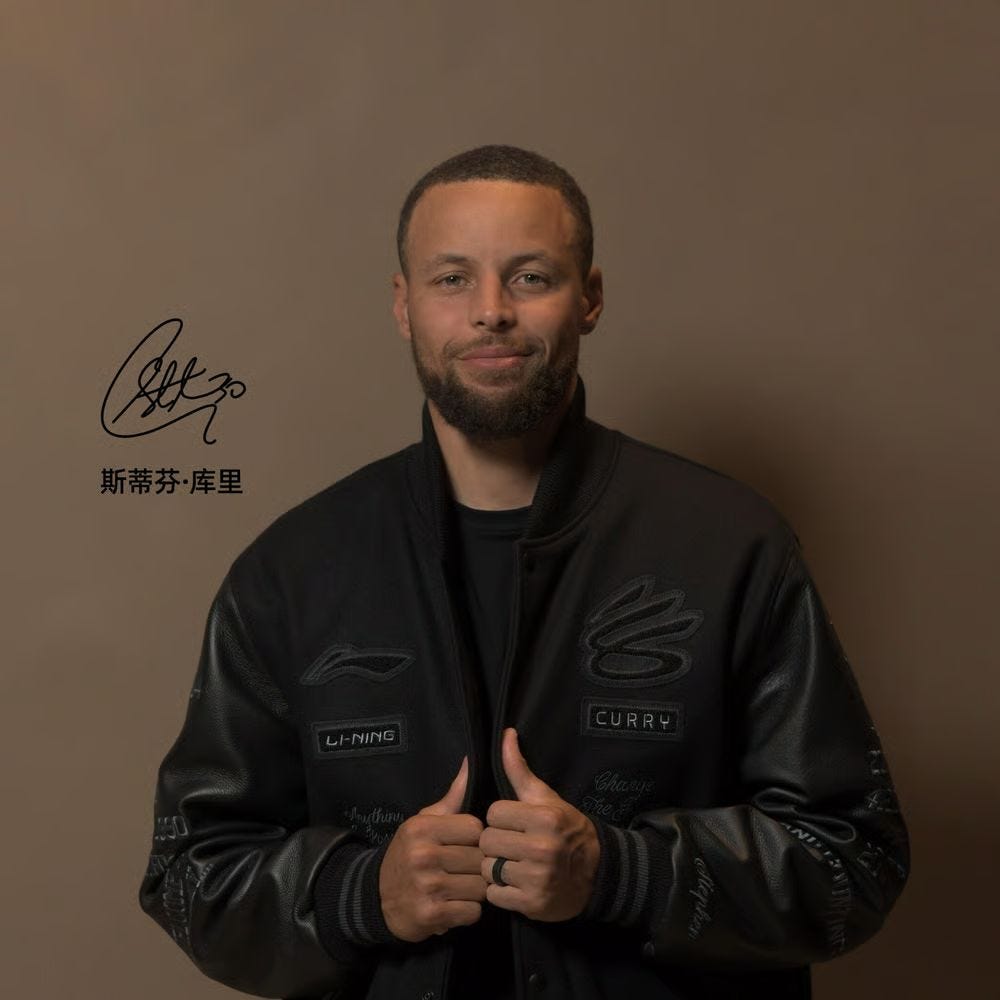
Let me set the scene
Golden State Warriors star Stephen Curry has signed a 10-year, $400 million endorsement contract with Chinese sports apparel company Li-Ning. The same Li-Ning whose merchandise was banned from import into the United States in 2022.
Li-Ning and several other Chinese companies have been identified by the U.S. government and human rights groups as using forced labor to produce their goods. Li-Ning merchandise was banned in the United States in 2022. And the deal includes plans to open Curry Brand retail stores in America.
Let that contradiction sit for a moment. The brand manufacturing Curry’s products is legally prohibited from selling those products into the United States. The deal plans to open retail stores selling those products in the United States.
Either Curry Brand operates as a legally separate entity with a different supply chain one that can clear US customs. Or the deal includes a quiet bet that the regulatory environment shifts. Or the US retail component is aspirational PR that will quietly disappear when the lawyers get involved.
Nobody in the mainstream sports media is asking which one it is. This is the most interesting story in global sports business right now and it has almost nothing to do with basketball.
What You Actually Need to Know About Li-Ning
Started in 1990 by Chinese gymnast and Olympic gold medalist Li Ning, the namesake brand has grown into one of the most recognizable homegrown sports companies. But over 98% of the company’s $4.3 billion revenue last year came from the domestic market.
Li-Ning reported about $4.3 billion (29.6 billion RMB) in revenue in 2025, with more than 98% of it coming from inside China. $4.3 billion revenue. 98% from China.
For context:
Nike revenue (FY2025): $46.3 billion.
Li-Ning revenue (2025): $4.3 billion
Nike China revenue (declining): Down 20% over four years, with additional losses reported in 2026. Many on Wall Street now refer to this simply as “Nike’s China Problem.”
The market opportunity Li-Ning is chasing isn’t America. It never was. It’s the 1.4 billion Chinese consumers who are increasingly choosing domestic brands over the Swoosh. This is the central strategic logic of the entire deal and once you see it, everything else makes sense.
The US Ban: What It Actually Means
Before we get to the strategy, the legal reality matters.
The Uyghur Forced Labor Prevention Act (UFLPA) was signed into law by President Biden on December 23, 2021. Enforcement began on June 21, 2022. The UFLPA establishes a rebuttable presumption that goods mined, produced, or manufactured wholly or in part in the Xinjiang Uyghur Autonomous Region of China are prohibited from US importation unless the importer can provide “clear and convincing evidence” that the goods were not produced with forced labor.
Xinjiang matters for Li-Ning specifically because: Xinjiang accounted for nearly 90% of China’s cotton production, causing significant forced labor risks associated with importing cotton apparel from China.
Rep. Chris Smith, a New Jersey Republican who co-chairs the Congressional-Executive Commission on China, said Tuesday that he plans to ask the Department of Homeland Security to examine Li-Ning imports. “Steph Curry is one of the most talented and watched basketball players in the world, which is exactly why this matters,” Smith said. “The NBA, its players, and sites like Amazon cannot suggest that they stand for social justice at home while cashing checks from companies tied to the Chinese Communist Party’s forced-labor economy.”
Congressional attention on day two of the announcement. This is not a peripheral controversy that will fade. A sitting Republican congressman is actively requesting DHS examination of Li-Ning imports specifically because of the Curry deal.
The legal question for Curry Brand: The deal apparently includes plans to open Curry Brand retail stores in the United States. For these stores to legally sell Li-Ning manufactured products, one of three things must happen:
Option 1: Curry Brand establishes an entirely separate US supply chain manufacturing in a country with clean labour certification, using cotton that can be traced to non-Xinjiang sources, with documentation sufficient to satisfy “clear and convincing evidence” standard under the UFLPA.
Option 2: Li-Ning successfully demonstrates its existing supply chain has no Xinjiang nexus clearing the “rebuttable presumption” that makes its goods presumptively banned.
Option 3: The US retail component never actually materialises — it’s PR language in the announcement that quietly disappears when compliance teams get involved.
Nobody has publicly explained which scenario applies. Curry opted for Li-Ning over other pitches from American and foreign companies despite similar financial commitments, including at least one brand that offered more.
He left more money on the table from another brand to sign with Li-Ning. Which means the US retail component isn’t just about American revenue. It’s about American perception being seen as a global brand with domestic presence.
Why Li-Ning Paid $400M: The Real Strategic Math
Let’s do the actual numbers on why this deal makes sense for Li-Ning even if the US stores never open.
Li-Ning’s revenue: $4.3B (2025)
Steph Curry’s China market value: Curry has traveled to China seven times with the most recent tour to Chongqing last August, and each visit has drawn massive, frenzied crowds. China has approximately 300 million active basketball players. The NBA has been broadcasting in China for decades. Steph Curry two-time MVP, four-time champion, the man who fundamentally changed how basketball is played is one of the most recognisable American athletes among Chinese consumers.
China was once Nike’s secret commercial engine and an area where investors expected the Swoosh to keep outpacing its rivals. Then things flipped upside down. Nike’s revenue in its Greater China region has fallen 20% over the last four full fiscal years, with additional losses reported in 2026.
Nike is losing China. Li-Ning is gaining it.
And now Li-Ning has Steph Curry the face of the most distinctive offensive style in basketball history, playing a game that requires exactly the footwear innovations Li-Ning has been investing in — basketball shoes for guards, three-point shooters, movement specialists.
The investment thesis: If the Curry partnership drives even 5 - 10% revenue growth for Li-Ning in China, that’s $215 - 430M in incremental annual revenue against a $40M/year endorsement cost.
The return on that $400M investment paid over 10 years at $40M/year could be positive within 24 months.
And the basketball shoes market in China specifically: Golf products are involved here too, and China is a huge golf market.
The deal includes a full golf line. Curry is a plus-handicap golfer and winner of the 2023 American Century Championship. Golf is one of China’s fastest-growing sports and Li-Ning has zero presence in the category. The deal covers basketball products, athleisure lifestyle wear, the ability for Curry to sign male and female athletes under his brand, and a full golf line.
Basketball + golf + lifestyle in a 1.4 billion consumer market where both sports are growing rapidly.
The Way of Wade Blueprint: Why Li-Ning Knows This Works
This is not a new playbook for Li-Ning. They’ve been running it for 14 years.
2012: Dwyane Wade leaves Jordan Brand for Li-Ning.
At the time, this was considered career suicide. Wade was at his peak a Finals MVP, three-time champion, one of the most marketable guards in the game. Li-Ning offered a 10-year pact worth more than $8 million per year with additional incentives and royalties in tow.
Never before had a superstar guard who still had a robust domestic sneaker market available to him made the move to a Chinese shoe at the height of his career.
What happened: After selling products in 5,704 Li-Ning storefronts and 11 standalone WADE stores throughout China, Li-Ning and Wade are teaming up to launch WayOfWade.com and bring more consistent launches to his US fanbase.
5,704 Li-Ning storefronts. 11 standalone Wade stores. A lifetime deal. Wade and the Chinese apparel company Li-Ning announced that the three-time NBA champion has signed a lifetime contract with the brand.
Wade’s $8M/year deal produced:
11 standalone WADE stores in China
Distribution across 5,704 Li-Ning locations
A cult sneaker following that reshaped Li-Ning’s cultural positioning
A lifetime deal extension for an athlete who’d already retired
Now apply that math to Steph Curry:
Curry is:
More famous globally than Wade was in 2012
More recognised in China (seven visits, each drawing “massive, frenzied crowds”)
More culturally resonant with the modern Chinese consumer (skill-based, precision game vs athletic dominance)
The face of a playing style three-point shooting that China’s basketball generation is obsessed with
In China specifically, where basketball fandom runs deep and brand loyalty around athlete partnerships is fierce, attaching Curry to Li-Ning is a calculated bet with enormous upside. If Wade at $8M/year built 11 standalone stores and transformed Li-Ning’s basketball positioning, what does Curry at $40M/year build? That’s Li-Ning’s bet.
And it’s a bet backed by 14 years of data proving the model works.
Why Curry Chose Li-Ning Over More Money
Curry opted for Li-Ning over other pitches from American and foreign companies despite similar financial commitments, including at least one brand that offered more. He turned down more money.
Why?
Draymond Green pointed to three driving forces: the brand’s rapid ascent on the global stage, the sheer size of the Chinese consumer market, and the rare opportunity Curry now has to build a business empire that outlasts his playing career.
While high-value athlete brand partnerships are common like LeBron James’s reported lifetime Nike contract and Michael Jordan’s creation of the Jordan Brand Curry’s deal stands out for its scale, operational control, and international reach. Industry sources say Curry declined at least one other lucrative offer to prioritise long-term control and expansion, especially in global retail markets.
The key phrase: “operational control.”
The agreement will include basketball products, athleisure lifestyle wear, the ability for Curry to sign athletes under his brand, and a full golf line. The ability to sign other athletes under his brand.
This transforms Curry Brand from an endorsement arrangement into something closer to what Jordan Brand is within Nike an athlete-led sub-brand with its own identity, its own athlete roster, its own product categories.
The ability to recruit and sign other athletes under Curry Brand creates a structure with long-term commercial independence a model that goes well beyond the typical endorsement arrangement.
At 38 years old, Curry is building for what comes after basketball.
The Jordan Brand comparison is explicit. From a market perspective, the 10-year agreement challenges the multibillion-dollar model established by Michael Jordan’s Jordan Brand at Nike. At 38, Curry’s contract extends beyond his NBA career. By securing full ownership of his intellectual property and a leadership role in brand expansion, Curry is partnering with an international company ready to launch.
The structural difference from Jordan Brand: Jordan Brand lives inside Nike. Jordan gets royalties on products manufactured and distributed by Nike. Nike controls the supply chain, the retail relationships, the international expansion.
Curry Brand with Li-Ning is different: Li-Ning gives Curry the manufacturing and distribution infrastructure. Curry maintains operational control, IP ownership, athlete signing authority, and creative direction. It’s a genuine platform, not a sub-brand within someone else’s infrastructure.
If this works and the Wade precedent suggests it can Curry won’t just be the face of a Chinese brand. He’ll be running a global sports brand that happens to be manufactured and distributed by Li-Ning.
That’s the play. That’s why he took less money from other brands.
The Geopolitical Dimension Nobody Wants To Discuss
Let’s be direct about something the sports press is dancing around. This deal exists in a specific geopolitical context: The US-China trade relationship is the most contested economic relationship in the world right now. Tariffs, technology restrictions, UFLPA enforcement, congressional scrutiny of NBA-China ties these aren’t background noise. They’re the operating environment for this deal.
Rep. Chris Smith said: “The NBA, its players, and sites like Amazon cannot suggest that they stand for social justice at home while cashing checks from companies tied to the Chinese Communist Party’s forced-labor economy.”
This critique lands because it’s structurally coherent. The NBA has built significant brand equity on social justice positioning players using their platforms for causes, the league’s outspoken stances on various issues. Partnering with a company identified by the US government as linked to forced labour creates an obvious tension.
But the business reality is equally coherent: China was once Nike’s secret commercial engine. Nike’s revenue in Greater China has fallen 20% over four years.
Nike is losing China. The void is being filled by Li-Ning, Anta, and other domestic Chinese brands. American athletes are choosing sides in a commercial war that has nothing to do with basketball and everything to do with which sports brand wins the largest consumer market on earth.
Steph Curry just chose a side. And the US retail ban? Over 98% of Li-Ning’s $4.3 billion revenue comes from inside China. The US market isn’t the prize for Li-Ning. It’s the optics.
Having Curry Brand stores in America signals global ambition. It generates American press coverage. It creates FOMO in Chinese consumers who know their favourite brand has international reach. The stores might exist primarily as brand-building exercises rather than revenue centres even if the legal and supply chain issues can be resolved.
When the market size of a basketball-obsessed nation of 1.4 billion people is on the line, compliance headaches in Washington become a manageable obstacle rather than a dealbreaker.
The Chinese Brand Moment
Steph Curry’s deal is the institutional scale-up of a thesis that’s been building for 14 years.
The timeline:
2006: Shaq signs with Li-Ning. First major American athlete with a Chinese brand. Mostly symbolic.
2010: Kevin Garnett signs with Anta. Signals Chinese brands are serious about acquiring American talent.
2012: Dwyane Wade leaves Jordan Brand for Li-Ning. Seismic. First superstar guard at career peak choosing China over America.
2015-2020: Klay Thompson signs with Anta ($80M deal). Jimmy Butler, Fred VanVleet, D’Angelo Russell, CJ McCollum all sign Li-Ning deals. Chinese brands build NBA rosters.
2026: Steph Curry signs $400M with Li-Ning. The category scales from “interesting experiment” to “institutional business.”
Those deals showed other NBA players that Chinese sports brands are serious about them, said Shawn Liu, Anta’s director of basketball sports marketing. The Wade deal proved the model. The Klay deal proved it scales. The Curry deal proves it can be built into a generational brand.
For Li-Ning, the partnership is equally transformative. The brand has been building momentum internationally, and landing one of the most recognizable faces in basketball accelerates that timeline considerably.
The Jordan Brand comparison: Jordan Brand was built on one player’s cultural dominance, his specific playing style (explosive, dominant, winning), and two decades of patient brand-building that turned a signature shoe into a multi-billion dollar sub-brand within Nike.
Li-Ning is explicitly trying to build the Chinese equivalent a brand anchored to an athlete whose playing style (skill-based, precision, democratic anyone can shoot threes) resonates with the values Chinese basketball culture is converging toward.
Jordan Brand generated approximately $5B in revenue in 2024. If Curry Brand at Li-Ning reaches even 20% of Jordan Brand’s scale, that’s $1B annually from a market that’s 14 years into building this infrastructure. That’s the ambition. That’s why $400M is not overpaying.
My Take
Here’s where I actually land on this: Steph Curry made a rational, well-structured business decision. The China market opportunity is real. Li-Ning’s operational infrastructure is real. The Way of Wade proof of concept is real. The ability to build a brand that outlasts his playing career is real.
The US retail complication is real too but it may be secondary to the core strategy.
Over 98% of Li-Ning’s $4.3 billion revenue comes from inside China. The US stores if they ever open are brand signalling for Chinese consumers, not a primary revenue strategy.
The geopolitical criticism is also real. When the US government has legally identified forced labour concerns serious enough to ban imports, and a Congressman is publicly asking DHS to investigate the deal within 48 hours of announcement, the human rights dimension isn’t abstract.
But the business logic is clear: Nike is losing China. Li-Ning is gaining. Steph Curry is one of the most beloved American athletes among Chinese consumers. The Wade deal built 11 standalone stores and 5,704 distribution points. Curry is structurally better positioned than Wade in China at the time of signing.
$400M for 10 years in exchange for the potential to build the Chinese equivalent of Jordan Brand in the world’s largest sports market? For Li-Ning, that’s not a bet. That’s due diligence. For Curry, turning down more money to get IP ownership and athlete-signing authority? That’s thinking like a founder, not an endorser.
The US regulatory question is the unresolved thread. And it’s the one that will determine whether this becomes a genuine global brand or an extraordinarily lucrative Chinese one. Watch the supply chain disclosures. Watch whether those US stores ever actually open. Watch whether Congress presses DHS to act.
Because the business story is fascinating. The human rights story hasn’t finished being written.
P.S. The detail that most reveals what this deal is really about: Charania noted that it wasn’t even the most lucrative offer Curry received from all of the brands who weighed in. Curry turned down more money. A player who already has a $215M NBA contract, existing endorsements, and generational wealth chose a deal structured around brand autonomy and China market access over a higher cheque. That’s not an athlete decision. That’s a founder decision. He’s not monetising his fame. He’s building infrastructure for what comes after basketball. The $40M/year is almost incidental to the real prize IP ownership, athlete-signing authority, and positioning as the institutional anchor of Li-Ning’s global basketball ambition. That’s the Wade-to-Curry evolution in one sentence: Wade proved Chinese brands could build cult sneaker culture around an NBA star. Curry is the test of whether that cult culture can scale into a globally recognised brand architecture. We’ll know in 5-7 years. And we’ll be watching.
P.P.S. Curry said in the statement that he was impressed with the company’s shoes made for Butler and Wade, which led him to conclude that the Chinese brand could be the right partner. The product testing detail is easy to overlook but it’s telling. Curry didn’t just take the meeting and take the money. He actually wore Jimmy Butler’s and Dwyane Wade’s Li-Ning shoes during games before signing. For a player as particular about his footwear as Curry whose Curry Brand with Under Armour was built around his specific movement patterns, his release point, his lateral cutting product approval came before commercial negotiation. That’s founder thinking applied to brand partnerships. The product has to be right first. Everything else follows.