


Hey,
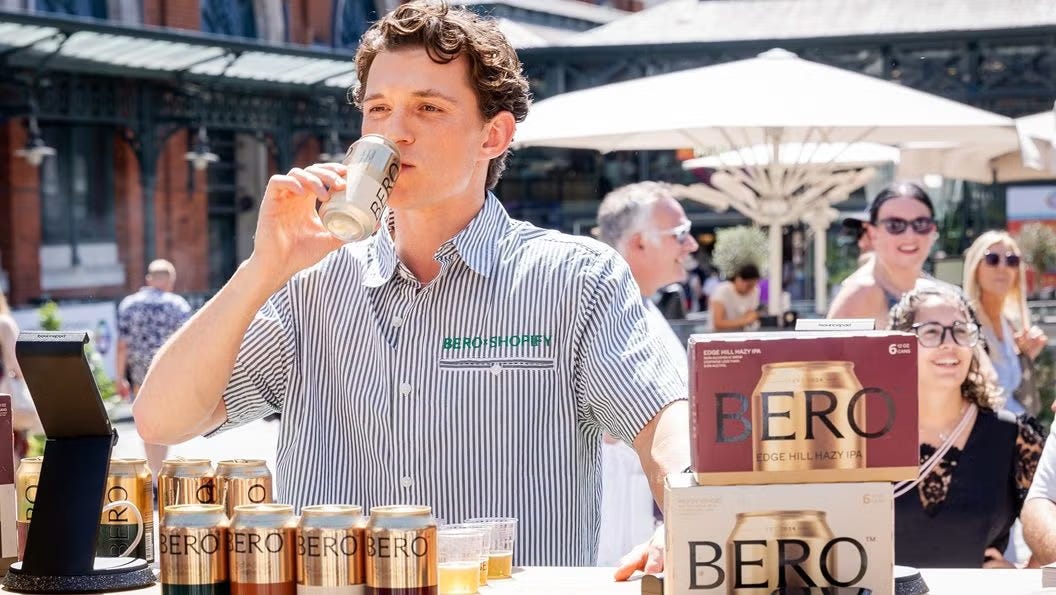
So Tom Holland the guy who plays Spider-Man and has 65 million Instagram followers just raised investment from Paine Schwartz Partners at a $100 million+ valuation for his non-alcoholic beer brand, BERO.
Year one revenue: Nearly $10 million.
Year two target: $30 million (3x growth).
Positioning: Premium NA beer for “one nice beer” occasions dinner tables, date nights, actual social moments.
Now, before you roll your eyes and think “another celebrity launching overpriced water,” let me show you why this deal actually matters...
Because BERO isn’t competing with Heineken 0.0 at the supermarket.
They’re competing for the moment when someone says: “I’m not drinking tonight, but I still want to feel like I’m part of this.”
And that moment? It’s worth billions.
Let me break down what’s actually happening in non-alcoholic beer, why BERO raised at $100M+ on $10M revenue (that’s a 10x revenue multiple), and why this category is about to explode in ways most people aren’t seeing yet.
The Numbers That Show This Isn’t Just Celebrity Hype
Let’s start with what makes BERO’s raise remarkable:
BERO’s Reported Metrics:
Year 1 revenue (2024): ~$10M
Year 2 target (2025): ~$30M (3x growth)
Valuation: $100M+ (10x revenue multiple)
Investor: Paine Schwartz Partners (food/agriculture PE firm)
Structure: Tom Holland is co-founder, not just endorser
Co-founder: John Herman (ex-Nutrabolt, actual beverage operator)
Distribution: DTC + retail + heavy on-premise (restaurants, bars, hospitality)
Now compare to the category leader:
Athletic Brewing:
Revenue: $100-150M+ (2024)
Valuation: ~$800M (post-Series D, 2023)
Revenue multiple: 5-8x
Distribution: National retail (Target, Whole Foods, Total Wine) + on-premise
Founded: 2017 (7 years to $100M+ revenue)
BERO raised at a 10x revenue multiple ($100M valuation on $10M revenue).
Athletic Brewing trades at a 5-8x revenue multiple ($800M on $100-150M revenue).
BERO’s multiple is higher than the category leader.
Why would investors pay a premium for a brand doing 1/10th the revenue?
Three reasons:
1. Category momentum: NA beer is one of the fastest-growing beverage categories globally (+31% CAGR 2020-2024)
2. Celebrity distribution advantage: Tom Holland’s 65M Instagram followers = free customer acquisition at scale
3. Premium positioning: BERO is targeting the high end ($12-15 per 6-pack vs. Athletic’s $9-11), where margins are better
But here’s the real question: Is this actually a business, or is it a celebrity vanity project that’ll fade in 18 months?
Let me show you why it’s the former.
Why BERO Isn’t a Vanity Brand
1. Tom Holland Is Actually a Co-Founder
Not an endorser. Not a brand ambassador. A co-founder.
What this means:
He has equity (likely 30-40%), not just royalty
He’s involved in product development
He’s involved in strategic decisions
When you’re an endorser earning 5% royalty, you post once, collect your check, and move on. When you’re a co-founder with 35% equity, you’re incentivized to build a $1B brand.
Tom’s potential economics:
If BERO hits Athletic Brewing’s trajectory:
Revenue: $150M by Year 7
Valuation: $750M-1B (5-7x revenue)
Tom’s 35% stake: $262-350M
Compare to endorsement deal:
5% royalty on $150M revenue = $7.5M total
The co-founder structure creates $250M+ more value for Tom than an endorsement.
2. John Herman (Co-Founder) Brings Actual Beverage Expertise
John Herman’s background:
Head of Innovation at Nutrabolt
Helped scale Nutrabolt (C4) from $1B to $2B+
Understands CPG distribution, retail partnerships, product development
This is the operator Tom Holland isn’t
The division of labour:
Tom: Brand, marketing, celebrity distribution, cultural credibility
John: Operations, product, retail partnerships, supply chain
This is the exact structure that works:
Fenty Beauty: Rihanna (brand) + LVMH team (operations) = $550M revenue
Skims: Kim Kardashian (brand) + Jens Grede (operations) = $4B valuation
BERO: Tom Holland (brand) + John Herman (operations) = TBD
Celebrity + operator = viable business.
Celebrity alone = vanity project.
3. Paine Schwartz Partners Isn’t Betting on Vibes
Who is Paine Schwartz?
$4B+ agriculture and food-focused private equity firm
Portfolio includes: Oatly, Perfect Day, NotCo, Farmers Business Network
They invest in food/beverage infrastructure, not celebrity brands
Why they invested in BERO:
They didn’t invest because Tom Holland is famous.
They invested because:
Category is proven: Athletic Brewing validated NA beer as venture-backable
Unit economics work: $10M Year 1 revenue shows product-market fit
Distribution advantage: Tom’s celebrity accelerates customer acquisition
Premium positioning: Higher margins than Athletic (less price competition)
Operator credibility: John Herman’s Nutrabolt (C4) background de-risks execution
When sophisticated PE firms invest, they’ve done the work:
Validated unit economics (CAC, LTV, retention)
Modelled path to $100M+ revenue
Stress-tested competitive positioning
The Category Context: Why NA Beer Is a Real Market Now
Five years ago, non-alcoholic beer was a punchline.
The options:
Heineken 0.0 (tasted like sadness)
O’Doul’s (tasted like regret)
Beck’s NA (tasted like water pretending to be beer)
Consumer perception: “If you’re not drinking, just order a Coke.”
Then Athletic Brewing launched in 2017 and changed everything.
What Athletic Brewing Proved
The thesis:
Non-alcoholic beer doesn’t have to taste bad
People want beer flavour without alcohol (not beer-flavoured water)
NA beer can be positioned as premium, not compromise
The execution:
Invested in brewing process (real beer, alcohol removed vs. flavoured water)
Focused on taste first (won blind taste tests vs. alcoholic beer)
Built retail + on-premise distribution simultaneously
Positioned as lifestyle choice, not recovery product
The results:
Revenue: $0 (2017) → $100M+ (2024)
CAGR: ~100%+ for first 5 years
Valuation: $800M (2023 Series D)
Distribution: National retail + 20,000+ on-premise accounts
Athletic Brewing proved three things:
1. Taste can be good enough that people choose NA beer even when alcohol is an option
2. On-premise distribution (bars, restaurants) is critical (social occasions drive trial)
3. The category is venture-backable (fast growth, high margins, defensible brand)
Before Athletic: NA beer was a recovery product for alcoholics.
After Athletic: NA beer is a lifestyle choice for mindful drinkers.
That shift unlocked billions in market value.
The Market Opportunity: How Big Can This Actually Get?
Let’s look at the numbers:
US Beer Market:
Total size: $100B+ annually
Volume: ~6B cases per year
US Non-Alcoholic Beer Market (2024):
Size: ~$500M (0.5% of total beer market)
Growth rate: +31% CAGR (2020-2024)
If NA beer reaches just 5% of total beer market:
Market size: $5B annually
That’s 10x growth from current $500M
For context, NA beer penetration in other markets:
Germany: 6-7% of beer market
Spain: 10-12% of beer market
US: 0.5% of beer market
Upside: US is dramatically underpenetrated
Why the US is behind:
1. Cultural: American drinking culture is booze-forward
2. Quality: Until recently, NA beer tasted terrible
3. Availability: Limited on-premise distribution (bars didn’t stock it)
But all three are changing:
Cultural shift:
Gen Z drinking 20% less than Millennials
“Sober curious” movement growing
Wellness culture prioritizing mental clarity
Drinking less is becoming cool, not weird
Quality improvement:
Athletic Brewing proved taste can compete
New brewing techniques (dealcoholization tech improving)
Blind taste tests: Modern NA beers winning vs. alcoholic
Distribution expansion:
Athletic in 20,000+ on-premise accounts
Heineken 0.0 in bars nationwide
NA beer becoming table stakes for restaurants/bars
The convergence of these three trends creates explosive growth.
Where BERO Fits: The Premium Positioning Play
BERO isn’t trying to be Athletic Brewing.
Athletic’s strategy:
Breadth: 10+ SKUs across styles (IPA, golden, wit, etc.)
Pricing: $9-11 per 6-pack (competitive with craft beer)
Distribution: Volume play (Target, Whole Foods, Total Wine)
Positioning: “Great-tasting NA beer for everyone”
BERO’s strategy:
Focus: 2-3 core SKUs (beer-forward, European-style lagers)
Pricing: $12-15 per 6-pack (premium positioning)
Distribution: DTC + on-premise heavy (restaurants, hospitality)
Positioning: “The one nice beer” for mindful moments
The occasion BERO owns:
Not: Post-workout hydration (Athletic) Not: Weeknight casual drinking (Heineken 0.0) Yes: Dinner party where you want one beer but don’t want to drink Yes: Date night where you’re driving home Yes: Business dinner where you want clarity Yes: Social moments where you want the ritual without the alcohol
BERO is targeting premiumization in NA beer the same way craft beer premiumized alcoholic beer.
The Unit Economics: Why This Business Actually Works
Let’s reverse-engineer BERO’s economics:
Assumptions (based on category comps):
Revenue:
Year 1: $10M
Average 6-pack price: $13 (DTC/on-premise blended)
Units sold: ~770K 6-packs
COGS (Cost of Goods Sold):
Industry benchmark for premium NA beer: 30-35% of revenue
BERO COGS: ~$3-3.5M (30-35% of $10M)
Gross Margin:
Revenue: $10M
COGS: $3.5M
Gross profit: $6.5M (65% margin)
Operating Expenses:
Year 1 (brand-building phase):
Marketing: $3M (30% of revenue, heavy DTC/awareness)
Sales/distribution: $1.5M (on-premise team, retail partnerships)
G&A: $1M (operations, overhead)
Total opex: $5.5M
EBITDA:
Gross profit: $6.5M
Opex: $5.5M
EBITDA: $1M (10% margin)
Year 1 at 10% EBITDA is remarkable for a consumer brand.
Compare to typical Year 1:
Most DTC brands: -30% to -50% EBITDA (burning cash)
BERO: +10% EBITDA (profitable or near-breakeven)
Why BERO’s economics work:
1. Celebrity distribution = low CAC
Tom Holland’s 65M followers = free marketing.
Traditional NA beer brand:
CAC: $40-60 (paid social, influencer marketing, retail slotting)
BERO:
CAC: $20-30 (Tom posts organically, earned media, word-of-mouth)
The celebrity advantage cuts customer acquisition cost in half.
2. Premium pricing = high gross margin
Athletic Brewing (mid-tier):
Price: $10 per 6-pack
COGS: $3.50 (35%)
Gross margin: 65%
BERO (premium):
Price: $13 per 6-pack
COGS: $4 (31% due to scale disadvantage)
Gross margin: 69%
The $3 price premium flows through as higher gross profit dollars per unit.
3. On-premise focus = better margins
Retail (Target, Whole Foods):
Retailer takes 30-40% margin
Brand gets 60-70% of retail price
On-premise (restaurants, bars):
Venue takes 40-50% margin
Brand gets 50-60% of menu price
But: Menu price is 2-3x retail price
Example:
Retail sale:
BERO 6-pack: $13 retail
BERO’s net: $8-9 (70%)
On-premise sale:
BERO single bottle: $7-9 on menu
BERO’s net: $3.50-4.50 (50%)
Per 6-pack equivalent: $21-27
BERO’s net: $10.50-13.50
On-premise revenue per unit is 30-50% higher than retail. That’s why BERO is going heavy on restaurants/hospitality.
4. Subscription model potential
Based on Athletic Brewing’s playbook:
One-time DTC purchase:
Revenue: $13
CAC: $25
Loss: -$12
DTC subscriber (every 4 weeks):
CAC: $25
Monthly revenue: $13
6-month LTV: $78
Profit: $53
If 30% of DTC customers convert to subscription:
100 customers:
CAC: $2,500
One-time revenue: $1,300
30 subscribers: $2,340 (6-month value)
Total: $3,640 revenue on $2,500 CAC
ROAS: 1.45x (profitable)
The subscription model turns unprofitable DTC into profitable channel.
The Competitive Landscape: Who’s Already Here and Who’s Coming
Let’s map the NA beer category:
Tier 1: Mass Market (Heineken, Budweiser, Corona)
Pricing: $7-9 per 6-pack
Distribution: Everywhere (grocery, convenience, bars)
Positioning: NA version of alcoholic beer
Market share: ~60% of NA beer
Tier 2: Craft/Athletic (Athletic Brewing, Partake, Bravus)
Pricing: $9-11 per 6-pack
Distribution: Specialty retail + on-premise
Positioning: Better-tasting NA beer
Market share: ~30% of NA beer
Tier 3: Premium (BERO, Gruvi, Hairless Dog)
Pricing: $12-15 per 6-pack
Distribution: DTC + on-premise focused
Positioning: Premium NA for special occasions
Market share: ~10% of NA beer
BERO is competing in Tier 3 (premium), not Tier 2 (Athletic).
Why this matters:
Tier 2 is crowded:
Athletic Brewing (leader)
Partake (VC-backed, $10M+ raised)
Bravus (growing fast)
Tier 3 is wide open:
No dominant player yet
Premium positioning barely explored
Opportunity to own the category
The risk:
If mass-market brands (Heineken, Budweiser) launch premium lines, they have:
Existing distribution
Brand equity
Marketing budgets
BERO’s defense:
1. Authenticity: Tom Holland’s sobriety journey is real (not corporate strategy)
2. Premium credibility: Independent brand feels more premium than Budweiser extension
3. Speed: BERO can move faster than big beer companies
But long-term, brand equity + distribution will matter more than first-mover advantage.
The Path to $100M Revenue: Can BERO Actually Get There?
Let’s model BERO’s trajectory:
Base Case (follows Athletic Brewing’s path):
Year 1 (2024): $10M Year 2 (2025): $30M (3x growth) Year 3 (2026): $60M (2x growth) Year 4 (2027): $100M (1.67x growth)
This assumes:
Distribution expansion (more retail, more on-premise)
Subscription model taking hold (30-40% of DTC converts)
Premium positioning maintained (no discounting)
Bull Case (celebrity distribution advantage):
Year 1 (2024): $10M Year 2 (2025): $35M (3.5x growth) Year 3 (2026): $80M (2.3x growth) Year 4 (2027): $140M (1.75x growth)
This assumes:
Tom Holland’s celebrity accelerates growth vs. Athletic
International expansion (UK, EU)
On-premise becomes 40%+ of revenue (higher margin)
Bear Case (premium positioning fails):
Year 1 (2024): $10M
Year 2 (2025): $20M (2x growth)
Year 3 (2026): $30M (1.5x growth)
Year 4 (2027): $40M (1.3x growth)
This assumes:
Premium price point limits addressable market
Celebrity fatigue (Tom Holland moves on)
Competition intensifies (Heineken premium, Athletic moves upmarket)
Most likely: Between base and bull case.
Why?
BERO has advantages Athletic didn’t:
Celebrity distribution (65M followers)
Category validation (Athletic proved model)
Better technology (NA brewing improved since 2017)
But BERO has challenges Athletic didn’t face:
More competition (Athletic had clear field)
Higher price point (limits volume)
Celebrity risk (Tom’s image tied to brand)
My estimate: $80-100M by Year 4 (2027).
At $100M revenue:
5x revenue multiple: $500M valuation
7x revenue multiple: $700M valuation
Tom’s 35% stake: $175-245M
That’s the bet Paine Schwartz is making.
What This Means for Anyone Building Premium Consumer Brands
You don’t need to be Spider-Man to learn from BERO’s playbook:
Lesson 1: Celebrity + Operator = Viable Business
Celebrity alone doesn’t work:
Most celebrity brands fail (see: every celebrity tequila)
Operator alone limits growth:
Great product, no distribution
Celebrity + operator = leverage:
Celebrity provides distribution/awareness
Operator provides execution/credibility
BERO’s formula:
Tom Holland (celebrity distribution)
John Herman (beverage operations)
Together: Viable path to $100M+
Application:
If you’re an operator building premium brands:
Partner with micro-celebrities in your niche (not A-listers)
100K-500K engaged followers > 5M passive followers
Lesson 2: Premium Positioning Requires Premium Distribution
BERO isn’t just charging $12-15 per 6-pack randomly.
They’re building distribution to justify premium:
On-premise (restaurants validate quality)
DTC (direct relationship, no retailer discounting)
Select retail (premium grocers, not mass)
Launching premium at Target = immediate price comparison = loses premium positioning.
Launching premium at restaurants → then select retail → then Target = maintains premium.
Distribution sequence determines pricing power.
Lesson 3: Own One Occasion, Not Every Occasion
Athletic Brewing’s positioning:
“Great-tasting NA beer for every occasion”
Breadth of SKUs (IPA, lager, wit, stout)
Trying to replace all beer
BERO’s positioning:
“The one nice beer for mindful moments”
Focus on core SKUs
Owning specific, premium occasions
When you own one occasion deeply, you can charge premium.
When you serve all occasions, you compete on price.
Lesson 4: Unit Economics Matter from Day One
BERO hit $10M Year 1 revenue and is likely profitable or near-breakeven.
Most DTC brands:
Burn $5-10M to reach $10M revenue
Negative EBITDA for 3-5 years
BERO’s path:
Celebrity cuts CAC in half
Premium pricing drives margin
Profitable or near-profitable from Year 1
This gives BERO optionality:
Raise when they want (not when they need)
Invest in growth (not survival)
Negotiate from strength
Profitability = leverage.
Lesson 5: Category Timing Is Everything
If BERO launched in 2017 (when Athletic did):
Would’ve had to prove category viability
Would’ve had to educate consumers
Would’ve faced retail skepticism
Launching in 2024:
Athletic already validated category
Consumers already educated
Retailers already allocating shelf space
BERO is riding Athletic’s category-creation work.
Lesson: Sometimes being second (with advantages) beats being first (with risk).
The Final Reality
Tom Holland’s BERO just raised at a $100M+ valuation on $10M revenue.
That’s a 10x revenue multiple—higher than the category leader Athletic Brewing.
Why?
Because sophisticated investors see what’s coming:
The category is exploding (+31% CAGR, massive underpenetration vs. Europe)
Premium positioning is wide open (no dominant player above $12/6-pack)
Celebrity distribution works (65M followers = customer acquisition advantage)
The structure is right (co-founder with equity, not endorser with royalty)
The operator is credible (John Herman’s Nutrabolt (C4) background de-risks execution)
Is BERO guaranteed to hit $100M revenue?
No. Plenty can go wrong:
Tom Holland’s image could change (controversy, career pivot)
Premium positioning could fail (consumers unwilling to pay $13 vs. $10)
Competition could intensify (Heineken launches premium, Athletic moves upmarket)
But the bet makes sense:
Non-alcoholic beer is one of the few consumer categories growing 30%+ annually.
Premium NA beer is completely underdeveloped.
Tom Holland has authentic credibility (his sobriety journey is real).
John Herman knows how to scale beverage brands.
And Paine Schwartz doesn’t write $100M+ valuation checks based on vibes.
The question isn’t: “Can NA beer work?”
Athletic Brewing already proved it can.
The question is: “Can premium NA beer command 30-50% higher prices?”
BERO is betting yes.
And based on $10M Year 1 revenue, consumers are agreeing.
What premium occasion are you building for?
David
P.S. BERO’s $100M+ valuation on $10M revenue seems insane until you realize Athletic Brewing went from $0 to $100M revenue in 6 years and raised at $800M valuation. BERO is betting they can do it faster with celebrity distribution. If they hit $100M by Year 4, that $100M entry valuation looks cheap. If they stall at $30M, it looks stupid. That’s the bet. And Paine Schwartz has $4B+ deployed—they know which way they’re betting.
Want to go deeper? Book office hours here - intro.co/DavidOlusegun