


This one is going to be uncomfortable.
Because the story of Uncle Nearest Premium Whiskey isn’t a story about a bad product.It’s not a story about bad timing, or tariffs, or a declining spirits market, it’s a story about what happens when a brilliant founder confuses building a brand with building a business. And the lessons are so clear so preventable that every founder reading this needs to sit with it.
The timeline:
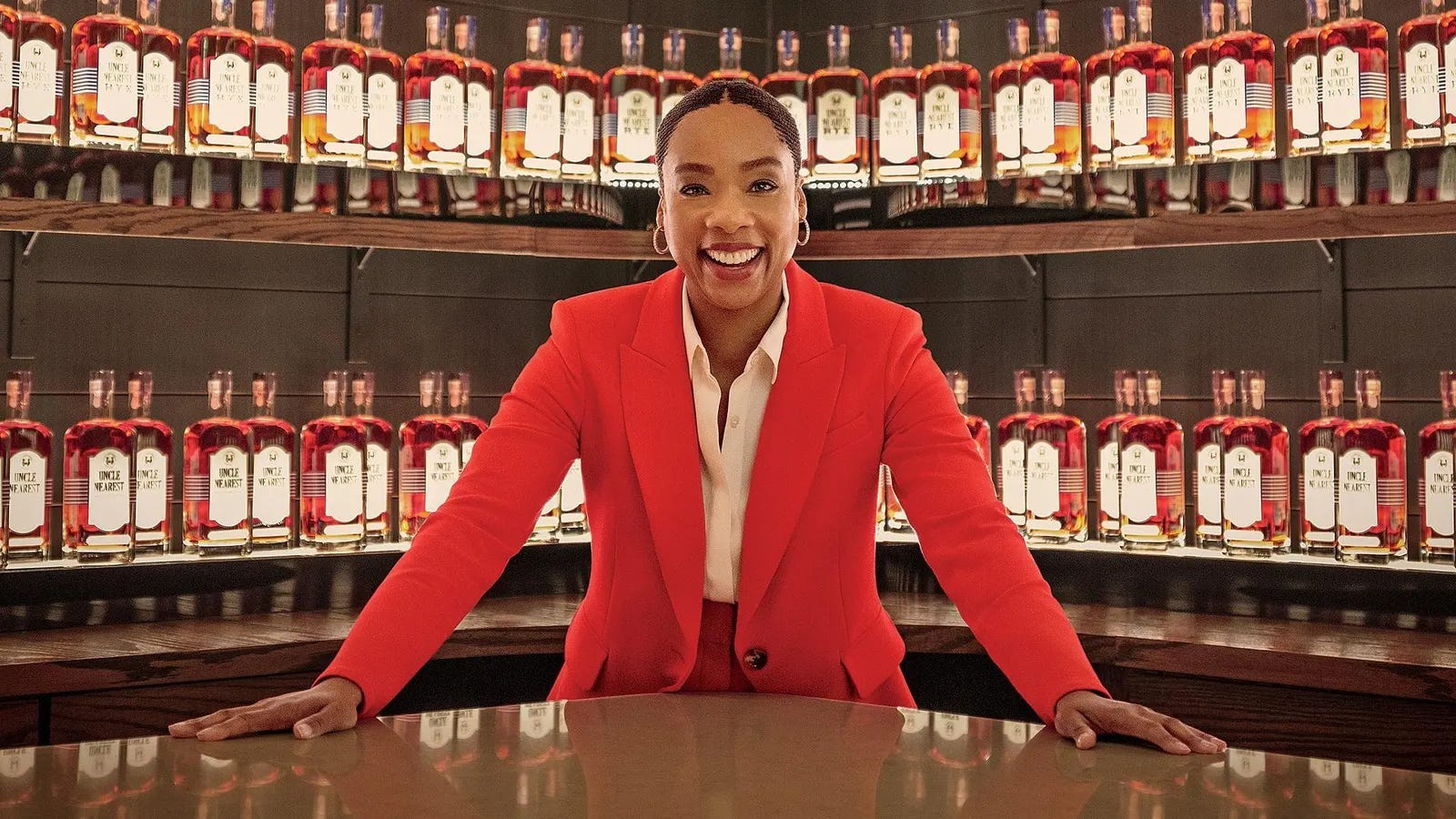
2016: Fawn Weaver, a California entrepreneur with no spirits background, reads a New York Times article about Nathan “Nearest” Green — the first known African American master distiller, the man who taught Jack Daniel how to make whiskey, whose name never appeared on a bottle.
2017: Uncle Nearest launches. Within a year, Weaver is selling in all 50 states.
2019: A 300-acre distillery opens in Shelbyville, Tennessee the first in the country named after a Black distiller.
2022: Uncle Nearest reports over $100M in whiskey sales. The distillery becomes the seventh most visited in the world with 200,000+ annual visitors.
2023: Forbes estimates the valuation at $1.1 billion. Weaver appears on Shark Tank, NPR, CNBC. She declares publicly: “I want it to be a $50 billion company.”
November 2023: Weaver had raised $225 million in individual support. The business was backed by 163 individual investors, providing an average check of $500,000 a person.
August 2025: Uncle Nearest was placed into court-ordered receivership after a lawsuit from lender Farm Credit Mid-America alleging the company defaulted on roughly $108 million in loans and lines of credit. A federal judge appointed a receiver to oversee the company and manage its assets.
February 2026: The court-appointed receiver files a report describing the company as being in “financial shambles.” He reported that financial records prior to 2024 were deleted or unavailable. He stated there had never been an independent audit. He told the court he could not assemble a reliable list of investors, how much they invested, or when those investments were made. He reported the company had been losing approximately $1 million per month. He also stated Uncle Nearest had not filed federal tax returns since 2018 and was struggling with payroll and vendor obligations. Young estimated the company’s value at roughly $100 million a number that stands in sharp contrast to the $1.1 billion valuation publicly shared in 2023.
No tax returns since 2018. No independent audit. Ever. Pre-2024 financial records: deleted.
Actual value: $100M on $158M in debt. Let me tell you how a $1.1 billion brand becomes insolvent.
And more importantly what you can do right now to make sure you’re not building the same trap.
The Origin Story
Before we do the post-mortem, you have to understand what was built. Because this isn’t a story about a fraud. It’s a story about a founder who fell in love with the vision and stopped counting.
Fawn Weaver stumbled upon a little-known story about Nathan “Nearest” Green, the first known African American master distiller and the man who taught Jack Daniel how to make whiskey. What started as a spark of curiosity turned into Uncle Nearest Premium Whiskey, a billion-dollar brand rewriting the rules of heritage, ownership, and excellence in the whiskey world.
This is a genuinely extraordinary founding story.
Nathan “Nearest” Green was born circa 1820. He taught Jack Daniel a young white man how to distill whiskey using the Lincoln County Process. For 150 years, his name appeared on nothing. No bottle. No plaque. No credit.
Fawn Weaver read about him on a flight to Singapore in 2016, flew to Tennessee to meet his descendants, and within months decided to build a brand bearing his name.
The mission was real. The execution in the early years was exceptional: By 2022, Uncle Nearest had been awarded more than 450 medals, including top honours at international competitions. It became the most-awarded American whiskey brand three years in a row.
Products are now featured in over 30,000 stores, bars, hotels, and restaurants in 12 countries. In 2023, the Uncle Nearest US distillery was the seventh-most visited in the world with over 200,000 visitors.
The product was exceptional. The story was exceptional. The execution in market was exceptional. But somewhere between the 200,000 visitors and the $1.1 billion valuation headline, the financial architecture collapsed.
And by the time anyone knew how bad it was, the records had been deleted.
The Seven Specific Failures (And What Each One Teaches You)
Failure #1: No Independent Audit. Ever. In Nine Years.
There had never been an independent audit. This sentence should terrify every founder reading this. An independent audit isn’t bureaucracy. It’s the mechanism that makes everything else work.
Without an audit:
Investors don’t know what they actually own
Lenders don’t know what they’ve actually secured
The founder doesn’t know what the business is actually worth
The company can’t identify problems until they’re catastrophic
With an independent audit (annually):
Real numbers are verified by a neutral third party
Discrepancies are caught when they’re fixable, not when they’re fatal
Any inflated valuation claims get reality-checked before they become public commitments
When you go to raise capital or take on debt, you have credible documentation
When a single executive controls all reporting, the board’s fiduciary function is effectively neutralised, resulting in a loss of operational autonomy and exposure to receivership. Liability exposure for founders and boards escalates when financial records are compromised or erased.
The Uncle Nearest receiver couldn’t even assemble a reliable list of investors, the amounts they invested, and when. Think about that. $225 million raised from 163 investors and nobody could reconstruct the cap table.
Failure #2: No Federal Tax Returns Since 2018
Uncle Nearest had not filed its federal tax returns since 2018 and was struggling with payroll and vendor obligations. The company raised $225 million from investors. It borrowed $108 million from a lender. It appeared on CNBC, NPR, and Shark Tank. And nobody filed a tax return for seven years.
This is the most fundamental compliance obligation any business has and it was ignored for the entire growth phase of the company.
What does this mean in practice?
For investors: Their investment was in a company with seven years of unknown tax liability, penalties, and potential criminal exposure. Nobody told them.
For lenders: The $108M loan was secured by a company whose actual financial position was unknowable because basic fiscal records didn’t exist.
For the company: Seven years of unfiled returns means seven years of compounding penalties, interest, and potential IRS criminal referral for wilful non-compliance.
Systemic failures in financial oversight have turned Uncle Nearest from a high-growth spirits brand into a cautionary tale of governance collapse.
Failure #3: The Valuation Was A Story, Not A Number
Young estimated the company’s value at roughly $100 million. That number stands in sharp contrast to the $1.1 billion valuation publicly shared in 2023. If total liabilities sit near $158 million, that signals insolvency.
$1.1 billion claimed. $100 million actual. $158 million in debt. The company was insolvent before anyone publicly knew.
When you claim $1.1 billion in value:
Investors invest at that implied valuation (paying too much)
Lenders extend credit secured against that valuation (over-secured)
The company starts making decisions as if it has $1.1 billion in backing (overspending)
Overstated its revenues by nearly $30 million in 2024. This is the financial equivalent of building a house on ground that doesn’t exist.
Farm Credit maintains that Uncle Nearest’s collateral, like its barrels of whiskey, were inflated. The barrels of whiskey pledged as collateral the physical assets securing $108M in loans were reportedly inflated in value. The lender claimed the whiskey producer provided “apparently inaccurate” barrel inventory reports that overstated values by $21 million.
Failure #4: Debt as a Growth Fuel Without Debt Discipline
The lawsuit claims the whiskey company violated loan terms and failed to maintain required financial conditions while carrying more than $100 million in liabilities. Before the receivership, the company was losing approximately $1 million per month and could not cover its $450,000 monthly payroll without borrowing from its payroll processing company, with those advances repaid by Farm Credit.
The company was borrowing money from a payroll processing company to make payroll and then repaying that with money from their primary lender.
They were robbing Peter to pay Paul at billion-dollar scale. Debt in consumer businesses is a tool, not a strategy.
Debt works when:
You borrow to purchase income-producing assets (inventory that sells, equipment that produces)
You have clear visibility on cash flow to service the debt
The interest rate is below your return on that capital
Debt doesn’t work when:
You borrow to fund operating losses
You have no audit to verify your actual position
You pledge assets as collateral that you’re simultaneously selling to pay other bills
The lender claimed the whiskey producer sold whiskey barrels to pay other obligations barrels that had been pledged as collateral for the loan.
Before taking on any significant debt:
Know your exact monthly cash burn (audited, not estimated)
Know your exact monthly revenue (audited, not estimated)
Model the debt service against both scenarios (base case and 30% revenue decline)
Never borrow against assets you might need to sell to survive
Maintain the minimum cash balance required by your loan covenants — this is not optional, it’s a legal obligation
The moment you’re borrowing from one source to service another, you have a liquidity crisis. Stop. Fix it. Do not raise more capital until you understand why the hole exists.
Failure #5: Diversifying Away from the Core Before the Core Was Secure
Here is the list of assets the court-appointed receiver identified for sale: Uncle Nearest Inc. is preparing to sell off non-core assets, including French vineyards, a Cognac château, and other real estate.
French vineyards. A Cognac château. A Martha’s Vineyard property. Real estate holdings. A whiskey company from Shelbyville, Tennessee, was buying French wine estates.
The company also recently purchased the largest Grand Champagne vineyard in Cognac, France, and Square One Organic Spirits, a boutique organic spirits company. The largest Grand Champagne vineyard in Cognac, France.
While the core business was losing $1M per month and hadn’t filed a tax return since 2018. This is the most seductive trap in consumer brand building: the temptation to build an empire before you’ve secured a throne.
The pattern is almost universal in founder-led companies that collapse:
Core business shows early momentum
Founder raises capital on the back of that momentum
Capital used to build adjacent businesses, prestige assets, trophy acquisitions
Core business cash flow insufficient to service the debt
Everything collapses simultaneously
The Martha’s Vineyard property: Farm Credit Mid-America accused the Weavers of missing loan payments and misusing loan proceeds, alleging that the duo diverted funds to acquire a $2.25 million property on Martha’s Vineyard.
Young filed a motion alleging that one of the Weavers’ businesses was used in an attempt to hide assets from creditor Farm Credit, including $20 million in loans that Fawn Weaver allegedly signed for.
The Weavers dispute these allegations. Fawn Weaver has maintained that the Martha’s Vineyard property was legitimate and that she was the victim of a smear campaign. But the broader structural point stands regardless of who’s right about individual transactions: a company that was losing $1M per month and couldn’t service its debt had no business making any acquisition of any kind.
The rule I’d apply: Don’t acquire anything that isn’t directly generating revenue for your core product until:
Your core product is cash flow positive (not just revenue positive)
Your debt is manageable against a worst-case revenue scenario
You have 12+ months of operating runway in cash
You have a completed, independent audit that confirms the above
The prestige assets can wait. The core business cannot.
Casamigos sold for $1 billion. The brand is tequila. Just tequila. No cognac. No vineyard. No real estate portfolio. Just an exceptional tequila, beautifully branded, at scale.
Depth in one thing beats width across many things every time.
Failure #6: 500 Money Transfers, No Oversight
Young stated that records of close to 500 money transfers between Uncle Nearest and various company accounts reveal a serious mix of funds, and that all of them were being run as a single business. 500 money transfers. No oversight. No audit trail.
When you have 500 money transfers between company accounts with no independent verification, what you have is not a business. You have a series of IOUs between entities that nobody fully controls.
When a single executive controls all reporting, the board’s fiduciary function is effectively neutralised. In cases of severe financial mismanagement or lender disputes, courts can appoint a receiver who assumes full operational authority. This is the governance failure at the heart of everything.
Fawn Weaver deliberately chose individual investors over VC and PE precisely because she wanted to maintain control: “I’m gonna find enough individuals of high net worth who are accredited investors who are willing to back my vision, who are willing to believe in me, but will stay out of my way.”
She said this like it was a strength. And in many ways, founder control IS a strength. Julian Hearn at Huel. Nima Jalali at Salt & Stone. Patrick Schwarzenegger’s companies. All maintained majority control and built extraordinary value.
But there’s a critical difference between founder control and zero accountability. What Weaver built:
40% equity, 80% voting rights for herself
Individual investors (no institutional oversight)
No independent board with genuine authority
No CFO with actual power (the CFO she now blames didn’t apparently have audit authority)
No independent audit
$225 million raised, no cap table anyone can reconstruct
The paradox of unchecked control: When you’re the only one who can verify the numbers, you’re also the only one who can distort the numbers whether intentionally or not.
Investors and lenders who have no oversight mechanism have no choice but to rely entirely on the founder’s representation. When those representations turn out to be wrong, the damage is total.
Build the governance even when you don’t think you need it:
Independent board members with real authority (not just cheerleaders)
Separation of the CFO role from the founder’s personal influence
Annual external audit reported directly to the board, not through the CEO
Clear approval processes for any transaction above a threshold (e.g. any acquisition, any property purchase, any transfer between related entities above £50K)
A written financial policy that limits what can be spent without board approval
A lesson for every founder: Financial discipline is not the enemy of mission. It is the infrastructure that allows mission to survive.
The brands that will carry this legacy forward whether Uncle Nearest in restructured form or whatever comes next will need to be built on real numbers, real audits, real tax compliance, and real governance.
Not because that’s what the establishment demands. Because that’s what financial survival requires.
What to Have In Place Before You Take On Significant Capital
Based on everything that went wrong at Uncle Nearest, here is the minimum infrastructure every founder needs before raising serious money or taking on significant debt:
Financial Infrastructure (Non-Negotiable)
Annual independent audit by an external firm (not the founder’s choice of accountant)
Tax returns filed for every year of business operation
Monthly management accounts produced by the 15th of the following month
Audited P&L, balance sheet, and cash flow statement every quarter
Clear, documented cap table with all investor names, investment amounts, dates, and share classes
Separation between company bank accounts and any personal or related-party entities
Governance Infrastructure (Non-Negotiable)
Independent board members with genuine fiduciary authority (not just advisory)
CFO who reports to the board, not just the CEO
Written financial policy specifying what requires board approval (all acquisitions, all loans, all related-party transactions above threshold)
No commingling of funds between related entities without documented intercompany agreements
Documented approval trail for all significant expenditure
Debt Discipline (Before You Borrow)
Know your exact monthly burn rate (audited)
Model debt service against a 30% revenue decline scenario
Never pledge the same asset twice
Maintain covenant-required minimum cash balances — these are legal obligations
Read every loan agreement yourself before signing. Understand every covenant.
Valuation Discipline (Before You Publish)
Valuation claims should be based on audited revenue, actual EBITDA, and comparable transactions
Do not make public valuation claims that aren’t verified by independent analysis
Your investors should know the actual value, not the aspirational one
If someone tells you the company is worth $1.1B and you know the company has never been audited that’s not a valuation. It’s a wish.
Uncle Nearest built something genuinely historic.
Fawn Weaver put her own money into the venture. She and her husband, Keith, acquired a 300-acre property in Shelbyville, Tennessee, where they built the Nearest Green Distillery the first in the country named after a Black distiller. In just a few short years, Uncle Nearest became the fastest-growing independent American whiskey brand in US history.
That is a remarkable achievement. Full stop.
And now it’s in receivership. Potentially headed for liquidation. With 163 investors unable to reconstruct their own cap table. With no tax returns for seven years. With pre-2024 financial records deleted. The mission survived the market. It didn’t survive the financial architecture.
And that’s the lesson: No product is so good, no story is so compelling, no mission is so righteous that it survives without the boring, unglamorous infrastructure of financial discipline.
The brands that outlast their founders that carry legacies forward for generations aren’t just the ones with the best stories.
They’re the ones that filed their taxes. That got audited. That knew their actual numbers. That built governance structures that could withstand scrutiny. The story of Nearest Green deserves a company that lasts 100 years.
That company needs real numbers.
Are you building a brand or building a business? The difference is whether the numbers can survive daylight.
Keep building,
P.S. The most heartbreaking detail in the entire Uncle Nearest story isn’t the $108M default or the deleted records. It’s this: Since she and her husband have no children, Weaver plans to eventually bequeath the business to Nearest Green’s descendants. “I’m going to build it large as hell. When I pass it on, I don’t want it to be a $10 billion company. I want it to be a $50 billion company,” Weaver told Forbes. “I am never going to profit on Uncle Nearest. I’ve known it from day one. I’m raising up their family.” The intent was genuine. The mission was real. The descendants of Nearest Green deserved a thriving company. Financial discipline isn’t just about protecting yourself. It’s about protecting the people and the mission your company exists to serve. Get your numbers right. For them.
P.P.S. The receiver’s report contained this detail that should terrify every founder who’s ever raised from individual investors: He told the court he could not assemble a reliable list of investors, how much they invested, or when those investments were made. $225M raised. 163 investors. No reconstructible cap table. If you’ve taken a single pound from a single investor and you can’t tell me in 60 seconds exactly how much they invested, what their ownership percentage is, what share class they hold, and what that’s worth at a range of exit scenarios, stop everything and fix that right now. Your investors trusted you with their capital. The least you owe them is knowing they exist.
This was such a great article! So well written and informative. While we were researching talking about Fawn Weaver on our podcast, your article popped up.
It was fair and diplomatic, and very well thought out.
Thank you!
👏👏