


So after four years of “consumer is dead” think pieces and founders pivoting to B2B SaaS to get funded, something quietly shifted in Q1 2026.
$16 billion in fresh consumer VC commitments are deploying right now.
Six major consumer funds closed in the last 90 days (vs. zero in Q1 2025).
$3B+ in consumer M&A closed in January-February alone—including Poppi ($1.95B to PepsiCo), Dr. Squatch (~$1.5B to Unilever), Siete Foods (~$1.2B to PepsiCo), and Rhode ($1B to e.l.f. Beauty).
For context: In Q1 2025, consumer VC deployed only $800M—a six-year low. Deal activity was dead. Major funds weren’t raising. The entire category was written off.
One year later, deployment is up 20x.
But here’s what everyone’s missing: This isn’t 2021 coming back. The rules have completely changed.
The platform VCs (Forerunner, VMG, L Catterton) raised $14B+ in the last 15 months and they’re not deploying into DTC brands burning $10M/year on Facebook ads hoping to sell for 20x revenue.
They’re deploying into:
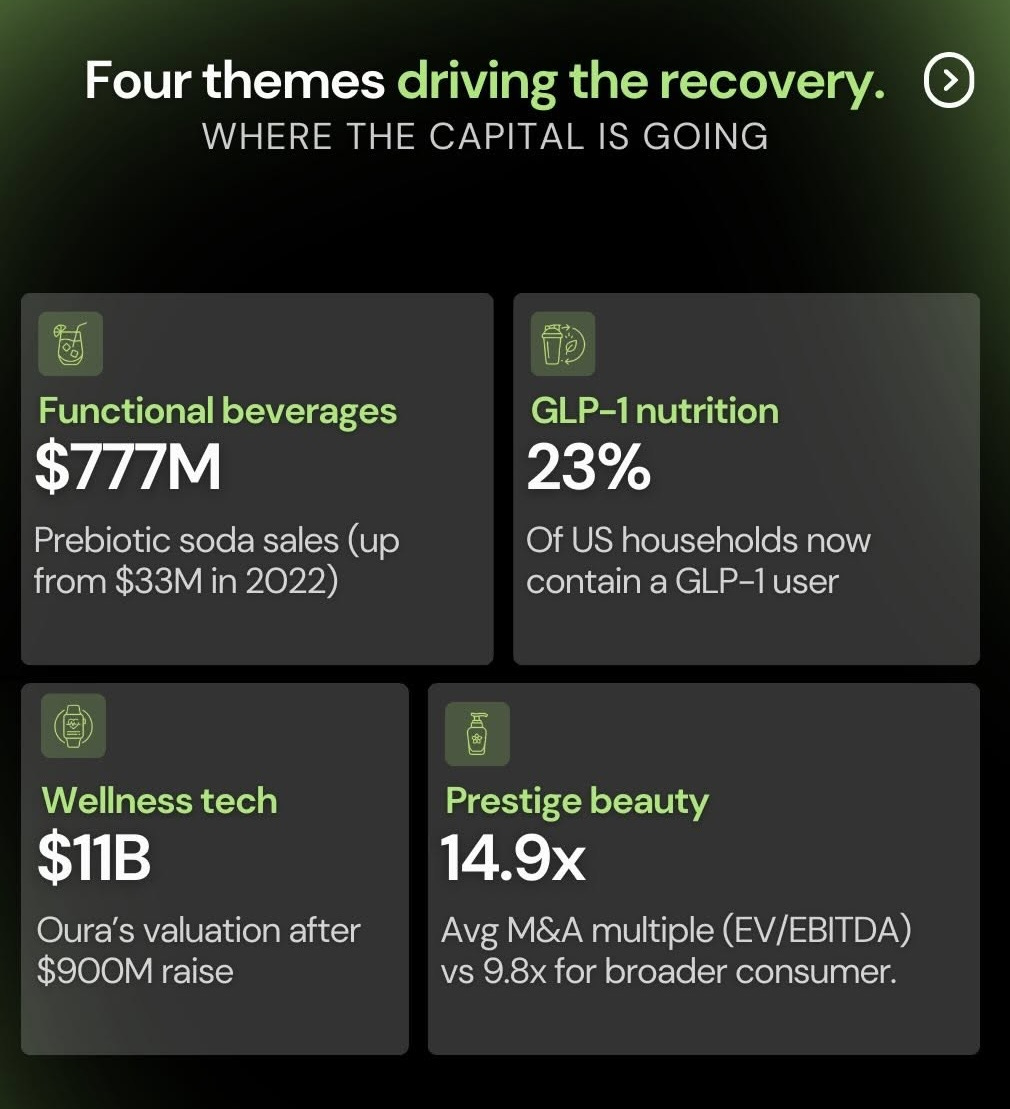
GLP-1 nutrition brands (23% of US households now have a GLP-1 user)
Functional beverages with actual retail traction (prebiotic sodas up from $33M to $777M in 3 years)
Prestige beauty at 14.9x EBITDA multiples (vs. 9.8x for mass consumer)
Wellness tech that’s capital-efficient from day one
Consumer VC is back. But it’s a completely different game.
Let me show you what actually changed, who’s winning in the new era, and why the next 12 months will determine if this is a real recovery or another false start.
The Numbers That Show This Isn’t a Mirage
Let’s start with the data that proves something fundamental shifted:
Q1 2025 vs. Q1 2026 (One Year Apart):
Q1 2025 (The Bottom):
VC deployed: $800M (6-year low)
Total deals: 111
Major consumer fund closes: 0
Macro context: “Tariff shock, deep uncertainty in CPG”
Q1 2026 (The Recovery):
Fresh commitments deploying: $16B
M&A (Jan-Feb alone): $3B+
Major funds closed (last 90 days): 6 of 10 largest consumer funds
GP sentiment: “Cautiously offensive” (no longer defensive)
For perspective: $16B in fresh commitments is:
2.4x the total US consumer VC deployed in all of 2024 ($6.8B)
20x Q1 2025 deployment ($800M)
Close to 2021 levels (but structured completely differently)
This isn’t a small uptick. This is a category coming back from the dead.
The Six Fund Closes That Changed Everything
Between November 2024 and March 2026, six major consumer-focused funds closed with a combined ~$16B in commitments.
Here’s the breakdown:
1. L Catterton (May 2025): ~$11B
Largest consumer-focused PE firm globally
Strategy: Large-scale buyouts + growth equity
Status: Largest consumer fund close in history
Why this matters:
L Catterton isn’t a seed fund betting on DTC startups. They’re writing $100M-500M checks into profitable, scaled brands.
Recent L Catterton investments:
Birkenstock (took public, $8B valuation)
Glossier (growth equity round)
Savage X Fenty (Rihanna’s lingerie brand)
When the world’s largest consumer PE fund raises $11B, it’s a signal: Institutional capital believes in consumer again.
2. VMG Partners Consumer VI (May 2025): $1.0B
At hard cap (fully subscribed)
Focus: Growth-stage consumer brands ($50-200M revenue)
Strategy: Operational value-add, not just capital
VMG’s track record:
Olipop (prebiotic soda, now $500M+ revenue)
Graza (olive oil, premium positioning)
Liquid Death (acquired by Keurig Dr Pepper for $1.4B, 2024)
VMG raised at hard cap = LPs are oversubscribing because returns have been strong.
3. Forerunner Ventures VII (May 2025): $1.0B
At hard cap (oversubscribed)
Focus: Early-stage consumer brands + platforms
Led by Kirsten Green (legendary consumer investor)
Forerunner’s portfolio:
Glossier (early investor)
Chime (fintech, but consumer-facing)
Faire (wholesale marketplace)
Forerunner’s thesis: Consumer brands that own distribution or have platform economics (not just DTC brands hoping for acquisition).
4. Prelude Growth Partners III (Aug 2025): $600M
2.4x larger than prior fund (Fund II was $250M)
Focus: Growth-stage beauty, wellness, food
Why fund size matters:
When a fund raises 2.4x more than its previous fund, it means:
Fund II returns were exceptional (LPs reinvesting)
Fund III can write bigger checks (moving upmarket)
Investor confidence is back
5. Bansk Group Fund II (Dec 2025): $1.45B
45% above $1B target
Focus: Consumer brands, healthcare, financial services
Strategy: Operational transformation, not passive capital
Raising 45% above target = LPs fighting to get allocation.
6. Encore Consumer Capital V (Jan 2026): $350M
Oversubscribed
Focus: Emerging consumer brands, sustainability-focused
Plus additional closes (Jan-Mar 2026):
CAVU Consumer Partners V: $325M (18% above target)
SEMCAP Food & Nutrition: $125M
Coefficient Capital + Apex: $530M
Cutting Horse Fund: $75M
Combined total: ~$16B in the last 15 months.
For context: In 2022-2024 (3 years), consumer funds raised ~$8B total.
In the last 15 months, they raised 2x that amount.
The capital drought is over.
What Actually Changed: The Four Investment Themes Driving Deployment
Consumer VC isn’t back because investors suddenly forgot about 2022-2024 losses.
It’s back because four specific categories are working—and the data proves it:
Theme 1: Functional Beverages ($777M in Prebiotic Soda Alone)
The data:
2022 prebiotic soda sales: $33M
2025 prebiotic soda sales: $777M
Growth: 23.5x in 3 years
Category leaders:
Poppi: Acquired by PepsiCo for $1.95B (Jan 2026)
Olipop: ~$500M revenue, growing 100%+ annually
Culture Pop: Emerging player, VMG-backed
Why this category works:
Consumer demand:
Functional benefits (gut health, digestion)
Better-for-you (low sugar, natural ingredients)
Tastes good (not medicinal like Kombucha)
Unit economics:
Gross margins: 55-65% (strong for beverage)
Repeat rate: 40-50% (high for soda category)
CAC: $15-25 (social + retail sampling)
LTV: $120-180 (6-12 month retention)
LTV/CAC: 5-9x (venture-backable)
Investor returns:
CAVU invested in Poppi early (estimated $5M at $50M valuation)
Exit: $1.95B to PepsiCo
Return: ~88x in ~4 years
This is why VCs are back in beverages. When one fund returns 88x, every fund wants the next Poppi.
Theme 2: GLP-1 Nutrition (23% of US Households)
The data:
15M+ Americans on GLP-1 drugs (Ozempic, Wegovy, Mounjaro, Zepbound)
23% of US households contain a GLP-1 user
Market size: GLP-1 users need 1,800-2,200 calories/day vs. 2,000-2,500 for non-users
Opportunity: High-protein, nutrient-dense foods for smaller appetites
What’s getting funded:
Nutrition brands solving for:
High protein per calorie (20g+ protein in 200-300 calories)
Nutrient density (vitamins, minerals in small portions)
Easy digestion (GLP-1 users have slower gastric emptying)
Portion control (single-serve, 200-400 calorie meals)
Examples:
Ample: Meal replacement shakes, high-protein
Magic Spoon: High-protein cereal (20g protein per serving)
Huel: Complete nutrition, 400 calories per serving
Why VCs care:
Addressable market:
15M GLP-1 users today
Projected 30M by 2028
Average spend: $200-300/month on specialized food
TAM: $6-9B annually
Unit economics:
High AOV ($50-80 per order, subscription-based)
High retention (medical need, not discretionary)
LTV: $1,200-1,800 (12-18 month average subscription)
This is a structural tailwind. As long as GLP-1 adoption grows, these brands grow.
Theme 3: Wellness Tech ($11B Valuations, Capital-Efficient)
The standout: Oura Ring
Oura’s metrics:
Revenue: ~$500M (2024, estimated)
Recent raise: $900M at $11B post-money valuation (2025)
Multiple: 22x revenue
Why Oura commands premium valuation:
1. Hardware + software moat:
Ring hardware: $299-399 (one-time purchase)
Membership: $5.99/month (recurring revenue)
Blended model: Hardware at cost, profit from subscription
2. Retention economics:
Membership retention: 80%+ annually
Once you buy the ring, you keep subscribing
3. Data moat:
Millions of users contributing sleep/health data
Proprietary algorithms improving with scale
Network effects in health tracking
Comparison to traditional consumer:
Traditional DTC brand:
Hardware-only (one-time purchase)
No recurring revenue
Valuation: 2-4x revenue
Oura:
Hardware + subscription
Recurring revenue = 60%+ of total
Valuation: 22x revenue
VCs want consumer businesses with SaaS economics. Oura proved it’s possible.
Theme 4: Prestige Beauty (14.9x EBITDA vs. 9.8x Mass Consumer)
The data:
Prestige beauty M&A multiple: 14.9x EBITDA (average)
Broader consumer M&A multiple: 9.8x EBITDA
Premium: 52% higher multiples for prestige beauty
Recent prestige beauty exits:
Rhode (Hailey Bieber):
Acquired by e.l.f. Beauty for ~$1B (Jan 2026)
Revenue: ~$200M (16 months)
Multiple: ~5x revenue, ~15x EBITDA
Dr. Squatch:
Acquired by Unilever for ~$1.5B (Feb 2026)
Revenue: ~$300M
Multiple: ~5x revenue
Why prestige beauty commands premium:
1. Higher gross margins:
Mass beauty: 50-60% gross margin
Prestige beauty: 70-80% gross margin
More profit per dollar of revenue
2. Brand equity:
Prestige brands have pricing power
Can raise prices 5-10% annually without losing customers
Inflation-resistant
3. Lower CAC:
Prestige beauty sells through Sephora, Ulta (retailer drives traffic)
Mass beauty relies on paid digital marketing
Prestige CAC: $20-40, Mass CAC: $50-80
4. Strategic value:
CPG giants (Unilever, P&G, Estée Lauder) need prestige brands to reach Gen Z
Willing to pay premium multiples for cultural relevance
Strategic buyers > financial buyers
VC takeaway: Prestige beauty exits at 15x EBITDA. Software exits at 8-12x EBITDA. Prestige beauty is more valuable than SaaS right now.
The New Rules: What’s Different From 2021
Consumer VC is back, but the playbook has completely changed.
Here’s what worked in 2021 vs. what works now:
Rule 1: Fewer Deals, Higher Conviction
2021 playbook:
Spray and pray (invest in 30-50 companies per fund)
Seed checks: $500K-1M
Hope 1-2 become unicorns
Portfolio construction: quantity over quality
2026 playbook:
Concentrated bets (invest in 15-20 companies per fund)
Seed checks: $1-3M
Expect $1-3M revenue before Series A
Timelines stretched: 3 years to Series A (vs. 18 months in 2021)
Why this matters:
In 2021: Founders could raise on pitch deck + prototype
In 2026: Founders need $1-3M revenue + retail traction + proof of retention
Capital efficiency is the new growth-at-all-costs.
What VCs are saying (from uploaded data):
“Seed investors now expect $1-3M revenue and retail traction; timelines to Series A have stretched to 3 years. Capital efficiency is key.”
Translation: If you’re raising seed in 2026, you better have 12-18 months of revenue data showing:
Product-market fit (repeat rate 40%+)
Unit economics work (LTV/CAC 3x+)
Path to profitability (not just growth)
2021 was about potential. 2026 is about proof.
Rule 2: Specialists Over Generalists
2021: Platform VCs (Forerunner, First Round, a16z) dominated consumer
2026: Specialist funds with category expertise are winning
The shift (from uploaded data):
“Platform VCs have moved on to AI. Active consumer investors now are specialist funds with focused strategies.”
What this means:
Generalist VC (2021):
Invested across consumer categories
Value-add: Brand building, DTC growth, fundraising intros
Thesis: Consumer brands are all similar
Specialist VC (2026):
Deep expertise in ONE category (beauty, beverage, food, wellness)
Value-add: Retailer intros, supply chain optimization, M&A positioning
Thesis: Every category has different unit economics and requires different playbooks
Examples of specialist funds:
Beauty-focused:
Prelude Growth (beauty + wellness only)
VMG Partners (CPG + beauty)
Beverage-focused:
CAVU (food + beverage, Poppi investor)
Wellness-focused:
Coefficient Capital + Apex ($530M, wellness tech)
Why specialists win:
Retailers trust them:
When VMG backs a beverage brand, Whole Foods pays attention
When Prelude backs a beauty brand, Sephora takes meetings
Specialist backing = retail credibility
They know unit economics:
Beauty: 70% GM, 15% marketing, 20% EBITDA target
Beverage: 60% GM, 20% marketing, 15% EBITDA target
Can spot bad deals faster
They have exit relationships:
Prelude knows who at Unilever buys beauty brands
CAVU knows who at PepsiCo buys beverage brands
Exit optionality built into investment thesis
If you’re raising consumer VC in 2026, target specialists first, generalists second.
Rule 3: $16B Is Deploying, But It’s Not Deployed Yet
The critical caveat (from uploaded data):
“~$16B is deploying right now. The next 12 months will test if this is a real recovery. Consumer VC remains small (3-6% of total VC), but specialists are showing strong signals.”
What this means:
$16B in fresh commitments ≠ $16B already invested.
Fresh commitments = LPs committed capital to funds, but funds haven’t deployed yet
Typical deployment timeline:
Year 1: 20-30% deployed
Year 2: 30-40% deployed
Year 3: 20-30% deployed
Year 4-5: Final 10-20% deployed
So of the $16B committed:
2026: $3-5B will actually deploy into companies
2027-2028: $8-10B deploys
2029-2030: Final $2-3B deploys
The test:
If brands funded in 2026 succeed (reach profitability, strong unit economics, exits at good multiples):
LPs will commit more capital to consumer VCs in 2027-2028
Virtuous cycle begins
If brands funded in 2026 struggle (burn cash, can’t reach profitability, no exits):
LPs will pull back again
We’re back to 2022-2024 drought
The next 12 months determine if this recovery is real or a false start.
The M&A That’s Validating the Model
Here’s why VCs are confident: $10B+ in consumer brand exits since Jan 2024 are proving the model works.
Major exits (Jan 2024 - Mar 2026):
$1.95B: Poppi → PepsiCo
Revenue: ~$400M
Multiple: ~4.9x revenue
CAVU return: ~88x (estimated)
~$1.5B: Dr. Squatch → Unilever
Revenue: ~$300M
Multiple: ~5x revenue
Category: Men’s personal care
~$1.2B: Siete Foods → PepsiCo
Revenue: ~$300M
Multiple: ~4x revenue
Category: Better-for-you Mexican food
~$1B: Rhode → e.l.f. Beauty
Revenue: ~$200M (16 months post-launch)
Multiple: ~5x revenue
Return for investors: TBD, but likely 10-20x
$880M: Touchland → Church & Dwight
Revenue: ~$100M
Multiple: ~8.8x revenue
Category: Premium hand sanitizer
$795M: Simple Mills → Flowers Foods
Revenue: ~$200M
Multiple: ~4x revenue
Category: Better-for-you snacking
Plus: LesserEvil (~$750M to Hershey), Bachan’s ($400M), TRUBAR ($173M), Four Roses ($775M)
Total consumer M&A (2024-2026): $10B+
Why this matters:
For every Poppi exit at 88x return:
That fund can return 3-5x to LPs on one deal alone
LPs reinvest in next fund
For every Rhode exit at 5x revenue in 16 months:
Proves celebrity + operator partnerships work
More VCs back celebrity brands
For every Dr. Squatch / Siete / Simple Mills exit:
Validates better-for-you positioning
More capital flows to similar brands
M&A exits create VC returns. VC returns attract LP capital. LP capital creates more M&A.
The flywheel is spinning again.
What This Means for Founders Building in 2026
If you’re building a consumer brand right now, here’s how to think about the current environment:
For Pre-Seed / Seed Founders:
Good news:
$16B in fresh capital means more shots on goal
Specialist funds understand your category better than generalists did
Capital is available if you have traction
Bad news:
Bar to raise is higher (need $1-3M revenue for Series A, not $500K)
Timeline stretched (3 years to Series A vs. 18 months in 2021)
You need to be profitable or near-profitable to raise growth rounds
What to optimize for:
1. Capital efficiency from day one:
Bootstrap to $1M revenue if possible
Raise small seed ($1-2M) to get to $3M revenue
Don’t raise big rounds until unit economics are bulletproof
2. Retail traction early:
VCs want proof you can get into Whole Foods, Target, Sephora
DTC-only brands are much harder to fund
Get into 100-500 doors before raising Series A
3. Category selection:
Functional beverages, GLP-1 nutrition, prestige beauty, wellness tech = hot
Traditional CPG, mass beauty, commoditized categories = cold
Pick categories where VCs are actively deploying
For Series A+ Founders:
Good news:
$1B+ funds (VMG, Forerunner, Prelude) are writing $10-30M checks
M&A multiples are healthy (4-5x revenue for growth brands)
Exit environment is strong
Bad news:
Expectations are higher (need 40%+ growth, 15-20% EBITDA)
Profitability required (can’t burn $10M/year anymore)
If you’re not on path to $100M+ revenue, tough to raise
What to optimize for:
1. Position for strategic acquisition:
Know which corporates buy in your category (Unilever for personal care, PepsiCo for beverages, etc.)
Build relationships early
Start M&A conversations at $50M revenue, not $200M
2. Build for platform, not point solution:
Poppi isn’t “one soda flavor” → it’s prebiotic soda platform
Rhode isn’t “one lip product” → it’s prestige skincare for Gen Z
Platforms exit at higher multiples than single products
3. Profitability > growth:
30% growth at 15% EBITDA > 100% growth at -30% EBITDA
VCs want to see you can scale profitably
Prove path to 20%+ EBITDA margins before Series B
For Later-Stage Founders ($50M+ Revenue):
Good news:
L Catterton has $11B to deploy into brands like yours
M&A buyers are active (Unilever, PepsiCo, Church & Dwight all acquiring)
This is your exit window
Bad news:
If you’re not growing 20%+ and profitable, you won’t exit at premium
IPO market still closed for consumer (only tech IPOs working)
Strategic acquisition is only exit path
What to optimize for:
1. Clean up cap table:
Too many small investors = messy M&A process
Consolidate if possible
Acquirers want clean deals
2. Professionalize operations:
Get real CFO, real finance systems, real audit
Acquirers will do deep diligence
Any accounting issues will crater valuation
3. Build strategic relationships now:
If Unilever might acquire you, start conversations 18 months before you want to sell
Let them get to know business, build trust
Best M&A deals happen through relationships, not auctions
The Final Reality
Consumer VC just had its best quarter since 2021.
$16 billion in fresh capital deploying.
Six major funds closed in 90 days.
$10B+ in M&A exits validating the model.
But this isn’t 2021 coming back:
2021 was:
Platform VCs investing everywhere
DTC brands raising on decks
Growth-at-all-costs
18-month timelines to Series A
Valuations at 20x revenue
2026 is:
Specialist VCs with category expertise
Brands raising on $1-3M revenue + retail traction
Capital efficiency required
3-year timelines to Series A
Valuations at 4-6x revenue (for profitable, growing brands)
The categories that are working:
Functional beverages (Poppi, Olipop)
GLP-1 nutrition (23% of households have GLP-1 user)
Wellness tech with SaaS economics (Oura at $11B valuation)
Prestige beauty (14.9x EBITDA multiples)
The categories that aren’t:
Traditional CPG (commoditized, low margins)
DTC-only brands (no retail path)
Mass beauty (9.8x EBITDA, half of prestige multiples)
The test:
The next 12 months will determine if this is a real recovery or another false start.
If brands funded in 2026:
Reach profitability (not just growth)
Build sustainable unit economics (LTV/CAC 5x+)
Exit at good multiples (4-5x revenue)
Then LPs will commit more capital, and the virtuous cycle continues.
If brands funded in 2026:
Burn cash without path to profitability
Struggle with unit economics
Can’t find exit buyers
Then we’re back to 2022-2024 drought.
Consumer VC is back. But it’s not the same game.
Build for capital efficiency. Build for specialists. Build for exit.
That’s the new playbook.
P.S. The smartest move I’m seeing from founders right now: Bootstrap to $1M revenue, then raise a small seed ($1-2M) to get to $3M revenue with retail traction, then raise Series A ($10-15M) from specialist fund with category expertise and retailer relationships. Total dilution: 25-35% vs. 50-70% in the 2021 playbook. You own more of your company at exit, and you have a specialist investor who can actually help you navigate retail and M&A. That’s how you win in 2026.