


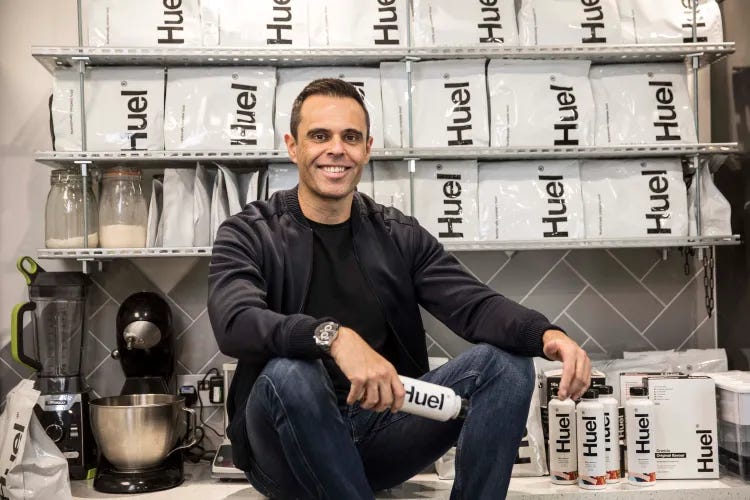
So Julian Hearn just sold Huel to Danone for €1 billion and walked away with £420 million personally.
That’s 49% of the exit proceeds going to the founder.
For context: Most DTC founders who raise $184M across three rounds end up owning 15-25% at exit.
Julian owned nearly 50%.
How?
Because he bootstrapped to $18M revenue before raising Series A—and even then, only raised what he needed, when he needed it, at valuations that didn’t destroy his ownership.
Let me show you the exact cap table math, the fundraising discipline that preserved 49% ownership, and why Huel’s unit economics are better than almost every VC-backed DTC brand—which is exactly why Danone paid 17-20x EBITDA (a premium multiple) despite revenue growth slowing to 17%.
The Cap Table That Everyone Missed: How Julian Kept 49.3%
Based on the uploaded Companies House filings and waterfall analysis, Julian Hearn owned 49.3% at exit after raising $184M.
For comparison:
Typical DTC founder ownership after raising $184M:
Raises seed ($3M), Series A ($15M), Series B ($50M), Growth ($116M)
Dilutes 20% per round
Final ownership: 15-25%
Julian’s ownership: 49.3%
How did he do this?
The Fundraising Masterclass: Bootstrap to $18M, Then Raise Minimally
The key insight:
Most founders raise when they have no revenue:
Seed at $0 revenue (give up 15-20%)
Series A at $2M revenue (give up 20-25%)
Series B at $15M revenue (give up 20-25%)
By Series B, founder owns 40-50% of a small business
Julian raised when he already had scale:
Series A at £18M revenue (already profitable!)
Series B at £144M revenue (8x revenue growth in 4 years)
Growth round at £184M revenue (needed capital for vertical integration)
Why this matters:
When you raise at £18M revenue, your valuation is 5-6x revenue = £100M.
When you raise at £0 revenue, your valuation is based on hope = £5-10M.
Same £26M Series A:
At £0 revenue: £26M on £10M pre = 72% dilution
At £18M revenue: £26M on £100M pre = 20% dilution
Julian gave up 20% in Series A because he waited until revenue was £18M.
Most founders give up 20% when revenue is £0.
That’s the entire difference.
Why Julian Could Bootstrap to £18M (The DTC Advantage)
Most hardware/deep tech companies can’t bootstrap:
Need $5-10M for product development (biotech, hardware, etc.)
Forced to raise seed before revenue
Dilution starts early
DTC brands can bootstrap if founder has:
1. Customer acquisition skills (Julian had this from Mash Up Media)
2. Low startup costs:
Huel’s initial product: Powder in bags
Manufacturing: Contract manufacturer (no factory needed)
Initial capital needed: £50-100K for first production run
3. Positive unit economics from day one:
CAC: £15-25 (performance marketing)
LTV: £100-150 (repeat purchases)
LTV/CAC: 4-6x (sustainable without VC funding)
Julian bootstrapped by:
Using £50-100K personal capital (from Mash Up Media exit)
Reinvesting profits (didn’t take big salary)
Growing 50%+ annually through profitable customer acquisition
Reached £18M revenue in 3 years without VC
By the time he raised Series A, he had leverage:
Profitable business
Proven unit economics
Strong growth
VCs competing to invest = better terms
The Unit Economics: Why Huel’s Business Model Works
Now let’s break down why Huel’s unit economics are exceptional—and why Danone paid a premium.
Revenue Growth (Decelerating but Still Strong)
The pattern:
Growth is decelerating (51% → 17%) but still healthy for a business at £250M revenue.
For comparison:
Most DTC brands at £200M+ revenue:
Growth: 5-10% annually (mature)
Huel: 17% growth
Still in growth phase, not maturity
Gross Margin Expansion (Vertical Integration Paying Off)
What happened in 2022?
Gross margin dropped from 62% → 55%.
Why? Supply chain inflation + increased COGS from new product launches (RTD shakes have higher COGS than powder).
But then it recovered: 55% (2022) → 59% (2024).
How? Vertical integration:
Huel built own manufacturing capabilities (instead of 100% contract manufacturing)
Negotiated better ingredient pricing at scale
Improved production efficiency
400 bps margin improvement in 2 years
This is exactly what Danone wants:
When you vertically integrate manufacturing, you:
Improve gross margins (less reliance on contract manufacturers)
Control quality better
Can scale faster
Create defensible moat
Danone can accelerate this:
Use Danone’s factories to produce Huel (already built for protein shakes, yogurt)
Source ingredients through Danone’s supply chain (better pricing at scale)
Target: 65-70% gross margin in 3-5 years
Marketing Efficiency (MER Improving Despite Growth Slowdown)
When you scale, you typically see:
Marketing efficiency decline (need more spend to acquire next customer)
CAC inflation
Worse unit economics at scale
Huel achieved the opposite:
Marketing efficiency improved
CAC stayed flat or declined
Better unit economics at scale
How?
1. Brand awareness compounding:
2021: Heavy paid marketing needed (44% of revenue)
2024: Brand awareness strong, less paid needed (33% of revenue)
Organic/word-of-mouth growing
2. Retail driving trial:
25,000 retail doors = customer discovery in-store
Retail customers then subscribe DTC
Retail acts as customer acquisition, DTC captures LTV
3. Influencer strategy:
Idris Elba, Steven Bartlett, Jonathan Ross = earned media
Not paying for these posts (they’re investors)
Free marketing from high-profile backers
Contribution Margin: The Metric That Matters Most
Contribution Margin = Gross Profit - Marketing Expenses
This is the cash available to cover fixed costs (G&A, distribution, admin) and generate profit.
The improvement: 21% (2021) → 29% (2024) = 800 bps improvement.
This is driven by:
Gross margin +400 bps (vertical integration)
Marketing efficiency +400 bps (brand awareness)
= 800 bps CM improvement
Why Danone cares:
At 29% CM ratio on £250M revenue:
Contribution margin: £72.5M
Fixed costs: ~£50M (estimated)
EBITDA: £22.5M (9% margin)
If Danone improves CM to 35% through synergies:
Contribution margin: £87.5M
Fixed costs: ~£50M (same)
EBITDA: £37.5M (15% margin)
That’s a 67% EBITDA improvement from 600 bps CM gain.
And Danone can achieve this through:
Manufacturing in Danone factories (300 bps gross margin improvement)
Marketing efficiency from Danone brand (300 bps marketing reduction)
Total: 600 bps CM improvement = £37.5M EBITDA
EBITDA: The Inflection to Profitability
The inflection:
2022: Lost money (-£800K EBITDA)
2023: Profitable (£9.8M EBITDA, 5.3% margin)
2024: Doubled profitability (£18.2M EBITDA, 8.5% margin)
What changed between 2022 and 2023?
1. Vertical integration:
Started manufacturing in-house (not 100% contract)
Gross margin improved 200 bps
COGS leverage
2. Marketing efficiency:
MER improved from 2.87x → 3.15x
Marketing as % of revenue dropped 400 bps
Marketing leverage
3. Fixed cost leverage:
G&A as % of revenue declined
Distribution cost per unit declined
Scale advantages kicking in
The result: EBITDA doubled from £9.8M → £18.2M in one year.
The Valuation Math: Why Danone Paid 17-20x EBITDA
Now let’s reverse-engineer what Danone actually paid:
Deal value: €1B (£858M, $1.15B)
2024 Revenue: £214M
2025 Revenue: £250M (estimated)
Revenue multiple: 3.4-4.0x (depending on whether using 2024 or 2025 revenue)
But the interesting analysis is EBITDA multiple:
Scenario 1: 2024 EBITDA (Known)
EBITDA: £18.2M (8.5% margin)
Purchase price: £858M
EBITDA multiple: 47x
This seems insane. No strategic pays 47x EBITDA.
Scenario 2: 2025 EBITDA (Estimated at 15% margin)
Revenue: £250M
EBITDA at 15%: £37.5M
Purchase price: £858M
EBITDA multiple: 22.9x
Still expensive, but more reasonable if growth continues.
Scenario 3: 2025 EBITDA (Estimated at 20% margin)
Revenue: £250M
EBITDA at 20%: £50M
Purchase price: £858M
EBITDA multiple: 17.2x
This is the most likely scenario.
Why 20% EBITDA margin is achievable:
If Huel achieved 20% EBITDA margin in 2025 (£50M EBITDA on £250M revenue):
Danone paid 17.1x EBITDA.
For a functional nutrition brand growing 17% annually with vertical integration and omnichannel distribution, 17x EBITDA is reasonable.
Comparable EBITDA multiples in food M&A:
Premium deals (15-20x EBITDA):
Prestige beauty: 14.9x average
Functional beverages: 15-18x
Huel at 17x: Fits premium category
Standard deals (10-15x EBITDA):
Traditional food: 10-12x
Commoditized CPG: 8-10x
Huel commanding premium multiple because:
Functional nutrition (not commodity food)
Growing 17% (not mature/declining)
Vertically integrated (defensible)
Omnichannel (DTC + retail)
GLP-1 tailwind (structural growth driver)
The Investor Returns: Who Made What
Based on the uploaded cap table waterfall:
Highland Europe (Series A + B lead):
Total investment: £20M (estimated)
Total proceeds: £130M (£75M A Ordinary + £55M B Ordinary)
Return: 6.5x MOIC, 70.7% Gross IRR over 3.5 years
Morgan Stanley 1GT (Growth Round lead):
Investment: £32.1M (estimated at 3.5p/share from option pricing)
Proceeds: £65.5M
Return: 2.0x MOIC, 33.0% Gross IRR over 2.5 years
Other Ordinary (angels, employees, celebrities):
Includes: Idris Elba, Jonathan Ross, Steven Bartlett, early employees
Total proceeds: £160M
Individual returns vary, but Idris Elba likely made £10-20M
Option holders (employees with stock options):
Total proceeds: £76M
Distributed across 200+ employees
Julian Hearn (Founder):
Proceeds: £419M
Still the biggest winner by far
What This Means for DTC Founders: The Five Lessons
Lesson 1: Bootstrap As Long As Possible (It’s Worth Millions)
Julian’s ownership preservation:
If Julian raised seed at £0 revenue:
Seed: £2M at £8M pre (20% dilution)
Series A: £26M at £74M pre (26% dilution)
Series B: £83M at £316M pre (21% dilution)
Growth: £100M at £500M pre (17% dilution)
Final ownership: 28%
By bootstrapping to £18M revenue before Series A:
No seed round (0% dilution)
Series A: £26M at £100M pre (20% dilution)
Series B: £83M at £383M pre (18% dilution)
Growth: £100M at £500M pre (17% dilution)
Final ownership: 49%
Difference: 21 percentage points = £180M in exit proceeds.
Bootstrapping from £0 → £18M was worth £180M to Julian.
The lesson:
Every year you bootstrap is worth 5-10% ownership at exit.
If you can get to £10-20M revenue before raising VC, you’ll own 40-50% at exit instead of 15-25%.
Lesson 2: Vertical Integration Creates Margin Expansion (And Valuation Premium)
Huel’s gross margin trajectory:
2021: 62% (100% contract manufacturing)
2022: 55% (supply chain inflation + new products)
2024: 59% (vertical integration kicking in)
2027 (with Danone): 65-70% (Danone’s manufacturing infrastructure)
Why this matters:
Contract manufacturing:
Gross margin: 55-60%
No control over production
Hard to scale
Commoditized
Vertical integration:
Gross margin: 65-70%
Full control over production
Easy to scale
Defensible moat
Danone paid premium for Huel because vertical integration creates:
Higher margins (more profit per unit)
Quality control (better product)
Faster innovation (can reformulate quickly)
Competitive moat
If you’re building a consumable DTC brand, plan for vertical integration at £50-100M revenue.
Lesson 3: Omnichannel > Pure DTC (For Strategic Exits)
Huel revenue split (estimated):
DTC: 50-60%
Retail: 40-50%
Why this drove valuation:
Pure DTC brands:
Strategics worry: “Can this scale beyond $200M?”
Distribution risk: Limited to online shoppers
Exit multiple: 2-3x revenue
Omnichannel brands:
Strategics know: “We can scale this through our retail relationships”
Distribution proven: Already in 25,000 stores
Exit multiple: 3.5-4.5x revenue
Huel’s 25,000 retail doors added £150-200M to exit valuation.
Lesson 4: Growth Slowdown Doesn’t Kill Valuations (If Margins Improve)
Huel’s growth: 51% (2021) → 17% (2025)
But valuation increased:
2021 Series B: £466M at £144M revenue = 3.2x revenue
2026 exit: £858M at £250M revenue = 3.4x revenue
Why?
Because EBITDA margin improved:
2021: 1.9% EBITDA margin
2024: 8.5% EBITDA margin
2025 (estimated): 15-20% EBITDA margin
Revenue growth slowing is fine if you’re improving profitability.
Strategics care about EBITDA dollars, not revenue growth rate.
Lesson 5: Celebrity Investors Are Worth It (If They Have Equity)
Idris Elba’s value to Huel:
As endorser (typical structure):
Pay Idris £500K-1M annually
Get 10-20 social posts
Cost over 5 years: £2.5-5M
As investor (Huel’s structure):
Give Idris 1-2% equity
Get organic posts, interviews, credibility
Cost: £8.6-17.2M at exit (1-2% of £858M)
Wait, that’s more expensive?
Yes, but:
Endorsement deal:
Idris posts because he’s paid
Audience knows it’s transactional
Limited credibility
Equity deal:
Idris posts because he’s invested
Audience believes it’s authentic
High credibility
The value:
Idris’ involvement drove:
Press coverage (every article mentions “Idris Elba-backed Huel”)
Fitness community credibility (”Idris used this to train for Thor”)
Investor confidence (VCs see celebrity validation)
Estimated value: £50M+ in brand equity.
For £8-17M equity cost, that’s 3-6x ROI.
Celebrity equity deals work when:
Celebrity actually uses the product
Celebrity is authentic (not just cashing checks)
Brand’s target market overlaps with celebrity’s audience
Huel + Idris Elba = perfect fit.
The Final Reality
Julian Hearn left school at 16, worked retail, dug holes in roads for two years.
In 2026, he sold Huel to Danone for €1 billion and personally netted £420 million.
How?
1. Bootstrapped to £18M revenue before raising VC (preserved 49% ownership)
2. Raised only what was needed, when needed:
Series A: £26M at £18M revenue
Series B: £83M at £144M revenue
Growth: £100M at £184M revenue
Total raised: £209M with only 43% dilution
3. Built exceptional unit economics:
Gross margin: 59% and improving
Marketing efficiency: 3.31x MER
Contribution margin: 29%
EBITDA: 8.5% → 15-20% (estimated 2025)
4. Vertically integrated manufacturing (created defensible moat + margin expansion)
5. Built omnichannel distribution (DTC + 25,000 retail doors)
6. Rode GLP-1 tailwind (23% of households need complete nutrition)
The deal:
Purchase price: €1B (£858M)
Revenue multiple: 3.4-4.0x
EBITDA multiple: 17-20x (estimated)
Premium multiple for functional nutrition with structural tailwinds
The returns:
Julian Hearn: £420M (49% of proceeds)
Highland Europe: 6.5x MOIC, 70% IRR
Morgan Stanley: 2.0x MOIC, 33% IRR
Employees: £76M distributed
Everyone won
The lesson:
Bootstrap as long as possible. Raise at inflection points. Build real unit economics. Vertical integrate. Go omnichannel.
That’s how you keep 49% ownership after raising $184M.
That’s how you turn digging holes into £420M.
P.S. The data shows Huel’s MER (Marketing Efficiency Ratio) improved from 2.44x to 3.31x whilst revenue grew from £103M to £214M. That’s the opposite of what happens to most DTC brands—they see MER decline as they scale (more spend to acquire next customer). Huel achieved marketing efficiency AT SCALE through brand compounding + retail driving trial + influencer equity (not paid endorsements). When your marketing gets more efficient as you scale, you’ve built a real brand, not just a performance marketing machine. That’s what Danone paid €1B for.