


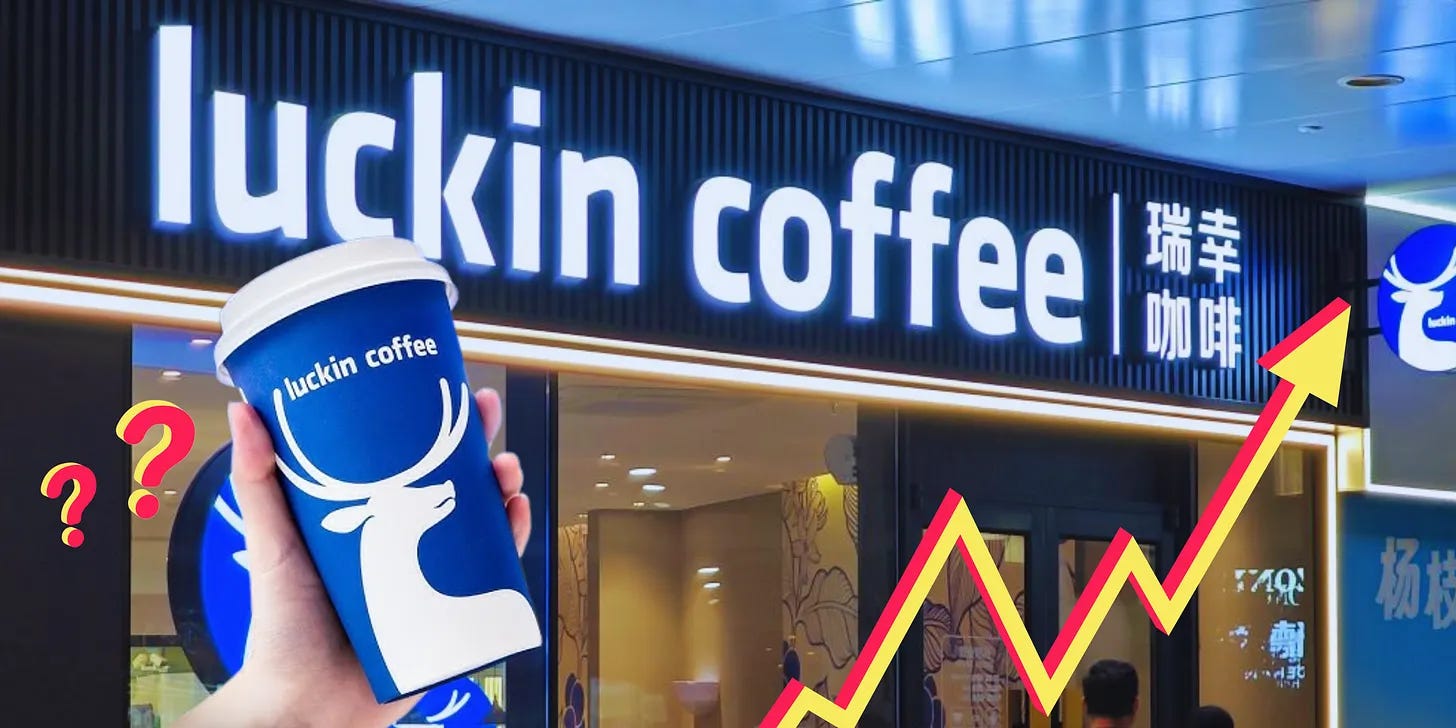
So in 2020, Luckin Coffee was the poster child for everything wrong with Chinese tech stocks.
The scandal:
$310 million in fabricated revenue (COO and team literally made up sales)
Stock crashed 90% in a single day
Nasdaq delisted them
Founders forced out in disgrace
Company facing bankruptcy
Every rational investor ran.
Centurium Capital wrote a $240 million check.
Five years later:
Luckin trades at $40/share (vs. Centurium’s entry at ~$6.50)
Return: 6.2x in 5 years (39% IRR)
Market cap: ~$10 billion
Revenue: ~$7 billion (2024)
Stores: 31,000+ (vs. 7,000 Starbucks China stores)
Now acquiring Blue Bottle Coffee (spending winnings on iconic Western brands)
This is one of the best distressed consumer bets in PE history.
But here’s what makes it fascinating: Centurium didn’t rebuild Luckin. They didn’t rebrand it. They didn’t even change the product.
They just fixed the governance, kept the business model, and let the machine print money.
Let me show you how a PE firm turned a $310M fraud into a $10B market cap—and why this playbook works when everyone else is running scared.
The Scandal: How Luckin Became the Biggest Chinese Fraud Since Enron
To understand Centurium’s bet, you need to understand how bad things were in 2020:
Luckin Coffee Timeline (2017-2020):
2017: Launch
Founded by Charles Lu and Jenny Qian
Positioning: “Tech-enabled coffee” (app-based ordering, rapid expansion)
Goal: Become bigger than Starbucks in China
2018-2019: Hypergrowth (Mostly Fake)
Store count: 0 → 4,500+ stores in 18 months
Revenue (claimed): $0 → $717M (2019)
IPO: May 2019 on Nasdaq, $4.2B valuation
The playbook looked amazing:
Open stores faster than Starbucks
Subsidize drinks (sell $5 coffee for $2)
Build app-based loyalty
Raise VC money to fund growth
January 2020: Anonymous Short Report
Muddy Waters Research publishes report alleging fraud
Claims Luckin is fabricating sales data
Stock initially holds, company denies allegations
April 2, 2020: The Confession
Luckin announces internal investigation found $310M in fabricated revenue
COO Jian Liu and team made up transactions
Stock crashes 90% in one day (from $26 → $2.50)
May 2020: Nasdaq Delisting
Nasdaq delists Luckin Coffee
Founders forced out
Company facing bankruptcy
Investor lawsuits pile up
At this point, Luckin looked dead.
Actual financials (post-restatement):
Revenue (real): ~$400M (2019), not $717M
Stores: 4,500+ (real, but unprofitable)
Cash: Burning fast
Debt: $1B+ in liabilities
Enterprise value collapsed to ~$500M
This is when Centurium showed up.
The $240M Bet: What Centurium Saw That Everyone Else Missed
In 2020-2021, whilst lawsuits were flying and investors were selling, Centurium Capital led a $240M investment into Luckin at ~$6.50/share.
Why would anyone invest in a company that just admitted to $310M in fraud?
Centurium’s thesis (based on their actions):
Insight 1: The Fraud Was Corporate Governance, Not Business Model
What was fake:
Revenue numbers (COO fabricating transactions)
Financial reporting (executives lying to investors)
Corporate governance (no oversight, fraudulent culture)
What was real:
4,500+ stores (physical locations existed)
Millions of customers (real people buying coffee)
App infrastructure (ordering system worked)
Supply chain (beans, cups, logistics all functional)
The underlying business was profitable at store level
The insight:
Most frauds fail because the business itself doesn’t work (Theranos, WeWork, etc.).
Luckin’s fraud was financial fraud, not operational fraud.
The stores made money. The app worked. Customers liked the product.
The executives just lied about how much money they were making.
If you fix the governance, the business could work.
Insight 2: Luckin’s Model Was Better Than Starbucks for China
Starbucks China model:
Store format: 1,000-2,000 sq ft sit-down cafes
Location: Premium retail (malls, high streets)
Rent: High (prime locations)
Labor: 8-12 employees per store
Capital per store: $300K-500K
Luckin’s model:
Store format: 200 sq ft pickup kiosks (90% of stores)
Location: Office buildings, transit hubs, residential
Rent: Low (tiny footprint)
Labor: 2-3 employees per kiosk
Capital per store: $50K-100K
The economics:
Starbucks store:
Revenue per store: $1M/year
Profit per store: $200K (20% margin)
Payback: 2.5 years
Luckin kiosk:
Revenue per kiosk: $300K/year
Profit per kiosk: $60K (20% margin)
Payback: 1.5 years
Luckin could open 5 kiosks for the cost of 1 Starbucks store.
And because kiosks are app-only (no in-store ordering), they’re operationally simpler.
Centurium realized: Luckin’s model was actually superior for density. They just needed honest management.
Insight 3: China’s Coffee Market Was Massively Underpenetrated
Coffee consumption per capita (2020):
United States: 400 cups/year
Europe: 600+ cups/year
China: 9 cups/year
The opportunity:
If China even reaches 50 cups/year (12% of US consumption), the market would be 10x larger than 2020.
Starbucks couldn’t serve that market alone:
Too capital-intensive (premium stores)
Too slow to expand (opening 500 stores/year)
Can’t reach 300+ Chinese cities
Luckin’s model could:
Open 5,000+ stores/year (low capex)
Deploy into tier 2-3 cities (low rent)
Serve office workers who want quick pickup
Achieve density Starbucks never could
Centurium bet: China’s coffee market will grow 5-10x. Luckin’s model is best positioned to capture that growth.
Insight 4: The Valuation Was Absurd (Distressed Pricing)
At $6.50/share (Centurium’s entry), Luckin’s implied valuation:
Market cap: ~$1.5B
Enterprise value: ~$500M (after accounting for debt/liabilities)
Revenue (real, post-restatement): ~$400M (2020)
EV/Revenue: 1.25x
For comparison:
Starbucks China (comparable business):
Revenue: $3B (2020)
Valuation: ~$12B (4x revenue)
If Luckin could clean up governance and grow to $2B revenue at similar 4x multiple:
Valuation: $8B
Centurium’s entry: $1.5B
Potential return: 5-6x
The bet wasn’t that Luckin would become the next Starbucks.
The bet was that fixing governance and maintaining growth would return the company to “normal” coffee chain multiples.
At distressed pricing ($6.50/share), you had 5-6x upside if the turnaround worked.
What Centurium Actually Did: The Restructuring Playbook
Centurium didn’t just write a $240M check and hope for the best.
They forced a complete restructuring:
Move 1: Seized Control (Corporate Coup)
Centurium’s restructuring terms:
1. Forced out entire C-suite:
Founders Charles Lu and Jenny Qian: Out
COO Jian Liu (fraud architect): Already fired, facing criminal charges
CFO, CMO, head of operations: Replaced
2. Installed new management:
Brought in professional operators from Starbucks China, Yum China
New CEO: Experienced F&B executive, not tech founder
Governance-first mentality
3. Board control:
Centurium took board seats
Installed independent directors
Created audit committee with teeth
No more founder control
This was a hostile takeover disguised as an investment.
Centurium didn’t partner with Luckin. They seized it.
Move 2: Fixed Financial Reporting (Rebuilt Trust)
The problem: No one trusted Luckin’s numbers after $310M fabrication.
The solution:
1. Full restatement:
Hired forensic accountants
Restated 2018-2020 financials
Real revenue: ~$400M, not $717M
2. New auditors:
Replaced auditor (previous one complicit or incompetent)
Hired Big 4 firm
Quarterly audits, full transparency
3. Rebuilt investor relations:
Public disclosure of real metrics (store count, same-store sales, app users)
Regular earnings calls
Show, don’t tell
By mid-2021, Luckin’s numbers were credible again.
Move 3: Kept the Business Model (Didn’t Rebuild)
Here’s what Centurium didn’t do:
❌ Didn’t rebrand (”New Luckin Coffee 2.0”)
❌ Didn’t close stores to “right-size”
❌ Didn’t pivot to premium (stay mass-market)
❌ Didn’t change product (still app-based coffee kiosks)
What they did do:
✅ Kept the kiosk model (200 sq ft pickups)
✅ Kept app-only ordering (no in-store transactions)
✅ Kept aggressive expansion (5,000+ stores/year)
✅ Kept the engine, replaced the driver
The insight:
The business model worked. The governance didn’t.
Most PE firms would have “fixed” Luckin by making it more like Starbucks (bigger stores, sit-down cafes, premium positioning).
Centurium realized the model was already optimized for China. They just needed honest operators.
Move 4: Doubled Down on Density (Not Premium)
Starbucks’ China strategy:
7,000 stores (2024)
Focus: Tier 1 cities (Beijing, Shanghai, Shenzhen)
Format: Premium sit-down cafes
Luckin’s strategy under Centurium:
31,000+ stores (2024)
Focus: Tier 1-3 cities (everywhere)
Format: Kiosks in office buildings, transit hubs, universities
The kiosk advantage:
Starbucks store (1,500 sq ft):
Rent: $10K/month (premium location)
Capex: $400K
Can serve 300-500 customers/day
Economics: High revenue per store, but limited store count
Luckin kiosk (200 sq ft):
Rent: $1.5K/month (office building lobby)
Capex: $60K
Can serve 200-300 customers/day
Economics: Lower revenue per kiosk, but 5x more kiosks per city
Luckin’s bet:
Better to have 10 kiosks generating $300K each ($3M total) than 1 Starbucks store generating $1M.
Density > Premium.
This is the opposite of what Western PE would have done (chase premium, reduce store count).
Centurium embraced the mass-market kiosk model and scaled it.
Move 5: Product Velocity (113 New Drinks in One Year)
Starbucks product strategy:
Core menu: 50-60 drinks (stable)
Seasonal launches: 4-6 new drinks/year
Focus: Consistency and brand equity
Luckin product strategy:
Core menu: 30-40 drinks
New launches: 113 new drinks in one year (2023)
Focus: Trend-chasing and viral marketing
Examples:
Luckin’s viral drinks (2023-2024):
“Sauce-flavored Latte” (with Moutai baijiu, Chinese liquor)
Sold 5.4M cups in one day
Generated $15M revenue in 24 hours
Went viral on Douyin (Chinese TikTok)
Coconut Cloud Latte
Sold 100M+ cups in 2023
Became best-selling drink in China
The strategy:
Starbucks optimizes for consistency. Luckin optimizes for virality.
Launch 100+ drinks/year. 90% will fail. 10% will go viral and drive millions of orders.
App-based model makes this possible:
No physical menu boards to update
No barista training on 100 drinks (app handles complexity)
Can launch and kill products weekly
This is fast-fashion applied to coffee.
Centurium didn’t invent this strategy. Luckin was already doing it. Centurium just let them keep doing it without interference.
The Results: One of the Best PE Trades in Consumer
Let’s look at what Centurium’s $240M bet became:
Centurium’s Investment (2021):
Investment: $240M
Entry price: ~$6.50/share
Stake: ~15-20% (estimated)
Luckin Today (2024-2025):
Stock price: ~$40/share
Market cap: ~$10B
Revenue: ~$7B (2024)
Stores: 31,000+
Profit: Estimated $500M+ EBITDA
Centurium’s return:
Mark-to-market (if held):
Entry: $240M at $6.50/share
Current: ~$1.5B at $40/share
Return: 6.2x in 5 years
IRR: 39%
For PE, 39% IRR over 5 years is exceptional.
But the story gets better:
Luckin Is Now Using Winnings to Buy Western Icons
In 2024, Luckin announced acquisition of Blue Bottle Coffee (premium Western coffee brand, previously owned by Nestlé).
Blue Bottle metrics:
Stores: 100+ globally (US, Japan, Korea)
Revenue: ~$100M (estimated)
Positioning: Premium third-wave coffee (opposite of Luckin’s mass-market)
Why this matters:
Luckin in 2020: Chinese fraud, fighting bankruptcy
Luckin in 2025: Acquiring iconic Western coffee brands
This is the ultimate vindication of Centurium’s bet.
They turned a distressed Chinese fraud into a platform that’s now buying Western premium brands.
The playbook flipped:
2000s-2010s: Western companies (Starbucks, Nestlé) buy Chinese brands
2020s: Chinese companies (Luckin) buy Western brands (Blue Bottle)
Centurium didn’t just save Luckin. They created a platform that’s now consolidating the global coffee industry.
Why This Worked: The Five Lessons
Lesson 1: Fraud ≠ Bad Business (Separate Governance from Operations)
Most investors saw: $310M fraud = untrustworthy company = avoid forever
Centurium saw: Fraud was governance failure, not business model failure
The test:
Business model fraud (avoid):
Theranos: Technology didn’t work
WeWork: Unit economics didn’t work
Nikola: Product didn’t exist
Governance fraud (opportunity if fixable):
Luckin: Stores existed, customers existed, economics worked
Just needed honest management
When governance is the problem, you can fix it with new leadership.
When the business model is broken, you can’t fix it with more capital.
Centurium correctly diagnosed Luckin as governance fraud, not business fraud.
Lesson 2: Distressed Pricing Creates Asymmetric Returns
Centurium’s entry: $6.50/share
At that price:
Downside: Company goes bankrupt, lose $240M (100% loss)
Upside: Company returns to “normal” coffee multiple, 5-6x return
Risk/reward:
Lose 1x
Make 5-6x
Asymmetric payoff
This is classic distressed investing:
When everyone is selling (fraud scandal, delisting, lawsuits), prices crater below intrinsic value.
If you can fix the problem causing distress (governance), you buy assets for 20-30 cents on the dollar.
Centurium paid $1.5B for a business that’s now worth $10B.
That’s buying for 15 cents on the dollar.
Lesson 3: Don’t “Fix” What’s Already Working
The mistake most PE firms would have made:
“Luckin is a mess. Let’s rebuild it to look like Starbucks.”
Changes they would have made:
Close 50% of stores (focus on profitability)
Rebrand as premium
Open sit-down cafes (not kiosks)
Reduce product velocity (focus on core menu)
This would have killed Luckin’s competitive advantage:
Density (31,000 stores)
Low capex (kiosk model)
Product velocity (113 drinks/year)
Centurium’s approach:
“The business model is already optimized for China. We’re just going to run it honestly.”
They kept:
Kiosk model (didn’t go premium)
App-only ordering (didn’t add in-store)
Rapid expansion (didn’t slow down)
Product velocity (kept launching 100+ drinks/year)
They changed:
Management (new CEO, CFO, operators)
Governance (board oversight, audits)
Financial reporting (transparency)
Replace the driver. Keep the engine.
Lesson 4: China’s Coffee Market Is Still Massively Underpenetrated
2020 coffee consumption:
US: 400 cups/person/year
China: 9 cups/person/year
2024 coffee consumption:
US: 400 cups/person/year (flat)
China: 15-20 cups/person/year (still tiny)
If China reaches even 50 cups/person/year (12% of US level):
Market would be 5-10x larger than today
Room for 100,000+ coffee stores in China (vs. 38,000 today)
Luckin + Starbucks have 38,000 stores combined.
There’s room for 100,000+.
Centurium bet on structural tailwind (coffee adoption in China) + superior business model (kiosks) = massive returns.
The bet wasn’t on Luckin alone. It was on China’s coffee market growing 10x.
Lesson 5: Geographic Arbitrage (China Model > Western Model for Density)
Western coffee model (Starbucks):
Premium stores
High capex
Slow expansion
Works in US/Europe (mature markets)
Chinese coffee model (Luckin):
Kiosks
Low capex
Rapid expansion
Works in China (high-density cities, app-native consumers)
Centurium didn’t try to impose Western coffee culture on China.
They let Luckin build for Chinese consumer behavior:
App-first (not walk-in)
Speed over experience (pickup, not sit-down)
Viral over premium (trend-chasing drinks)
This is geographic arbitrage:
Starbucks tried to bring American coffee culture to China. It worked, but slowly.
Luckin built Chinese coffee culture from scratch. It scaled 5x faster.
Western PE firms would have tried to make Luckin more like Starbucks.
Centurium (Chinese PE) understood Chinese consumers better and let Luckin be Luckin.
What This Means for Distressed Consumer Investing
Centurium’s Luckin bet proves a playbook that’s replicable:
The Distressed Consumer Playbook:
Step 1: Find governance fraud, not business fraud
Business still operates (stores open, customers buying)
Problem is financial reporting, not unit economics
Stock price collapsed, but operations intact
Step 2: Buy at distressed pricing (20-30 cents on dollar)
Wait for maximum fear (delisting, lawsuits, bankruptcy rumors)
Enter when rational investors have fled
Price needs to imply 5-10x upside if fixed
Step 3: Seize control (not just invest)
Force out existing management
Take board seats
Install professional operators
This is a takeover, not a partnership
Step 4: Fix governance, keep business model
Don’t “rebrand” or “pivot”
Just run the existing business honestly
Most distressed businesses fail because PE tries to rebuild what’s already working
Step 5: Ride structural tailwinds
Luckin benefited from China coffee adoption (10x growth coming)
Find businesses in categories that are growing even if company is struggling
Structural tailwinds cover operational mistakes
Where to Look for Next Luckin:
Candidates (hypothetical):
Chinese tech/consumer companies facing scandals but with real operations:
Education tech firms (shut down by government, but profitable internationally)
Gaming companies (regulatory issues, but strong IP)
E-commerce platforms (accounting scandals, but real GMV)
Western consumer brands in distress:
Bed Bath & Beyond (bankrupt, but brand equity remains)
Rite Aid (bankrupt, but store network valuable)
Party City (struggling, but holiday category growing)
The pattern:
Stock price destroyed by scandal/bankruptcy.
But underlying assets (brand, stores, customers) still valuable.
Buy for 20-30 cents on dollar, fix governance, ride tailwind.
This is how PE creates 5-10x returns.
The Final Reality
In 2020, Luckin Coffee admitted to $310 million in fabricated revenue.
Stock crashed 90%. Nasdaq delisted them. Founders forced out.
Centurium Capital wrote a $240 million check at $6.50/share.
Five years later:
Stock: $40/share (6.2x return)
Market cap: $10 billion
Revenue: $7 billion
Stores: 31,000+ (4.4x Starbucks China)
Now acquiring: Blue Bottle Coffee (using winnings to buy Western icons)
This is one of the best distressed PE trades in consumer history.
Centurium’s playbook:
Separated governance fraud from business fraud (stores worked, management lied)
Bought at distressed pricing ($6.50/share = 15 cents on dollar)
Seized control (forced out founders, installed operators)
Kept the business model (kiosks, app-only, density)
Rode structural tailwind (China coffee consumption growing 10x)
The result:
Turned a Chinese fraud into a $10B platform now buying American coffee brands.
The lesson for investors:
Fraud creates opportunity if you can separate governance from operations.
When governance is the problem, you fix it with new management.
When the business model is the problem, you can’t fix it with more capital.
Luckin’s business model was always superior for China density.
The executives were just liars.
Centurium fixed the liars and let the business print money.
That’s not luck. That’s pattern recognition.
P.S. Luckin now opens more stores per week than Starbucks opens per month in China. 31,000 stores vs. 7,000. The kiosk model won. At $60K capex per kiosk vs. $400K per Starbucks store, Luckin can outspend Starbucks 6:1 on expansion with the same capital. That’s why they’re winning. And that’s why Centurium’s bet paid off. They correctly identified that Luckin’s model was already superior. They just needed to run it without committing fraud. Sometimes the best investment is fixing what’s broken, not rebuilding from scratch.