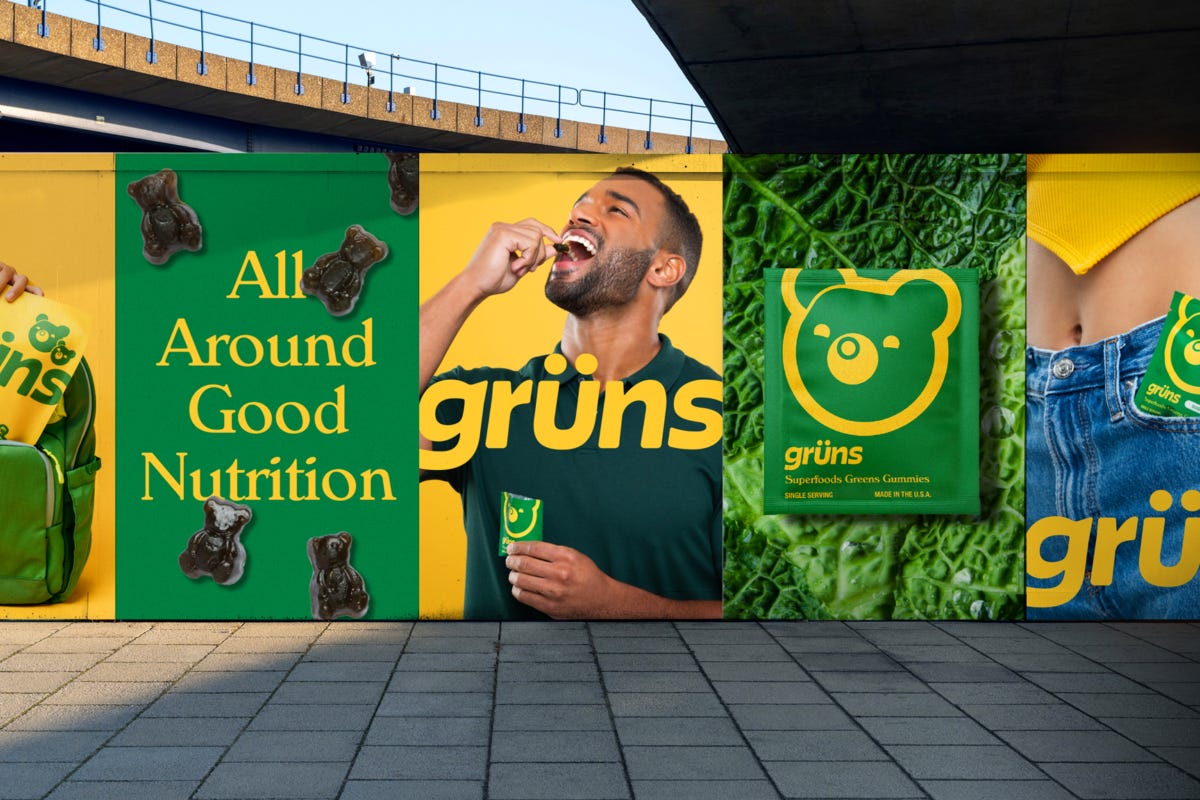
The Fastest Billion-Dollar Exit in Consumer History: How Gruns Sold to Unilever in 3 Years (And Why the Math Behind It Changes Everything)
A former PE analyst started a greens powder company in his Stanford dorm room in 2023.
Three years later literally 36 months he just sold it to Unilever for $1.2 billion.
His name: Chad Janis
The company: Gruns (yes, pronounced “greens” but spelled like a meme)
Time to exit: 3 years
Previous record holder: Rhode (Hailey Bieber) at 3.5 years to $1B from e.l.f. Beauty
And somehow beat Hailey Bieber’s record.
Let me repeat that: A former PE analyst with zero celebrity, zero influencer following, zero brand recognition just sold faster than a Kardashian-adjacent celebrity founder.
Now here’s where it gets interesting.
This isn’t a story about “right place, right time” or “got lucky with timing.”
This is a story about financial engineering applied to consumer brands and why the math changes everything.
Chad was building a compounding machine that turned $1 into $3 on a predictable, repeatable basis.
And Unilever paid $1.2 billion for the machine. Let me show you exactly how he did it
The Deal: What Actually Happened (And Why the Numbers Are Wild)
Gruns → Unilever Acquisition (March 2026):
Purchase price: $1.2 billion
Revenue (estimated): $300-350M (2025)
Revenue multiple: 3.4-4.0x (in line with premium functional nutrition deals)
Time to exit: 3 years from founding (2023-2026)
Total capital raised: $35M+ (one known round from Headline at $500M valuation, May 2025)
Headline’s return:
Invested: $35M at $500M valuation (May 2025)
Exit: $1.2B (March 2026)
Holding period: 10 months
Return: 2.4x MOIC, ~140% gross return, 55% unlevered IRR annualised
For context on how absurd Headline’s return is:
Top-quartile VC returns:
Seed: 3-5x MOIC over 7-10 years = 15-20% IRR
Series A: 2-3x MOIC over 5-7 years = 15-20% IRR
Headline: 2.4x in 10 months = 140% return, 55% annualized IRR
That’s printing money.
Who Is Chad Janis? (And Why His Background Matters)
Chad Janis:
Summit Partners (consumer-focused PE firm, $30B+ AUM)
Worked on consumer deals including analysis of Dr. Squatch ($1.5B to Unilever, 2026)
Stanford undergrad (started Gruns in dorm room, 2023)
Comes from finance/deals side
Why this background is the unlock:
Most founders think: “Build great product → Get customers → Revenue grows → Get acquired”
Chad thought: “Model the exit multiple → Reverse engineer required metrics → Build machine to hit metrics → Get acquired at target multiple”
This is PE brain applied to consumer brand building.
And it’s why he exited in 3 years whilst brands with better products are still grinding at $20M revenue after 7 years.
What Gruns Actually Sells (And Why the Category Matters)
Product: Supplement Gummies
Positioning: “Daily nutrition from fruits and vegetables in an easy-to-consume package”
Comparable brands:
AG1 (Athletic Greens): The category leader, $300M+ revenue, rumored $2-3B valuation
Bloom Nutrition: Influencer-led (Mari Llewellyn), $100M+ revenue
Momentous: Andrew Huberman-backed, science-focused
Ritual: Women’s multivitamin/greens, $100M+ revenue
1. High LTV:CAC ratio (the math works)
Typical greens powder economics:
AOV (first order): $60-80
COGS: $12-18 (75-80% gross margin)
CAC (customer acquisition cost): $20-30 via performance marketing
First order: Break-even to slight loss
But then:
Subscription retention: 6-12 months average
Repeat orders: 6-12 orders per customer
LTV (lifetime value): $180-360
LTV:CAC ratio: 3-6x (venture-scale economics)
For comparison:
Low LTV:CAC categories (hard to scale):
Apparel: 1.5-2x LTV:CAC (people don’t repeat frequently)
Food/snacks: 2-3x LTV:CAC (commodity, low loyalty)
Hard to build compounding machine
High LTV:CAC categories (venture-scale):
Supplements: 3-6x LTV:CAC (daily use, subscription)
Skincare: 3-5x LTV:CAC (daily use, brand loyalty)
Math works, machine compounds
Gruns picked the right category.
2. Subscription model = predictable revenue
One-time purchase brands:
Revenue = marketing spend (turn off ads, revenue stops)
Unpredictable cash flow
Hard to model, hard to finance
Subscription brands:
Revenue = new customers + existing subscribers
Predictable cash flow (can forecast 6-12 months out)
Easy to model, easy to finance, easy to sell
Unilever knows:
If Gruns has 500K active subscribers
Average subscription length 9 months
Monthly revenue = 500K × $65/month = $32.5M/month
Predictable $390M annual revenue with high visibility
Subscription = valuation premium.
3. Science-backed positioning (appeals to strategics)
Gruns’ positioning (from their site/PR):
“Science-backed greens powder”
Formulated with nutritionists
Transparent ingredient sourcing
Clinical credibility
Why this matters for acquisition:
Influencer-led brands:
Bloom Nutrition: Mari Llewellyn’s following drives sales
Risk: If influencer leaves/reputation damaged, brand dies
Strategics discount for key person risk
Science-backed brands:
Gruns: Product stands independent of founder
Can be marketed to doctors, nutritionists, mainstream
Strategics pay premium for durability
Unilever bought:
Not “Chad Janis’ greens powder”
But “science-backed functional nutrition platform”
Can scale beyond Chad’s personal brand
The Playbook: How Gruns Hit $300M Revenue in 3 Years
Now let’s get into the actual mechanics, because this is where it gets interesting.
The Financial Model
Here’s what most people miss:
Gruns didn’t win on branding. They won on cohort economics.
Let me explain the model:
Step 1: Establish 3.0+ LTV:CAC Ratio (The Foundation)
Standard greens powder unit economics:
Month 1 (Acquisition):
Customer acquired via Meta/Google ads
CAC: $25
First order: $70 (1-month supply)
COGS: $14 (20% of revenue)
Gross profit: $56
Marketing: $25
Contribution margin: $31 (but this is misleading see below)
Reality: First order loses money when you account for full costs
Month 1 actual P&L:
Gross profit: $56
CAC: $25
Fulfillment: $8
Payment processing: $2
Platform fees: $2
True contribution margin: $19 (before opex)
But here’s the magic:
Months 2-12 (Retention):
60% of customers subscribe for Month 2
50% stay for Month 3
40% stay for Months 4-6
30% stay for Months 7-12
Average: 6 orders per customer over 12 months
LTV calculation:
First order: $70
Repeat orders: 5 orders × $65 = $325
Total LTV: $395
COGS: $84 (6 orders × $14)
Gross profit: $311
Minus CAC: $25
Minus fulfillment (6 × $8): $48
Minus processing/fees (6 × $4): $24
Net LTV: $214
LTV:CAC = $214 / $25 = 8.5x
Wait, that’s way higher than 3x?
Yes, but you don’t measure LTV:CAC on fully-loaded lifetime value.You measure on payback-period LTV (usually 6-12 months, not lifetime).
Payback-period LTV:CAC:
LTV at 6 months: $65 × 3 orders = $195
Minus COGS (3 × $14): $42
Minus fulfillment/fees (3 × $12): $36
Net 6-month LTV: $117
CAC: $25
6-month LTV:CAC = 4.7x
But the number Gruns actually optimized to: 3.0x on a payback basis.
Why 3.0x specifically?
Below 3.0x:
Not enough margin to cover opex
Can’t scale without burning cash
Not venture-scale
Above 4.0x:
Leaving money on table
Could spend more on CAC and grow faster
Underinvesting in growth
3.0-3.5x is the sweet spot:
Enough margin to be profitable
Aggressive enough to maximize growth
Optimal growth + profitability balance
Gruns managed to 3.0x LTV:CAC on payback, which means:
They could spend aggressively on customer acquisition
While still generating positive contribution margin at cohort level
Compounding machine activated
Step 2: The J-Curve (Why They Raised $35M)
When you manage to 3.0x LTV:CAC on a payback basis, you create a J-curve.
What’s a J-curve?
Months 1-6 (the “J” part—burning cash):
Spending $1M/month on customer acquisition
Acquiring 40,000 new customers (at $25 CAC)
Revenue Month 1: $2.8M (40K × $70)
But contribution margin after CAC: Break-even to slight negative
Burning cash to acquire customers
Months 7-12 (the “curve up” part—cohorts flip green):
Same 40,000 customers from Month 1
Now on Month 7 of subscription
30% retained = 12,000 still subscribing
Revenue from this cohort: $780K/month (12K × $65)
No CAC (already acquired)
COGS: $168K
Fulfillment/fees: $144K
Contribution margin: $468K (pure profit from this cohort)
Plus new customers acquired in Month 7:
Another 40,000 new customers
Revenue: $2.8M
Break-even after CAC
Building next cohort
Total Month 7 revenue:
Old cohort (Month 1 customers): $780K
New cohort (Month 7 customers): $2.8M
Total: $3.58M
But contribution margin:
Old cohort: $468K (profitable)
New cohort: $0 (break-even after CAC)
Total: $468K contribution margin
Do this for 12-24 months and here’s what happens:
Month 24:
Revenue: $30M/month
New customer revenue: $3M (10% of total)
Repeat customer revenue: $27M (90% of total)
Contribution margin: $12M+ (40%+ CM ratio)
This is the compounding effect.
But to get there, you need to burn cash in Months 1-12 whilst cohorts mature.
This is why Gruns raised $35M from Headline, working capital to fund the J-curve whilst cohorts compounded.
And this is why Headline made 55% IRR in 10 months:
They understood the math. They knew the cohorts would flip green. They just needed to fund the J-curve.
Ten months later: Cohorts flipped green, EBITDA exploded, Unilever paid $1.2B.
Step 3: Cohort Stacking (How Revenue Compounds Exponentially)
Most founders think linearly:
“If I acquire 10K customers/month, revenue grows linearly.”
Wrong.
Revenue compounds when cohorts stack:
Month 1:
New customers: 10K
Revenue: $700K
Total revenue: $700K
Month 6:
New customers: 10K → Revenue $700K
Month 1 cohort (5 months old): 4K retained → Revenue $260K
Month 2 cohort (4 months old): 4.5K retained → Revenue $293K
Month 3 cohort (3 months old): 5K retained → Revenue $325K
Month 4 cohort (2 months old): 5.5K retained → Revenue $358K
Month 5 cohort (1 month old): 6K retained → Revenue $390K
Total revenue: $2.33M (3.3x Month 1 despite same acquisition rate)
Month 12:
New customers: 10K → Revenue $700K
11 prior cohorts contributing
Total revenue: $4-5M (6-7x Month 1 despite same acquisition rate)
Revenue grows exponentially whilst CAC stays flat.
And this is how Gruns went from $0 → $300M in 3 years:
Year 1 (2023):
Months 1-12: Building initial cohorts
Revenue: $20-40M
Burning cash (J-curve trough)
Year 2 (2024):
Months 13-24: Early cohorts maturing
Revenue: $80-120M
Approaching break-even (cohorts starting to flip green)
Year 3 (2025):
Months 25-36: Cohorts fully mature
Revenue: $250-350M
Highly profitable (90% repeat revenue, minimal CAC)
The “Brand Aura” Strategy (Why Perception Matters as Much as Metrics)
Gruns had aura from day one.
What’s “brand aura”? The perception that you’re the winner before anyone has the data to prove it.
How Gruns created aura:
1. Selective information disclosure (created mystique)
Most brands overshare:
Monthly revenue updates
“We just hit $X revenue!” posts
Constant fundraising announcements
Desperation energy
Gruns undershared:
Only announced major milestones ($100M revenue, $300M revenue)
Only announced one fundraise (Headline, $35M)
Stayed quiet otherwise
Scarcity energy
Why this works:
When you’re constantly sharing metrics, people see the struggle. When you only share wins, people assume you’re always winning.
Gruns looked like they were always winning.
2. Coordinated PR
Gruns’ PR strategy (reconstructed from public appearances):
Avoided:
Generic “founder journey” content
“Bootstrapped to $X” humble brags
Podcast circuits (Chad did very few interviews)
Focused on:
Strategic placement in high-signal publications (WSJ, Forbes, TechCrunch, only for major milestones)
Industry-insider buzz (DTC operators talking about “Gruns’ insane growth”)
Let others talk about them, rather than talking about themselves
The result:
By the time Gruns hit $100M revenue, the narrative was already:
“Gruns is the fastest-growing greens powder brand ever.”
Even if the data didn’t fully support it yet.
Perception became reality.
3. Team composition signaling (hired operators, not just doers)
Most DTC brands at $50M revenue:
Founder as CEO
Small team (15-30 people)
Generalists wearing multiple hats
Gruns at $50M revenue:
Hired experienced operators from larger brands
Built in-house data/tech team (not common for consumer brands)
Signaled: “We’re building for $500M+, not just $50M”
Why this matters:
When Unilever’s corp dev team evaluates brands, they ask:
“Can this team scale to $500M+ without us?”
If the answer is:
“No, they’ll need our operators” → Discount valuation (integration risk)
“Yes, they’re already building the team” → Premium valuation (less risk)
Gruns signaled “yes” from day one.
Unilever paid a premium for reduced integration risk.
What This Exit Means for Consumer Founders
If you’re building a consumer brand right now, here’s what Gruns proves:
Lesson #1: Manage to 3.0x LTV:CAC on payback, not lifetime
Most founders:
Optimize for profitability (5-6x LTV:CAC)
Grow slowly
Take 7-10 years to hit $100M
Winners:
Optimize for growth (3.0x LTV:CAC on payback)
Grow aggressively
Hit $100M in 3-5 years
3.0x is the magic number.
Lesson #2: Raise capital for J-curve, not vanity
Bad reasons to raise VC:
“Want to hire faster”
“Want bigger office”
“Want to do brand partnerships”
Good reason to raise VC:
“Have 3.0x LTV:CAC on payback, need working capital to fund J-curve whilst cohorts mature”
Gruns raised $35M for the right reason.
Headline made 55% IRR because they understood the math.
Lesson #3: Build for exit from day one
Most founders:
“Let’s build for 10 years, then think about exit”
Optimize for long-term brand
Get surprised when acquisition offer comes
Chad Janis:
“Let’s build to exit at $1B+ in 3-5 years”
Optimize for metrics acquirers want (revenue, EBITDA, retention)
Execute exit on timeline
PE background = knew what metrics drive valuations.
Built specifically to those metrics.
Exited at target valuation in target timeframe.
Is This Replicable?
Everyone reading this is thinking:
“Can I do this?”
The honest answer: Probably not.
Here’s why:
1. Chad had unfair advantages
Summit Partners background:
Analyzed consumer deals professionally
Knew what metrics drive valuations
Had network to raise capital quickly
Stanford pedigree:
Signal of competence to investors
Access to talent pipeline
Instant credibility
Most founders don’t have these.
2. Timing was perfect (maybe too perfect)
2023-2026 was ideal for greens powder exit:
AG1 proved category ($300M+ revenue)
Bloom proved influencer-led works ($100M+ revenue)
GLP-1 boom created functional nutrition tailwind
Strategics hunting for greens brands
By 2027-2028:
Category more crowded
Multiples compress
Harder to replicate
3. The math only works in specific categories
3.0+ LTV:CAC on payback is rare:
Supplements ✅
Skincare ✅
Subscription consumables ✅
Most other categories ✗
If your category doesn’t have the unit economics, you can’t build the compounding machine.
Period.
But Here’s What IS Replicable (The Actual Takeaways)
Even if you can’t replicate the full Gruns playbook, here’s what you CAN steal:
1. The 3.0x LTV:CAC framework
Measure your unit economics:
What’s your CAC?
What’s your 6-month LTV (not lifetime)?
LTV:CAC ratio on payback basis = ?
If below 3.0x:
Either improve retention (increase LTV)
Or reduce CAC (improve conversion, creative, targeting)
Don’t scale until you hit 3.0x
If above 3.0x:
You can scale aggressively
Raise capital for J-curve
Build compounding machine
2. The cohort stacking model
Track cohort performance monthly:
Month 1 cohort: How many active in Month 6?
Month 2 cohort: How many active in Month 6?
Are later cohorts retaining better than early cohorts?
If yes:
You’re improving product/experience
Cohorts will compound harder
Scale aggressively
If no:
Fix retention before scaling
Scaling won’t fix retention problems
3. The “brand aura” strategy
Stop oversharing:
Don’t post every milestone
Don’t share monthly revenue updates
Only share major wins
Let others talk about you:
Seed information to industry insiders
Let press find you (don’t chase them)
Scarcity creates desire
4. The “build for exit from day one” mindset
Know what acquirers want:
Predictable revenue (subscription)
High retention (60%+ at 6 months)
Profitability path (positive unit economics)
Build these from month one
Model the exit:
What multiple do brands in your category exit at?
What revenue do you need to hit target exit value?
Reverse engineer the path
The Final Reality
A former PE analyst just sold his brand for $1.2 billion in 3 years.
By building a compounding machine with:
3.0x LTV:CAC on payback basis (math that works)
Cohort stacking (revenue compounds exponentially)
J-curve financing ($35M to fund working capital whilst cohorts mature)
Brand aura (selective disclosure, coordinated PR, let others talk)
Build for exit mindset (knew the metrics, built to the metrics)
Are you managing to 3.0x LTV:CAC? Or are you still building “a brand”?
Keep building,
David
P.S. The most important number in this whole story is 3.0x LTV:CAC on a payback basis. Not lifetime LTV:CAC (which is usually 6-10x for good brands). But specifically the ratio measured at 6-month payback. If you’re below 3.0x at 6 months, you can’t fund growth profitably. If you’re above 4.0x, you’re leaving growth on the table. 3.0-3.5x is the sweet spot where you can scale aggressively whilst cohorts mature and flip from red to green. This is the formula. Gruns ran it to perfection. And now every PE analyst with a consumer idea is going to try to copy it. The playbook is public. The question is: can you execute it?
P.P.S. Unilever has now bought Dr. Squatch ($1.5B), Nutrafol ($500M+), and Gruns ($1.2B) in the last 18 months. That’s $3.2B+ deployed into DTC subscription brands with strong unit economics. The pattern is clear: Unilever is buying compounding machines. If you have 60%+ retention at 6 months, DTC subscription revenue, and $100M+ run rate, you should probably have Unilever’s corp dev team on speed dial. They’re hunting for the next Gruns. And they’ll pay 3-4x revenue for the right machine.


