


Hey,
Imagine a 179-year-old company that sells baking soda quietly became one of the smartest players in Gen Z beauty.
Church & Dwight, the company behind Arm & Hammer, Trojan and Batiste dry shampoo just pulled off what might be the best acquisition in consumer beauty since Unilever bought Dollar Shave Club.
The deal: Acquired Hero Cosmetics in 2022 for $630 million on ~$115 million in revenue.
The result: Hero is now the category leader with 19%+ market share in acne patches, growing 3x faster than the category in 2025, launching new products in 2026, and printing money.
The multiple: 5.5x revenue (paid $630M for $115M revenue business).
For comparison, what everyone else was paying in 2022:
Unilever bought K18 for $160M on $40M revenue = 4x
Estée Lauder bought Deciem for $2.2B on $460M revenue = 4.8x
Church & Dwight paid 5.5x and got a business that’s now worth $1.5B+ (estimated)
That’s a 2.4x return in 3 years. Not from launching products. From buying at the trough whilst everyone else panicked.
Now here’s what makes this fascinating: Church & Dwight isn’t a sexy growth equity firm or a brand incubator with unlimited capital.
Let me show you how a boring consumer conglomerate became one of the smartest operators in Gen Z beauty
The Numbers That Show This Wasn’t Luck
Let’s start with what Church & Dwight actually bought and what it became:
Hero Cosmetics at Acquisition (2022):
Revenue: ~$115M (2021/2022)
Primary product: Mighty Patch (hydrocolloid acne patches)
Distribution: Target, Ulta, CVS, Walmart, DTC
Market position: Leader in acne patches (~15% category share)
Purchase price: $630M (5.5x revenue)
Hero Cosmetics Today (2025):
Revenue: ~$180-200M (estimated, based on category growth and share gains)
Market share: 19%+ in acne patches
Growth: 3x category rate (category growing ~10%, Hero growing ~30%)
New products launching: Cleansers, Mighty Shield (2026)
Distribution: Expanded mass retail + international
Estimated value: $1.2-1.5B (6-7.5x revenue on higher revenue base)
Value creation in 3 years:
Paid: $630M
Current value: $1.2-1.5B
Return: 90-138% (2-2.4x in 3 years)
Annualized return: 26-33%
For a consumer acquisition, this is exceptional.
Compare to other strategic acquisitions in beauty:
Unilever’s Dollar Shave Club:
Paid: $1B (2016)
Revenue at acquisition: $200M
Current status: Revenue declined to ~$150M, value destroyed
Return: -50%+
Coty’s Kylie Cosmetics:
Paid: $600M for 51% stake (2019)
Revenue at acquisition: $200M
Current status: Revenue down 60%, massive write-down
Return: -70%+
P&G’s Native:
Paid: $100M (2017)
Revenue at acquisition: $100M
Current status: Growing, estimated $250M+ revenue
Return: 2-3x (good outcome)
Church & Dwight’s Hero sits with P&G’s Native as one of the few successful strategic beauty acquisitions of the 2020s, and Church & Dwight has done this multiple times.
The Church & Dwight Playbook: How a Baking Soda Company Became a Gen Z Beauty Power
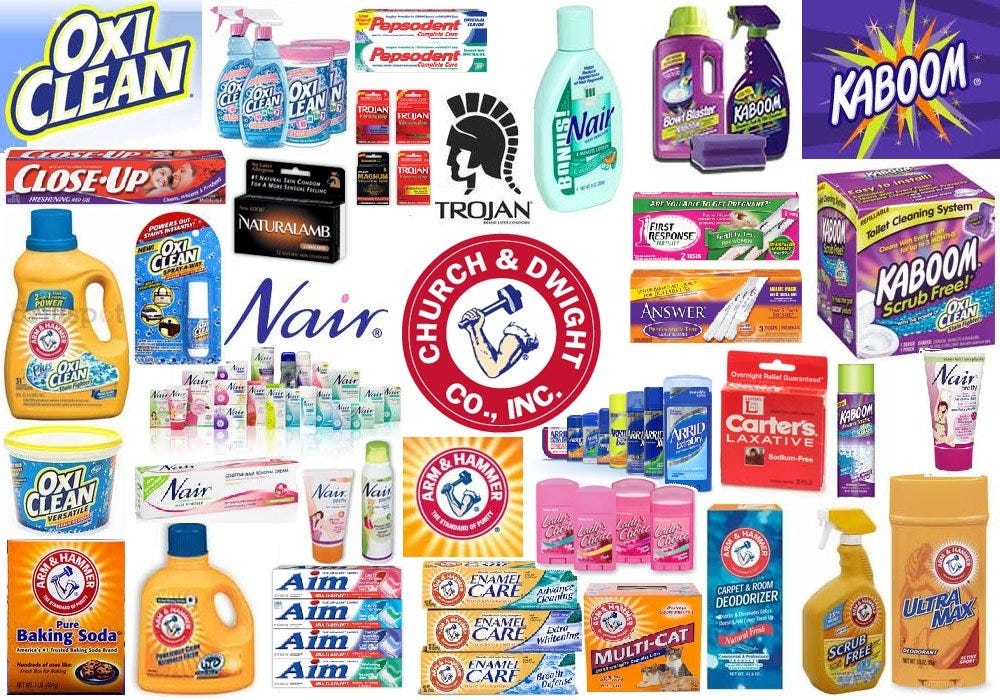
Most people don’t realize that Church & Dwight isn’t just Arm & Hammer.
Their current portfolio:
Personal Care:
Batiste (dry shampoo, #1 globally)
TheraBreath (mouthwash, fastest-growing oral care brand)
Hero Cosmetics (acne patches, category leader)
Touchland (power mist hand sanitizer, acquired 2025)
Waterpik (water flossers)
Trojan (condoms, #1 in US)
Household:
Arm & Hammer (baking soda, laundry detergent)
OxiClean (stain remover)
Kaboom (bathroom cleaner)
VitaFusion (vitamins, sold December 2025)
Total revenue: $5.4B (2024)
Operating margin: 20%+ (exceptional for CPG)
Move 1: Exit Low-Margin, Low-Relevance Categories
In December 2025, Church & Dwight sold VitaFusion (vitamins/supplements) to focus capital on higher-growth, higher-margin opportunities.
Why this matters:
VitaFusion was doing $300M+ in revenue, but:
Vitamins are commoditized (low differentiation)
Margin pressure from Amazon Basics, store brands
Declining category relevance with Gen Z/Millennials
Capital trapped in declining asset
By selling VitaFusion, C&D freed up capital to deploy into:
Hero expansion (new product launches)
Touchland acquisition (2025)
Future Gen Z-relevant acquisitions
This is the opposite of what most conglomerates do. Church & Dwight, ruthlessly exits declining categories, redeploys capital into growth
This is private equity discipline inside a public company.
Move 2: Buy Asset-Light, High-Frequency, Repeat-Purchase Brands
Look at what Church & Dwight has acquired in the past 5 years:
Hero Cosmetics (2022):
Product: Acne patches (consumable, replaced monthly)
Gross margin: 65-70%
Repeat rate: 60%+ (acne is chronic, patches are consumable)
Asset-light: No manufacturing, contract production
Touchland (2025):
Product: Power mist hand sanitizer (consumable, replaced every 2-3 months)
Gross margin: 70%+
Repeat rate: 50-60%
Asset-light: Contract manufacturing
TheraBreath (2020):
Product: Mouthwash (consumable, replaced monthly)
Gross margin: 65%+
Repeat rate: 70%+
Asset-light: Contract manufacturing
Notice the pattern:
All three brands have:
High-frequency repurchase (consumable products)
High gross margins (65-70%+)
Asset-light model (contract manufacturing, no capex)
Recurring revenue (50-70% repeat rates)
Mass + specialty distribution (Target, Ulta, CVS, etc.)
This is the exact opposite of what most conglomerates buy.
Traditional conglomerate acquisition:
Mature brand with scale
Low margins, high volume
Asset-heavy (factories, equipment)
One-time purchase products
Example: P&G buying Gillette
Church & Dwight acquisition:
Emerging brand with momentum
High margins, building volume
Asset-light (outsourced manufacturing)
Repeat-purchase products
Example: C&D buying Hero
The traditional model requires massive capital investment and has limited upside.
The C&D model requires minimal capital and has unlimited upside through line extensions and repeat purchases.
Move 3: Buy at the Trough, Not the Peak
Here’s where Church & Dwight’s timing was genius:
When C&D bought Hero (2022):
DTC beauty brands collapsing (Glossier down round, Drunk Elephant struggles)
Public markets crashed (beauty multiples compressed)
VCs pulling back (funding dried up)
Sellers desperate, buyers cautious
Hero’s position:
Revenue: $115M (growing but slowing)
Profitability: Break-even or slightly profitable
Valuation expectations: Coming down from 2021 highs
Realistic seller, willing to transact at 5.5x revenue
If Hero had sold in 2021 (peak hype):
Same $115M revenue
Valuation: $1B+ (8-10x revenue in bubble)
Buyer: VC firm or SPAC
Church & Dwight wouldn’t have paid that
But by waiting for 2022, C&D got Hero at 5.5x revenue a 40-45% discount to 2021 valuations.
Move 4: Scale Through Distribution Machine, Not Marketing Spend
Here’s what happened after Church & Dwight bought Hero:
Pre-acquisition Hero distribution:
Target: Limited SKUs, select stores
Ulta: Growing presence
CVS/Walgreens: Building distribution
Walmart: Minimal presence
International: Almost none
Reach: ~15,000 retail doors
Post-acquisition Hero distribution (C&D leverage):
Target: Expanded SKUs, all stores
Ulta: Full distribution, prominent placement
CVS/Walgreens: Expanded shelf space
Walmart: National rollout (C&D has relationships from Arm & Hammer)
International: Launched in Canada, UK, expanding to Europe/Asia
Reach: ~40,000+ retail doors
Distribution increased 2.6x in 3 years.
This is the strategic acquirer advantage:
Independent Hero:
Each retail relationship negotiated individually
Limited leverage (small player)
Slotting fees required (pay to get on shelf)
Slow, expensive distribution growth
Hero under Church & Dwight:
Leverages existing C&D retail relationships
Negotiating power (C&D does $5B+ across all retailers)
Bundled deals (Hero + Batiste + Arm & Hammer = package)
Fast, capital-efficient distribution growth
The distribution machine is worth more than the brand itself.
Hero’s brand equity got them to $115M revenue.
Church & Dwight’s distribution machine will get them to $300M+.
Why This Playbook Works (And Who Else Should Copy It)
You don’t need to buy $1B platforms. You need to buy incremental relevance.
The traditional strategic M&A thesis: “We should acquire brands that are already at scale ($500M+ revenue) to move the needle for our $50B+ company.”
The problem:
Brands at $500M+ revenue are expensive (8-12x revenue multiples)
Already mature (limited growth)
Often over-distributed (no white space)
Require massive integration (complex)
Limited value creation opportunity
The Church & Dwight thesis: “We should acquire brands that are $50-150M revenue with:
Cultural relevance (Gen Z loves them)
Repeatable economics (high-frequency, high-margin)
Distribution white space (we can 3-5x doors)
Category leadership (dominant in emerging niche)”
The advantages:
Brands are cheaper (4-6x revenue multiples)
Still growing fast (30%+ annually)
Huge distribution opportunity
Easy integration (small teams, asset-light)
Massive value creation opportunity
Church & Dwight is proving you can buy 5 brands at $100M revenue for $500M total and grow them to $300M+ each through distribution leverage.
That’s $1.5B in total value on $500M invested = 3x return.
vs. buying 1 brand at $500M revenue for $3B and struggling to grow it 20% = 1.2x return at best.
The math favours buying smaller, emerging brands with leverage.
Who Should Copy This Playbook (And Who Probably Will)
Based on Church & Dwight’s success, here are the strategics that should be buying Gen Z brands right now:
Unilever (Should Buy Contemporary Beauty/Personal Care)
What they should acquire:
The Ordinary/NIOD (if they don’t already fully own)
Starface (acne patches, Hero competitor)
Topicals (hyperpigmentation, Gen Z skincare)
Dieux Skin (science-forward skincare)
Why it fits:
Unilever has distribution muscle (CVS, Target, Ulta)
Portfolio needs Gen Z refresh (Dove, Vaseline aging)
Same playbook as C&D: Buy at $50-100M revenue, scale to $200M+
P&G (Should Buy Premium Personal Care)
What they should acquire:
Nécessaire (body care, elevated drugstore)
Offhours (sleep wellness)
Bubble (teen skincare)
Curie (natural deodorant)
Why it fits:
P&G has best-in-class distribution (everywhere)
Portfolio skews older (Olay, Pantene, Secret)
Same playbook: Leverage Walmart/Target relationships to scale emerging brands
Coty (Needs to Reboot After Kylie Disaster)
What they should acquire:
Makeup by Mario (makeup artist brand)
Kulfi Beauty (South Asian beauty)
Halsey’s About-Face (Gen Z makeup)
Ami Colé (melanin-rich skin)
Why it fits:
Coty has distribution infrastructure
Needs credibility after Kylie write-down
Buy proven brands at reasonable multiples (4-6x), not celebrity brands at 10x+
Colgate-Palmolive (Should Buy Oral Care/Personal Care)
What they should acquire:
Bite (toothpaste bits, sustainable)
Hum (wellness supplements)
By Humankind (refillable deodorant)
Why it fits:
Colgate has best oral care distribution globally
Portfolio needs sustainability/Gen Z angle
Same playbook as C&D’s TheraBreath acquisition
The pattern:
Every major CPG conglomerate should be running Church & Dwight’s playbook:
Identify emerging categories (30%+ growth)
Buy category leader at $50-150M revenue
Pay 4-6x revenue (not 10x+)
Leverage distribution to 3-5x doors
Create 2-3x value in 3-5 years
Church & Dwight is just the first to systematize it.
Your Takeaway
Church & Dwight bought Hero Cosmetics for $630M in 2022 when everyone else was panicking.
Three years later:
Hero revenue: $180-200M (from $115M)
Market share: 19%+ (from 15%)
Growth: 3x category rate
Estimated value: $1.2-1.5B
Return: 2-2.4x in 3 years
How they did it:
1. Ruthless capital allocation:
Exited declining categories (sold VitaFusion)
Redeployed into growth (Hero, Touchland)
2. Asset-light, repeat-purchase focus:
Only buy high-margin, consumable brands
Avoid capital-intensive manufacturing
3. Trough conviction:
Bought Hero in 2022 when valuations compressed
Paid 5.5x revenue vs. 10x+ in 2021
4. Distribution leverage:
Used existing retail relationships to 2-3x doors
Reduced marketing spend through retail sampling
5. SKU expansion:
Launched new products (Micropoint, cleansers, Force Shield)
Increased revenue per door
The lesson for founders:
Strategic acquirers don’t only want $1B platforms.
They want:
Category leadership in emerging niches
Profitable unit economics from day one
Distribution white space they can fill
Incremental cultural relevance
Hero had all four. That’s why they got acquired at 5.5x revenue and created 2x+ value in 3 years.
Are you building incremental relevance or trying to be everything to everyone?
Keep building,
David
P.S. Church & Dwight operates with 20%+ operating margins whilst owning brands Gen Z actually cares about (Hero, Touchland, Batiste). Most “modern” DTC brands operate at -20% margins whilst burning VC cash. The boring conglomerate figured out how to be cool and profitable. That’s the real disruption.
Want to go deeper? Book office hours here - intro.co/DavidOlusegun
Smart take. Private equity approach within a public company. Makes Elf’s acquisition of Rhode for $1 billion look a little desperate. Nécessaire is definitely an innovative brand ripe for acquisition. Brilliant leadership and distinct in the marketplace.