


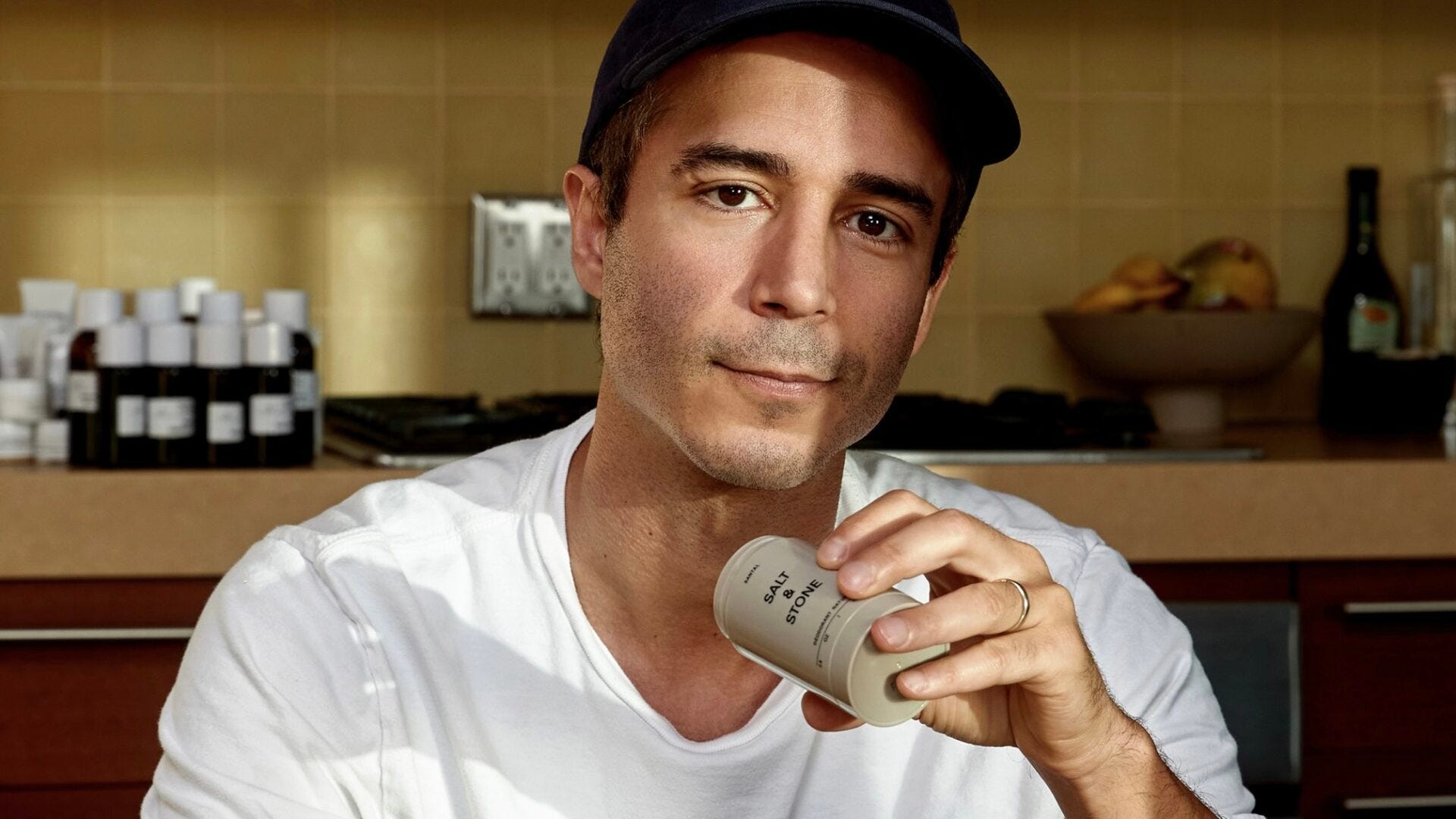
So a former pro snowboarder just sold his deodorant brand for $500 million.
The brand: Salt & Stone
The buyer: Advent International (global PE firm, $100B+ AUM)
The revenue: $165M (2025)
The multiple: ~3x revenue (premium for personal care)
The founding year: 2017 (8 years to $500M exit)
The capital raised: One minority round (Humble Growth, August 2024)
The founder’s stake at exit: Majority (retained equity, staying as CEO)
Now here’s what makes this fascinating: Salt & Stone isn’t positioned on “clean ingredients” or “natural” or “aluminum-free.”
It’s positioned on fragrance.
Four signature scents:
Santal & Vetiver
Bergamot & Hinoki
Black Rose & Oud
Neroli & Basil
Running across four product categories:
Deodorant (hero product)
Body mist
Body wash
Lotion
The insight: Body care as a fragrance delivery system.
Not: “Here’s natural deodorant that happens to smell nice.”
But: “Here’s a fragrance experience that happens to include deodorant.”
And this isn’t an isolated bet.
Last week, Sam K. of Five Seasons Ventures said on the In The Money podcast: “If you have a nuanced take on fragrance, I want to hear from you.”
His thesis: Take the boom in niche fragrance ($8B market growing 15%+ annually) and apply it to adjacent categories.
His examples:
Touchland: Fragrance-led hand sanitizer ($880M to Church & Dwight, 2025)
Sol de Janeiro: Brazilian fragrance-led body care ($2B+ valuation rumored)
Tallow & Ash: Fragrance-led laundry care (early stage)
Purdy & Figg: Fragrance-led surface cleaners (early stage)
This week: Advent paid $500M+ for Salt & Stone.
Sam called it.
Fragrance-led isn’t just a brand strategy anymore. It’s an acquisition thesis.
Let me show you why fragrance is becoming the premium signal in personal care, how Salt & Stone built $165M revenue with almost no VC funding, and why this exit proves that scent is the new moat in commoditized categories.
The Numbers: How a Former Pro Snowboarder Built $165M Revenue in 8 Years
Let’s start with Salt & Stone’s actual performance:
Salt & Stone at Exit (2025):
Revenue:
2025 revenue: $165M
Growth: Double-digit across all channels (15-20%+ estimated)
One deodorant sold every 5 seconds (globally)
Distribution:
DTC: 40% of sales (~$66M)
Retail: 60% of sales (~$99M)
Retail footprint: 1,700+ locations across 40 countries
Product mix:
Deodorant: ~60-70% of revenue (hero product)
Body wash: ~15-20%
Body mist: ~10-15%
Lotion: ~5-10%
Exit valuation:
Purchase price: $500M+ (reported)
Revenue: $165M
Revenue multiple: ~3.0x
For context on the multiple:
Recent personal care M&A:
Touchland → Church & Dwight ($880M, 2025):
Revenue: ~$100M
Multiple: ~8.8x revenue
Premium for hand sanitizer innovation
Hero Cosmetics → Church & Dwight ($630M, 2022):
Revenue: ~$115M
Multiple: ~5.5x revenue
Premium for acne patch category creation
Dr. Squatch → Unilever (~$1.5B, 2026):
Revenue: ~$300M
Multiple: ~5x revenue
Premium for men’s personal care
Salt & Stone at 3.0x revenue:
Lower than Touchland (8.8x) and Hero (5.5x)
But deodorant is more commoditized than hand sanitizer or acne patches
3x is premium for deodorant category
Why the premium?
Standard natural deodorant brands:
Native (P&G): Sold for ~$100M on ~$100M revenue = 1x multiple
Schmidt’s (Unilever): Sold for ~$100M on ~$50M revenue = 2x multiple
Commodity multiples (1-2x revenue)
Salt & Stone at 3x revenue = 50% premium over commodity.
What drove the premium? Fragrance positioning.
The Founder Story: From Pro Snowboarder to Fragrance Entrepreneur
Nima Jalali’s journey:
2000s: Professional snowboarding career
Competed internationally
Built understanding of performance/active lifestyle market
Key insight: Athletes care about how they smell (locker rooms, travel, close quarters)
2010s: Transition from athlete to entrepreneur
Exited snowboarding (injuries, age, career transition)
Worked in fashion/lifestyle (details unclear, but developed aesthetic sensibility)
Noticed: Natural deodorants worked but smelled terrible
2017: Founded Salt & Stone
Initial product: Natural deodorant in four fragrance profiles
Positioning: Performance meets fragrance (not “clean” meets “natural”)
Thesis: People will pay for deodorant that works AND makes them smell luxurious
The fragrance development:
Most natural deodorant brands (2017):
Used essential oils (tea tree, lavender, eucalyptus)
Smelled “natural” (aka medicinal, hippie-ish)
Target market: Whole Foods shoppers who tolerated the smell
Salt & Stone’s approach:
Hired perfumers (not just essential oil blending)
Created complex fragrance profiles:
Santal & Vetiver: Woody, earthy, masculine-leaning
Bergamot & Hinoki: Citrus, clean, unisex
Black Rose & Oud: Floral, resinous, feminine-leaning
Neroli & Basil: Herbal, fresh, unisex
Target market: People who shop at Le Labo and also want natural deodorant
The product positioning shift:
Before Salt & Stone:
“Natural deodorant” = hippie, crunchy, sacrifice
You bought it because it was better for you, not because you liked it
After Salt & Stone:
“Fragrance-led body care” = luxury, aspiration, premium
You buy it because you want to smell like this, and it happens to be natural
This is the same playbook as:
Aesop: Luxury hand soap (you buy for the experience, not just clean hands)
Le Labo: Niche fragrance (you buy for the scent, not just to smell good)
Byredo: Luxury fragrance (you buy for the aesthetic, not just perfume)
Nima applied luxury fragrance principles to deodorant.
The Fundraising Discipline: One Minority Round, Majority Ownership at Exit
Here’s where Salt & Stone’s story gets really interesting:
Total capital raised: One minority round (Humble Growth, August 2024)
Amount raised: Undisclosed, but likely $20-40M (minority round = 15-30% dilution)
Valuation at fundraise: Estimated $100-150M (based on exit multiple)
Exit: 18 months later at $500M+
Nima’s ownership at exit: Majority stake (50%+), retained equity, staying as CEO
For context:
Most DTC brands raising to $165M revenue:
Seed: $2-5M at $10-20M valuation (15-25% dilution)
Series A: $10-20M at $50-80M valuation (15-20% dilution)
Series B: $30-50M at $150-200M valuation (15-20% dilution)
Series C: $50-80M at $300-400M valuation (15-20% dilution)
Total raised: $100-150M, founder owns 20-40% at exit
Salt & Stone:
Bootstrap: $0 raised from 2017-2024 (7 years)
Minority round: $20-40M in 2024 (1 year before exit)
Total raised: $20-40M, founder owns 50%+ at exit
The ownership math:
If Nima owns 55% at $500M exit:
Nima’s payout: $275M
Humble Growth (assuming 25% stake): $125M on $30M investment = 4.2x MOIC in 18 months = 178% annualized return
Other investors/employees: $100M
For comparison:
Typical founder ownership at $165M revenue after raising $100M+:
Founder owns 25%
At $500M exit: Founder payout = $125M
Nima’s payout: $275M (55% ownership)
Typical founder payout: $125M (25% ownership)
Difference: $150M
That’s $150M Nima kept by bootstrapping to $100M+ revenue before raising institutional capital.
This is the same playbook as:
Julian Hearn (Huel): Bootstrapped to £18M revenue before Series A, owned 49% at €1B exit (£420M payout)
Anastasia Soare (ABH): Bootstrapped to $140M revenue before TPG investment, owned 62% (bought back TPG at distressed pricing)
Michael Dubin (Dollar Shave Club): Bootstrapped to $150M revenue, owned 50%+ at $1B exit to Unilever
The lesson: Every year you bootstrap is worth 5-10% ownership at exit.
Nima bootstrapped 7 years. That’s 35-70% ownership preserved.
The Fragrance Thesis: Why “Scent-First” Is the New Acquisition Target
Now let’s talk about why Sam K. of Five Seasons Ventures is actively hunting fragrance-led brands and why Salt & Stone’s exit validates this thesis.
The Category Context: Niche Fragrance Is Booming
Global fragrance market:
Total market: $50B+ (2024)
Niche/artisan fragrance: $8B (16% of total)
Niche growing at 15%+ CAGR vs. mass fragrance at 3-5%
Why niche is growing:
Consumer shift:
2010s: Wore same fragrance for years (Calvin Klein, Chanel No. 5)
2020s: Curate fragrance wardrobe (different scents for different moods)
Fragrance as self-expression, not just smell-good
Category leaders:
Le Labo:
Founded 2006, acquired by Estée Lauder (2014) for ~$200M
Now ~$500M+ revenue (estimated)
Signature scent: Santal 33 (became cultural phenomenon)
Byredo:
Founded 2006, minority investment from Manzanita (2016)
Now ~$300M+ revenue (estimated)
Cult following, celebrity-worn
Diptyque:
Founded 1961, acquired by LVMH (via L’Oréal JV, then Manzanita)
Revenue: ~$400M+ (estimated)
Premium candles + fragrance
The insight:
People will pay $300 for 100ml of fragrance if:
The scent is unique (not available at department stores)
The brand has aesthetic/cultural cachet
The experience is premium (packaging, storytelling)
This same willingness to pay premium for fragrance applies to adjacent categories.
The Adjacent Category Playbook: Fragrance-Led Expansion
Sam K.’s thesis:
If people pay $300 for Le Labo fragrance, they’ll pay $20-40 for products that deliver the same fragrance experience:
Deodorant (Salt & Stone)
Hand sanitizer (Touchland)
Body care (Sol de Janeiro)
Laundry (Tallow & Ash)
Surface cleaners (Purdy & Figg)
Let’s break down each:
1. Touchland (Hand Sanitizer) - $880M Exit to Church & Dwight
The brand:
Founded by Andrea Lisbona (2018)
Product: Fragrance-led hand sanitizer in luxury packaging
Signature scents: Vanilla Blossom, Citrus Berry, Lavender Bloom
The positioning:
Not: “Hand sanitizer that happens to smell nice”
But: “Luxury fragrance experience that happens to sanitize”
The performance:
Revenue: ~$100M (at acquisition, 2025)
Exit: $880M to Church & Dwight
Multiple: 8.8x revenue
Why the premium multiple?
Standard hand sanitizer:
Purell, Germ-X: Commodity (1-2x revenue multiples)
Functional, medicinal smell
Touchland:
Luxury positioning (premium pricing)
Fragrance-forward (people buy for scent)
Category creation (hand sanitizer as accessory)
Church & Dwight paid 8.8x revenue because Touchland proved you can charge $12 for hand sanitizer if it smells luxurious.
2. Sol de Janeiro (Body Care) - $2B+ Valuation Rumored
The brand:
Founded by Heela Yang and Marc Capra (2015)
Product: Brazilian-inspired body care (creams, mists, oils)
Signature scent: Brazilian Bum Bum Cream (pistachio, salted caramel, vanilla)
The positioning:
Not: “Body lotion that moisturizes”
But: “Brazilian beach vacation in a bottle”
The fragrance strategy:
Each product built around signature scent
Scent so distinctive people ask “what perfume are you wearing?”
Fragrance IS the product (moisturizing is secondary)
The performance:
Revenue: $400M+ (estimated, 2024)
Valuation: $2B+ (rumored in fundraising talks)
Multiple: 5x revenue
Why the premium valuation?
Standard body lotion:
Aveeno, Cetaphil, Eucerin: Functional (1-2x revenue)
Sold on efficacy (moisturize, repair, protect)
Sol de Janeiro:
Sold on experience (smell like vacation)
Viral on TikTok (”What’s that smell?” videos)
People buy for scent, keep using for scent
This is fragrance-led body care working at scale.
3. Tallow & Ash (Laundry Care) - Early Stage
The brand:
Founded recently (2022-2023)
Product: Fragrance-led laundry detergent
Positioning: Luxury laundry care with niche fragrance profiles
The thesis:
Standard laundry detergent: Tide, Gain (smell mass-market)
Opportunity: Laundry detergent with Le Labo-quality scents
Your clothes smell like $300 perfume for $25/bottle
Why this could work:
Laundry is low-involvement:
People use same detergent for years
Switching based on scent = easy decision
Fragrance is high-involvement:
People curate fragrance wardrobe
Want clothes to smell specific way
Tallow & Ash = high-involvement fragrance applied to low-involvement laundry.
4. Purdy & Figg (Surface Cleaners) - Early Stage
The brand:
Founded recently (2021-2022)
Product: Fragrance-led surface cleaners, dish soap
Positioning: Luxury cleaning products with niche scents
The thesis:
Standard cleaning: Method, Mrs. Meyer’s (mass-market “nice” scents)
Opportunity: Cleaning products with perfumer-quality fragrances
Your home smells like Aesop, not Whole Foods
Why this could work:
Cleaning products are daily-use:
People smell their dish soap, counter spray, floor cleaner daily
Current options: Chemical (Clorox) or basic-nice (Method)
Gap: Luxury fragrance experience in cleaning
Purdy & Figg = Le Labo for your kitchen.
Why This Playbook Works: The Four Structural Advantages
1. Premium pricing justified by fragrance:
Commodity deodorant:
Degree, Secret, Speed Stick: $5-8 per stick
Positioned on function (wetness protection, odor control)
Fragrance-led deodorant:
Salt & Stone: $18-22 per stick
Positioned on experience (smell luxurious)
3x price premium justified by scent
2. Repeat purchase driven by scent attachment:
Functional products:
People switch based on price, availability
Low loyalty
Fragrance products:
People attached to “their scent”
High loyalty (won’t switch even if cheaper alternative exists)
Scent creates moat
3. Cross-category expansion natural:
Once you own a scent:
Can deploy across categories (deodorant → body wash → lotion → candles)
Customer buys entire ecosystem to maintain scent
Higher LTV through category expansion
Salt & Stone:
Started: Deodorant only
Now: Deodorant, body wash, body mist, lotion
Customer buys 3-4 products to maintain Santal & Vetiver scent
4. Viral on social (scent-based content):
TikTok/Instagram:
“What perfume are you wearing?” videos go viral
People asking about scent = earned media
User-generated content drives discovery
Sol de Janeiro: Millions of “Brazilian Bum Bum” TikToks
Salt & Stone: Thousands of “Santal & Vetiver is the best scent” videos
Fragrance-led brands get free marketing through scent virality.
Why Strategics Are Paying Up: The M&A Thesis
Now let’s talk about why Advent paid $500M+ for Salt & Stone—and why more fragrance-led acquisitions are coming.
The Strategic Rationale (Why PE/CPG Want Fragrance Brands)
1. Fragrance = pricing power:
Church & Dwight’s perspective (Touchland acquirer):
Owns commodity brands: Arm & Hammer, OxiClean, Batiste
Gross margins: 40-45%
Problem: Commoditized, price competition
Acquires Touchland:
Premium positioning (fragrance-led)
Gross margins: 60-70%
Instant margin accretion
2. Fragrance = moat (hard to replicate):
Functional benefits are easy to copy:
Natural deodorant: Any brand can make it
Aluminum-free: Any brand can do it
No defensibility
Fragrance is hard to copy:
Each scent is unique (proprietary formulation)
Consumer attachment to specific scent
Even if competitor makes similar product, customers won’t switch if scent is different
3. Fragrance = category expansion:
Advent’s perspective (Salt & Stone acquirer):
Owns Salt & Stone deodorant (fragrance equity built)
Can launch: Body wash, lotion, candles, laundry, air care
One acquisition becomes 5-10 product lines
Le Labo playbook:
Started: Fragrance only
Now: Candles, body care, home care
Fragrance equity deployed across 20+ SKUs
Advent can do this with Salt & Stone.
The Exit Multiples: Fragrance Brands Command Premium
Let’s compare exit multiples:
Fragrance-led brands:
Touchland: 8.8x revenue
Salt & Stone: 3.0x revenue (deodorant is more commoditized)
Sol de Janeiro: 5x revenue (rumored valuation)
Average: 5-6x revenue
Function-led brands:
Native (natural deodorant): 1x revenue
Schmidt’s (natural deodorant): 2x revenue
Hero Cosmetics (acne patches): 5.5x revenue (outlier, category creation)
Average: 2-3x revenue
Fragrance-led brands trade at 2x the multiple of function-led brands.
Why?
Function is commoditizable:
Any brand can make natural deodorant
Race to bottom on price
Fragrance is defensible:
Unique scent profile = moat
Premium pricing sustainable
Strategics pay premium for moats.
What This Means for Founders: The Fragrance Playbook
If you’re building in personal care, home care, or any adjacent category, here’s the playbook:
Step 1: Lead with Fragrance, Not Function
Don’t build:
“Natural deodorant with clean ingredients”
“Eco-friendly laundry detergent”
“Non-toxic surface cleaner”
These are table stakes. Everyone has this.
Do build:
“Deodorant with niche fragrance profiles” (Salt & Stone)
“Laundry detergent that makes clothes smell like $300 perfume” (Tallow & Ash)
“Surface cleaner with Aesop-quality scents” (Purdy & Figg)
Function is commodity. Fragrance is premium.
Step 2: Hire Actual Perfumers (Not Just Essential Oil Blenders)
Most natural brands:
Use essential oils (lavender, tea tree, eucalyptus)
Mix in-house (no perfumer training)
Result: Smells “natural” (aka medicinal)
Fragrance-led brands:
Hire professional perfumers (IFF, Givaudan, Firmenich)
Create complex profiles (top/middle/base notes)
Result: Smells luxurious
This is the difference between:
Native deodorant (smells like hippie co-op)
Salt & Stone (smells like Le Labo)
The cost:
DIY essential oil blending: $500-2K per formula
Professional perfumer: $10-30K per fragrance
The ROI:
DIY formula:
Appeals to Whole Foods shoppers only
$5-10 price point
Commodity
Professional fragrance:
Appeals to luxury consumers
$18-25 price point
Premium
Spending $30K on perfumer pays back immediately through pricing power.
Step 3: Build Scent Families, Not Just Products
Don’t launch:
One deodorant
One body wash
One lotion
Do launch:
Deodorant in 4 scent families
Body wash in same 4 scents
Lotion in same 4 scents
Create scent ecosystem
Salt & Stone:
Santal & Vetiver: Across deodorant, wash, mist, lotion
Customer buys all 4 products to maintain scent
LTV = 4x
Sol de Janeiro:
Brazilian Bum Bum scent: Across cream, mist, oil, shower gel
Customer buys 3-5 products
LTV = 3-5x
Fragrance families create cross-sell.
Step 4: Bootstrap to $50-100M Revenue Before Raising
Salt & Stone:
Bootstrapped 7 years (2017-2024)
Raised minority round at $100M+ revenue
Owned 50%+ at $500M exit
Typical DTC brand:
Raises seed at $0 revenue
Raises Series A at $5M revenue
Raises Series B at $20M revenue
Owns 20-30% at exit
The difference:
If Salt & Stone raised traditional VC path:
Seed: $3M at $10M pre (23% dilution)
Series A: $15M at $50M pre (23% dilution)
Series B: $40M at $150M pre (21% dilution)
Final ownership: 38%
By bootstrapping:
No seed (0% dilution)
No Series A (0% dilution)
Minority round only (20-30% dilution)
Final ownership: 55%+
Difference: 17 percentage points = $85M in exit proceeds.
Bootstrapping to $50M+ revenue is worth $50-100M at exit.
Step 5: Target Categories with Low NPS (Opportunity for Fragrance Upgrade)
High NPS categories (avoid):
Skincare: People love their brands (Drunk Elephant, CeraVe)
Makeup: Emotional attachment
Hard to disrupt
Low NPS categories (target):
Deodorant: People tolerate their brands
Laundry: Nobody loves Tide
Surface cleaners: Functional, boring
Hand soap: Utilitarian
Easy to disrupt with fragrance
Salt & Stone won because:
Natural deodorant worked (function) but smelled bad (experience)
People wanted natural but hated the scent
Salt & Stone offered natural + luxurious scent = instant win
Find categories where function is solved but experience sucks.
Add fragrance. Win.
The Final Reality
A former pro snowboarder built a deodorant brand around fragrance and sold it for $500M+ to Advent International.
The brand: Salt & Stone
The revenue: $165M (2025)
The positioning: Body care as fragrance delivery system
The capital raised: One minority round (Humble Growth, August 2024)
The founder’s ownership: 50%+ (estimated, retained equity, staying as CEO)
The insight:
People don’t buy deodorant for function (aluminum-free, natural, wetness protection).
They buy it for how it makes them smell.
And if you can make them smell like $300 Le Labo fragrance for $18:
They’ll pay.
The broader thesis (Sam K., Five Seasons Ventures):
Take niche fragrance boom ($8B market, 15%+ growth) and apply to adjacent categories:
Deodorant (Salt & Stone, $500M exit)
Hand sanitizer (Touchland, $880M exit)
Body care (Sol de Janeiro, $2B+ valuation)
Laundry (Tallow & Ash, early stage)
Surface cleaners (Purdy & Figg, early stage)
The pattern:
Fragrance-led brands command premium multiples:
Salt & Stone: 3.0x revenue
Touchland: 8.8x revenue
Sol de Janeiro: 5x revenue (estimated)
Function-led brands get commodity multiples:
Native: 1x revenue
Schmidt’s: 2x revenue
The lesson:
Function is table stakes. Fragrance is premium.
If you’re building in personal care, home care, or any adjacent category:
Lead with fragrance (not function)
Hire professional perfumers (not DIY)
Build scent families (not single products)
Bootstrap to $50-100M revenue (preserve ownership)
Target low-NPS categories (opportunity for fragrance upgrade)
That’s how you build a $500M exit.
From the slopes to $165M revenue in 8 years.
Fragrance is the new moat.
Are you leading with function or fragrance?
Keep building,
David
P.S. Sam K. called this thesis literally one week before Salt & Stone’s exit was announced. When a savvy VC investor publicly declares “I want to fund fragrance-led brands in adjacent categories,” and then a $500M exit validates the thesis seven days later, that’s not coincidence. That’s pattern recognition. If you’re building in deodorant, laundry, cleaning, hand soap, or any “boring” category, ask yourself: could fragrance be the differentiator? Because Salt & Stone just proved you can turn deodorant into a $500M business if you make people smell like they’re wearing $300 perfume. That’s the entire playbook.