


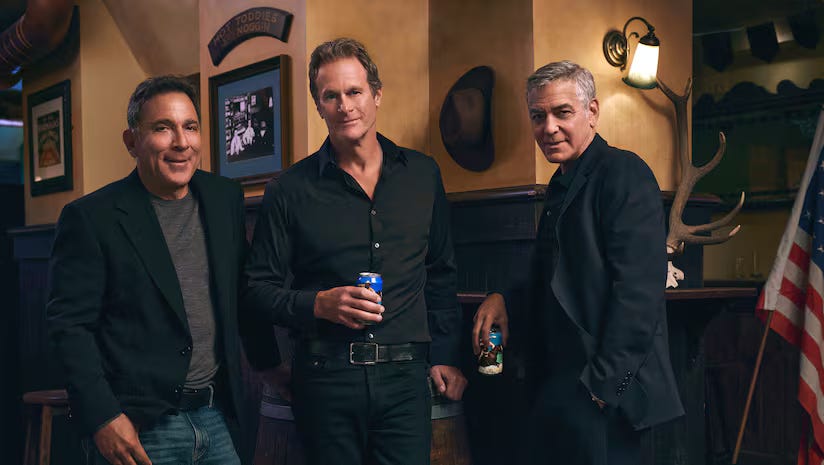
Let’s set the scene.
It’s 2013. George Clooney, one of the most famous humans on earth, is kicking back at his villa in Mexico with his best mates Rande Gerber (nightlife entrepreneur, husband of Cindy Crawford) and Mike Meldman (billionaire real estate developer behind Discovery Land Company).
They’re doing what rich people do when they get bored on vacation. They decide to make their own tequila. Not to sell. Not to build a brand. Just for themselves. something smooth enough to drink straight, no lime, no salt, no nonsense.
They weren’t trying to build a brand or chase trends. They were just looking for a drink they could enjoy without the usual burn or fuss. Four years later, Diageo called.
It was purchased in June 2017 by the multinational beverage company Diageo for $700 million plus up to a further $300 million based on the brand’s performance.
$1 billion for a tequila they made for themselves.
And now, nine years after that sale, the same three men just launched a non-alcoholic beer brand, closed a $15 million Series Seed, and assembled arguably the most dangerous team in the non-alc space.
The brand: Crazy Mountain
The investors: CAVU Consumer Partners (led the round), Coatue ($70B AUM), Discovery Land Company (incubator)
The CEO: Steve Fechheimer, former CEO of New Belgium Brewing
The category: The US non-alcoholic beer market, valued at $6.4 billion in 2025, with the global market expected to grow from $25.9 billion in 2026 to $50.8 billion by 2035.
This is worth paying attention to.
First, Let’s Talk About What CAVU Actually Represents
CAVU was founded in 2015 by brand builder and ABC Shark Tank guest judge Rohan Oza and former hedge fund veteran Brett Thomas. CAVU (Ceiling and Visibility Unlimited) is a pilot term used to describe the best possible flying conditions.
The portfolio reads like a greatest hits of modern consumer: CAVU has backed leading consumer brands including Poppi, Bai, ONE Brands, Vital Proteins, Once Upon a Farm, Waterloo, Whoop, The Farmer’s Dog, Thrive Market, Good Culture, and many others.
But the one that matters most for this story is Poppi. CAVU first invested in Poppi when Allison Ellsworth appeared on Shark Tank in 2018. They led subsequent rounds, including a $25M Series B in 2022. Poppi was purchased by Pepsi for nearly $2 billion, generating an estimated 88x return for CAVU’s earliest investment.
And now CAVU just closed their biggest fund ever: CAVU’s fifth fund closed at $325 million, besting its $275 million target, with the first investment going to magnesium-based drink brand Recess.
Crazy Mountain is Fund V’s highest-profile bet to date. Brett Thomas, Co-Founder and Managing Partner at CAVU, who will also join the board, said: “Moderation is not a fad — it’s a durable change in behavior. The brands that will win are those built around authentic founding vision and genuine product conviction. Crazy Mountain is just that.”
When the firm that 88x’d on Poppi calls something a durable behavioral change not a fad you listen.
The Origin Story: From “House of Friends” to “Beer, Only Freer”
The Casamigos story is the foundation of everything.
George Clooney, Rande Gerber, and Mike Meldman pooled their tastes, their ideas, and their time, and turned what started as casual evenings into something much bigger. The tequila wasn’t meant for the public, at least at first, it was made by friends, for friends, simply for the pure enjoyment of it. But as they shared it with their inner circle, word got out. People started asking where they could snag a bottle.
Since inception Casamigos received numerous awards from tequila experts and tastemakers across the US. The brand had a CAGR of 54% in the last two years before acquisition, reaching 120,000 cases in 2016.
Then Diageo showed up. The transaction valued Casamigos at up to $1 billion, with initial consideration set at $700 million and a further potential $300 million based on a performance linked earn-out over 10 years.
After the sale, you’d expect these three to retire. Clooney had his Lake Como villa. Gerber had his nightlife empire. Meldman had Discovery Land Company arguably the most exclusive private club developer in the world, responsible for luxury residential communities that sell memberships for $500K+.
Instead, they started watching what was happening in beverages. Gerber explained: “We wanted to create a beer that lets you enjoy the moment, as well as the morning after. Something real, refreshing and crafted for the way we actually live today.”
And unlike Casamigos, where the product was created accidentally over years of personal experimentation Crazy Mountain was incubated by Coatue and Discovery Land Company alongside the founding team before going public.
This wasn’t a weekend passion project. This was a deliberate, structured brand incubation.
Mike Meldman essentially used Discovery Land Company whose members represent the wealthiest consumer demographic in the US as a live testing ground. Meldman said: “We’ve spent years understanding what makes a brand resonate at scale. We believe the category is ready for something built around real beer culture, and that’s exactly what we’ve set out to create.”
That’s not founder hype. That’s market research disguised as hospitality.
The CEO Hire: Why Steve Fechheimer Changes Everything
The single most underrated part of this announcement?
Steve Fechheimer as CEO. This is where Crazy Mountain separates itself from every other celebrity non-alc brand.
Fechheimer is a graduate of the Wharton School at the University of Pennsylvania with a Bachelor of Science in economics, and also received an MBA from the University of Chicago Booth School of Business. With a background in spirits and global business development, he brings a fresh perspective to the craft beer world.
Before New Belgium, Fechheimer was the former Chief Strategy Officer at spirits giant Beam Suntory. Before that, he consulted at The Boston Consulting Group and Marakon Associates.
New Belgium co-founder Kim Jordan hired Fechheimer to supplant her as CEO in July 2017.
His six-year tenure saw New Belgium’s acquisition by Kirin-owned Lion Little World Beverages, a new record volume as the company pushed across 1.2 million barrels, Voodoo Ranger Imperial IPA becoming the top-selling IPA and the No. 2 best-selling craft beer in the US, and the biggest Year One craft beer launch of all time in Voodoo Ranger Juice Force IPA.
Let that sink in: the biggest Year One craft beer launch of all time.
Fechheimer then departed New Belgium in 2023 to “explore new challenges” after leaving the business performing at record levels.
He spent nearly three years exploring. Now he’s building Crazy Mountain.
This isn’t a CEO-for-hire. This is a beverage industry elite choosing to bet his next chapter on this category and this brand.
The Product: What Makes This Different From Every Other NA Beer
Let’s talk about what’s actually in the can. Crazy Mountain comes in two varieties: Original, described as a balanced, clean, and refreshing take on a classic lager, and Lime, a citrus-forward option for those who want a little more brightness in the can. Both varieties clock in at around 65 calories per 12-ounce can.
65 calories. Zero alcohol. £28 for a 12-pack.
But what separates Crazy Mountain technically from every other NA beer? The team uses a brewing process that means they don’t have to remove alcohol after brewing, so they keep the integrity of the flavour from start to finish.
This is the crucial technical point most coverage is missing.
Most NA beers are brewed normally, then the alcohol is stripped out afterwards, either through:
Vacuum distillation (heat-based alcohol removal)
Reverse osmosis (pressure-based filtration)
Both processes work. But both remove more than just alcohol — they strip out volatile aromatic compounds, hop oils, and fermentation byproducts that give beer its complexity.
The result is a beer that tastes thin, metallic, or “off.”
Crazy Mountain brews specifically for NA from the start, using arrested fermentation techniques that limit alcohol production in the first place, rather than removing it later.
The flavour profile is built for zero alcohol, not rescued from it.
Crazy Mountain is a premium non-alc lager-style brew for those who want to live healthier without giving up the taste, ritual, camaraderie, and satisfaction of drinking a cold one.
The brand is positioned for “cowboys, surfers, and bikers who crave a cold one after a long journey or anyone who chooses strength, clarity, and authenticity.”
This is a beer brand for people who choose not to drink tonight. That distinction matters enormously.
The Market: Why Now Is The Right Moment (And Why It’s Still Early)
The numbers on this category are staggering: The global non-alcoholic beer market was valued at $24 billion in 2025. The market is expected to grow from $25.9 billion in 2026 to $50.8 billion by 2035 at a CAGR of 7.8%.
The US non-alcoholic beer market alone accounted for $6.4 billion in 2025, driven by well-established health and wellness movements, the sober-curious trend gaining mainstream acceptance, and craft brewing culture embracing innovation.
The behavioral data is even more compelling: According to recent polling, 41% of Americans are actively trying to moderate their alcohol consumption in 2024, a 7% increase from 2023. Meanwhile, 58% of consumers say that low- and non-alcoholic beer is a good alternative for anyone looking to moderate their alcohol consumption long-term.
Athletic Brewing, the booze-free brainchild of Bill Shufelt, a former trader at Steve Cohen’s famed hedge fund Point72 Asset Management, and brewer John Walker, was already the undisputed market leader. The company, which launched in 2017, has carved out more than 50% market share and landed on the Inc. 5000 for the past four straight years. By 2024, it surpassed $90 million in annual revenue.
Athletic’s valuation has doubled with its latest fundraising and now stands at $800 million.
So Athletic is the category creator. The proof it works. But here’s the thing about proof-of-concept leaders: they rarely become the mass-market winner.
Craft brands validate categories. But mainstream brands capture them.
Red Bull validated energy drinks. Monster captured the mass market.
Snapple validated premium tea. Arizona took it mass.
SodaStream validated sparkling water at home. But the Sodastream of sparkling water brands (in terms of scale) is actually LaCroix.
Athletic Brewing validated NA craft beer. Who captures the mass-market opportunity?
There has also been a crop of entrepreneurially minded celebrities pouring into the space, actor Tom Holland launched Bero, retired basketball star Dwyane Wade co-founded Budweiser Zero with AB InBev and podcast host and actor Dax Shepherd created Ted Segers.
But none of them have:
A $1B beverage exit as proof
A former Fortune 500 brewery CEO running day-to-day
Coatue ($70B AUM) at the table from day one
Discovery Land Company’s ultra-HNWI member base as a live test market
CAVU’s distribution and retail network
That combination is unprecedented in NA beer.
The Real Play: What Crazy Mountain Is Actually Betting On
Everyone’s talking about the celebrity angle. That’s not the story. The real story is the convergence of five forces:
Force 1: The Sober-Curious Movement Is Now Mainstream
Younger drinkers use buzzwords like “sober curious” and “damp lifestyle” to describe moderating their alcoholic intake, rather than abstaining entirely. Gen Z drinks less than prior generations at the same age, and millennials hold the largest share of no-alcohol drinkers, according to IWSR.
People aren’t quitting beer. They’re choosing when to drink it and when not to. That means NA beer isn’t a replacement, it’s an addition to the repertoire.
Total beverage occasions expand. The pie grows.
Force 2: GLP-1 Drugs Are Changing Alcohol Consumption
This isn’t widely discussed yet in the NA beer conversation, but it should be.
GLP-1 users (now 23%+ of US households) report dramatically reduced desire for alcohol, not just food. The mechanism: GLP-1 receptors in the brain affect dopamine reward pathways for both food AND alcohol. Clinical research shows GLP-1 users consume 50-70% less alcohol.
For 15M+ Americans currently on these drugs, NA beer becomes the natural substitute, same ritual, same social occasion, no conflict with their medication or lifestyle.
Crazy Mountain is perfectly positioned for this tailwind without even having to market to it.
Force 3: The Ritual Problem (And How Crazy Mountain Solves It)
Gerber said: “Crazy Mountain belongs to everyone pushing for more and wanting to live wide open, whether it’s riding the biggest wave, climbing the highest mountain, the fight they show up for, or the dream they refuse to let go of.”
This is the insight that separates winning NA brands from losing ones: Drinking a beer is not primarily about alcohol. It’s about:
The cold can on a hot day
The post-workout ritual
The game day experience
The Friday evening wind-down
The social signal (”I’m in party mode”)
Most NA beers try to sell health. Crazy Mountain is selling the ritual.
“We wanted you to keep the ritual without the alcohol” is a fundamentally different pitch than “our beer is healthier.”
One appeals to your lifestyle. One appeals to your guilt. Lifestyle wins.
Force 4: Distribution Will Be The Moat
Here’s where Fechheimer becomes invaluable beyond his brewing expertise.
Building DSD (Direct Store Delivery) distribution is the hardest thing in beverage:
Relationships with regional distributors take years
Distributors have limited carrying capacity
Premium placement (eye-level, end caps, cooler doors) is contested
Steve Fechheimer built New Belgium’s DSD network across the entire US.
His tenure saw New Belgium push across 1.2 million barrels and become the #2 best-selling craft beer in the US.
He has the relationships. He knows the distributors. He understands the economics.
And CAVU, which deployed the same DSD playbook with Poppi — will support that expansion with their own relationships.
The celebrity gets you awareness. The operator gets you distribution. You need both.
Force 5: Taste Technology Has Finally Caught Up
The biggest knock on NA beer has always been simple: it doesn’t taste like beer.
Watery. Metallic. Thin. Like someone described beer to a scientist who’d never had one.
But brewing technology has transformed in the last 5 years:
Arrested fermentation techniques (brew for NA from the start)
Cold hopping methods that preserve aroma without fermentation
Reverse osmosis improved 300%+ in fidelity
Malt science advances allowing fuller body without alcohol
Advancements in brewing technology, including vacuum distillation, reverse osmosis, and arrested fermentation, allow producers to improve taste and aroma, enhancing acceptance and reducing historical stigma.
This matters because the #1 barrier to NA beer adoption is taste.
When NA beer tastes like beer, trial converts to repeat. When it doesn’t, people try it once and go back to Athletic or Heineken 0.0.
Crazy Mountain’s process-first approach (don’t remove alcohol, don’t brew it in) is the most technically sound path to full-flavour NA.
The Casamigos Playbook Reversed: What They Learned From The $1B Exit
Here’s the fascinating meta-layer of this story: Casamigos succeeded by accident with no infrastructure.
No professional beverage team. No VC backing. No distribution strategy. Just three friends who made great tequila and benefited from the cultural proximity to George Clooney’s orbit.
Crazy Mountain is the opposite:
Professional operator from day one (Fechheimer, not a celebrity CEO)
Category-leading VC from day one (CAVU, not a post-launch investor)
Institutional incubation (Coatue + Discovery Land Company, not kitchen experiments)
Product technology first (brewing process designed for NA, not retrofitted)
Deliberate category timing (NA beer at inflection, not early-days tequila)
The founders learned from Casamigos: the best celebrity brands aren’t run by celebrities. Coatue’s Ben Schwerin said: “The founding team has done it before, and we believe they’re the right group to build the defining mainstream brand in this space.”
“Done it before” is doing a lot of work in that sentence. They built a $1B exit with no plan. Now they have a plan.
Why This Could Be Bigger Than Casamigos
Let’s run the valuation math:
Athletic Brewing (NA beer category leader):
Revenue: $90M+ (2023)
Valuation: $800M (July 2024)
Multiple: ~8x revenue
Tom Holland’s BERO:
Revenue: ~$10M (estimated Year 1)
Valuation: $100M+ (Paine Schwartz investment)
Multiple: ~10x revenue
Crazy Mountain target scenario (Year 5):
If Crazy Mountain can:
Reach $150-200M revenue (Athletic Brewing in 7-8 years, Crazy Mountain could do faster with celebrity + CAVU distribution)
Maintain 8x revenue multiple (category standard)
Implied valuation: $1.2-1.6B
Who acquires them?
Diageo (already bought Casamigos, has NA beer gap in portfolio)
Keurig Dr Pepper (already an Athletic Brewing investor, understands category)
AB InBev (Budweiser Zero, but needs premium NA option)
Heineken (Heineken 0.0, but wants a premium NA brand)
The most poetic outcome: Diageo buys Crazy Mountain, the second brand from the same three founders completing the circle.
$1B for Casamigos in 2017. $1B+ for Crazy Mountain in 2031.
Same three guys. Different liquid.
What Founders Should Take From This (The Real Lessons)
Lesson 1: Your Exit Track Record Is Your Next Round’s Pitch Deck
Clooney, Gerber, and Meldman didn’t need a pitch deck. They needed three sentences:
“We built Casamigos. Diageo paid $1 billion. We’re doing it again in NA beer.”
CAVU wired $15M. Your track record is your most powerful fundraising asset.
If you’ve built and sold something before, even at $20M, even at $50M that signal is worth more than any pitch deck slide.
Don’t downplay your exits. Build your reputation around them.
Lesson 2: Hire the Operator Before You Hire Anyone Else
The single biggest mistake celebrity-backed consumer brands make:
The celebrity tries to run the business.
Tom Holland at BERO (working with John Herman, ex-Chobani). Ryan Reynolds at Aviation Gin (hired proper operators). Serena Williams at her VC fund (backed operators, didn’t try to run portfolio companies).
The ones who fail: Celebrities who think their fame translates to operational expertise.
Crazy Mountain hired Steve Fechheimer before they announced anything.
Wharton undergrad. Chicago Booth MBA. BCG + Marakon Consulting. Beam Suntory Chief Strategy Officer. New Belgium CEO for 6 years. Built the #2 craft beer brand in America.
The celebrity opens the door. The operator builds the house.
Lesson 3: Incubation > Acceleration
Most brands get:
Founded by founder
Pitch to VC 12-18 months later
Raise seed, hire team, build product
Lose 18 months to figuring out product-market fit
Crazy Mountain got:
Incubated inside Discovery Land Company (UHNW consumer base)
Live product testing with the highest-purchasing consumers in America
Coatue’s data and technology team analyzing consumer behavior
Launched knowing the product worked
Discovery Land Company membership clubs charge $500K+ to join and $100K+ in annual dues.
The members are the most affluent, trend-setting consumer demographic in the US. If Crazy Mountain works for Discovery Land members, it works for everyone.
Real market research beats desk research. Live incubation beats accelerator programs.
Lesson 4: Category Timing Matters More Than Product Quality
Casamigos launched tequila in 2013.
Was 2013 an interesting moment in tequila? Not particularly.
But the timing worked because:
Premium spirits growing
Margarita culture expanding
Celebrity spirits beginning (Casamigos was early)
Crazy Mountain is launching NA beer in 2026.
Non-alcoholic beer is projected to overtake ale as the second-largest beer category worldwide this year.
The timing here is not accidental. It’s calculated.
They waited until:
Athletic Brewing proved category at $800M valuation
Tom Holland’s BERO proved celebrity NA beer at $100M valuation
GLP-1 adoption hit 23% of US households
41% of Americans actively trying to moderate alcohol
They could have launched in 2022. They didn’t. Patience in category timing is a strategy.
The Final Reality
In 2013, George Clooney accidentally made one of the best-selling super-premium tequilas in history.
In 2026, the same team deliberately built what might become the defining mainstream non-alcoholic beer brand.
The difference between accident and intention:
Professional operator (Steve Fechheimer) vs. founder-CEO
Category-leading VC (CAVU + Poppi’s $2B exit) vs. no institutional backing
Incubation by Coatue’s data team + Discovery Land’s UHNW members vs. Mexican villa experiments
Deliberate process-first brewing technology vs. traditional methods repurposed
$6.4B US market growing to $50B globally by 2035 vs. tequila growing steadily
The raise:
$15M Series Seed
Led by CAVU (the firm that 88x’d on Poppi)
Coatue ($70B AUM) participating
Discovery Land incubating
The founding team:
George Clooney: Cultural distribution engine that money can’t buy
Rande Gerber: Nightlife and social occasion expertise
Mike Meldman: Real estate + exclusive community incubation
Steve Fechheimer: The operator who built 1.2M barrel craft beer at New Belgium
Rande Gerber said: “We’re building Crazy Mountain for the way we live today. Keeping the ritual of drinking a cold one, just without the alcohol.”
The ritual is the product. The beer is the delivery mechanism. And in a world where 41% of Americans are actively moderating their alcohol consumption, the ritual has never been more valuable.
Are you watching this space? Because the team behind Crazy Mountain definitely is.
P.S. The most important detail in this entire announcement that everyone glossed over: Coatue’s Ben Schwerin joined Crazy Mountain’s Board of Directors. Coatue is a $70B global technology investment platform. They are not a consumer VC. They don’t typically sit on boards of early-stage beverage brands. The fact that Ben Schwerin personally took a board seat, not just a check signals that Coatue sees Crazy Mountain as a technology + data play, not just a celebrity beverage bet. Discovery Land Company’s member data, Coatue’s data science infrastructure, and a $6.4B addressable market. This might be the most technologically sophisticated NA beer brand ever built. And nobody’s talking about that part.
P.P.S. Diageo paid $1B for Casamigos in 2017. They watched three of their best-performing acquisitions in recent years, including Casamigos generate exceptional returns. Diageo also owns Guinness 0.0, which is growing rapidly but sits at the mass-market end of NA beer. They have no premium, lifestyle-forward NA beer brand. Crazy Mountain could fill that gap perfectly. And if Diageo buys Crazy Mountain in 5-7 years, it would be the third transaction between essentially the same parties. The beverage M&A world is smaller than you think. And the best acquirers often come back to the same founders.
Amazing!