



One quick note before we start.
This is the last free post before the paywall goes up on 1 October. From then, paid subscribers get two posts a week and the free plan drops to one a month.
The 40% discount on an annual subscription closes at midnight on the 30th and then the link is dead and the rate goes back to normal. If this newsletter has earned it, now is the moment: creatorsblueprint.co/subscribe?coupon=248ce3f8
Right. On to the question, and I have picked this one deliberately because it is the thing that kills more good brands than anything else I write about.
Here is what landed in my inbox this week:
“David, we’re growing 60% year on year and I have never been more stressed. Every month we sell out, every month I’m scrambling to fund the next production run, and my accountant keeps telling me we’re ‘profitable’ while my bank balance says otherwise. Everyone congratulates us on the growth. It feels like we’re dying. What am I missing?”
You are not missing anything. You have correctly identified that you are in danger. I want to be direct. This is a serious issue and me giving you a reassuring answer would be irresponsible.
Growth is the most common cause of death in consumer brands. Not slow growth. Fast growth.
You are describing the exact condition that took Trapstar from £40 million in revenue to administration. Their own advisers put it in writing: the revenue decline was driven by “working capital constraints impacting inventory availability, rather than any underlying demand or brand performance.”
The demand was there. The brand was intact. Rihanna, Jay-Z and Stormzy still wore it. They just ran out of money to make the thing people wanted to buy. By the time administrators were appointed, 57 jobs were at risk and the business was being sold for parts.
So let me explain what is happening to your cash, why your accountant is technically right, and what you do about it starting this week
Why Profitable Companies Run Out Of Money
Profit and cash are measured on completely different clocks. Your P&L records a sale the moment you invoice. Your bank account records it the moment the money lands. In a fast-growing physical product business, those two events can be separated by four months, and in between you have already spent the cash on the next production run.
Say you are doing £3 million in revenue at 60% gross margin, growing 60% a year. Your accountant shows you a healthy P&L. Here is what is actually happening to your cash.
The cash conversion cycle, step by step:
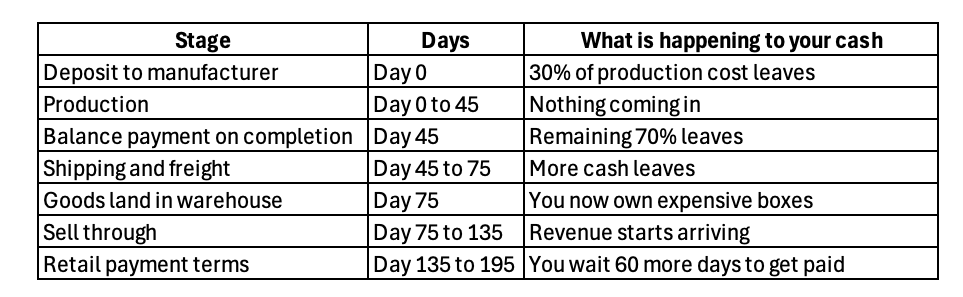
Total: roughly 195 days from paying out to getting paid back. Six and a half months.
You do not get to wait for that cycle to complete before starting the next one. If you are growing, you have to order the next production run before the last one has been paid for. And the next one has to be bigger. So you are funding two and a half production cycles simultaneously, each one larger than the last, out of a bank balance that only ever sees the proceeds of the smallest one. This is why growth consumes cash. It is not a sign you are doing something wrong. It is arithmetic.
The Number Your Accountant Is Not Showing You
Here is the calculation to run this afternoon. It takes about 20mins
Working capital requirement = Inventory days + Receivable days − Payable days
Using the cycle above:
Inventory days: 75 (manufacture to warehouse) + 60 (average time on shelf) = 135
Receivable days: 60 (retail payment terms) = 60
Payable days: what your suppliers actually give you. Assume 30
135 + 60 − 30 = 165 days of working capital.
Now convert that to money.
At £3 million revenue and 40% cost of goods, your annual COGS is £1.2 million. Daily COGS is roughly £3,300.
165 days × £3,300 = £544,000 permanently tied up in the business.
That is cash you will never see again while you are trading. It is not profit you can take out. It is not available for marketing. It is the cost of being in business at your current size.
If you grow 60% next year to £4.8 million, your working capital requirement grows proportionally to roughly £870,000. You need to find an additional £326,000 of cash, in advance, purely to fund the growth you have already been congratulated on.
Where does that £326,000 come from?
If your net margin is 10%, you made £300,000 in profit this year. Every single penny of it, plus a bit more, is consumed by the working capital your growth demands. You have grown 60%, generated £300,000 of profit, and have less cash in the bank than you started with.
That is what a 60% growing physical product business does by default, and it is exactly why your bank balance is telling you something different from your accountant.
The Spiral, And How To Recognise It Early
The dangerous part is what happens when the gap finally becomes unbridgeable. It follows the same sequence every time.
Stage one: You cannot fully fund the next production run, so you order 70% of what you need. This feels prudent.
Stage two: You sell out three weeks early. Revenue for the period comes in below forecast, not because demand fell but because you had nothing to sell.
Stage three: Lower revenue means less cash. The next order is 60% of what you need.
Stage four: You are now out of stock more than you are in stock. Retailers notice. Your shelf space gets reallocated to a competitor who can actually supply.
Stage five: Your customers form a new habit with a different brand. Repeat purchase rates fall.
Stage six: Revenue declines are now real rather than supply-driven, and by this point nobody can tell the difference. Including you.
Trapstar went from £40 million to £17.7 million in two years. That is a 55% decline. The brand had not lost its cultural equity. Footasylum bought it out of administration precisely because the equity was still there. The demand survived. The cash did not.
The early warning signs, in order of severity:
You are regularly out of stock on your best sellers.
You have started using personal credit or director loans to bridge production. You are paying suppliers late.
You are taking terms from a factor or paying for expedited freight because you left the order too late.
You have chosen a smaller production run knowing it will sell out.
11 Ways To Fix It, In Order Of How Fast They Work
I have ordered these by speed of impact, because when you are in this position you need cash this quarter, not next year.
This week
Renegotiate supplier terms before anything else: Every 30 days of supplier credit you win reduces your working capital requirement by roughly 30 days of COGS. In the example above, moving from 30 days to 60 days frees up £99,000. Permanently. For the price of a phone call. Suppliers will often give terms to a growing customer they want to keep. Most founders never ask because they assume the answer is no. Ask for 60. Settle for 45. You have just funded a month of growth for free.
Get a deposit or shorter terms from your largest customers: If wholesale is 40% of your revenue and you move those accounts from 60 days to 30, you free up another £66,000. Smaller independents will often pay on delivery or even pro forma. It is the large accounts that squeeze you, and they squeeze you because you let them.
Kill your slowest 20% of SKUs immediately: Every SKU carries inventory. In most brands I look at, the bottom fifth of the range accounts for under 5% of revenue and roughly 20% of the inventory value. Discontinuing them converts dead stock into cash and permanently reduces the working capital the business needs. It also makes every subsequent forecast more accurate, because you are predicting demand across fewer lines.
This month
Raise your prices: I know. But look at what it does mechanically. A 10% price increase on a 60% gross margin product takes you to 64% gross margin, and it drops straight through to cash because your COGS has not moved. On £3 million revenue, that is £300,000 of additional gross profit a year with no additional working capital requirement whatsoever. There is no other lever in this entire list that produces that much cash for that little effort. Most founders in this position are underpriced and terrified to move, and the fear is almost always worse than the churn.
Sort your forecasting properly: Most of the panic in your email comes from ordering blind. If you can forecast eight weeks out with reasonable accuracy, you can place orders earlier, use slower and cheaper freight, avoid expedited shipping, and negotiate from a position of calm rather than desperation. Expedited air freight instead of sea can cost five to ten times as much per unit. Brands in this trap pay it routinely and treat it as a cost of doing business. It is a cost of poor forecasting.
Shift your channel mix toward the ones that pay you fastest: DTC pays you in days. Retail pays you in 60 or 90. They are not equivalent revenue. A £ of DTC revenue is worth substantially more to a cash-constrained business than a pound of wholesale revenue, even at similar margins, because it arrives two months sooner and funds the next production run. If you are cash constrained, deliberately over-index on the fast-paying channel until the balance sheet can carry the slow one.
This quarter
Get an inventory or trade finance facility: This is the correct financial instrument for this specific problem and far too few founders use it. Trade finance lends against confirmed purchase orders. Inventory finance lends against stock you already hold. Both are secured on the asset and typically cost between 8% and 15% annually. Compare that to equity. If you sell 20% of your company to fund working capital, and the business is eventually worth £20 million, that funding cost you £4 million. A £300,000 trade facility at 12% costs you £36,000 a year. Working capital is the one thing you should almost never fund with equity. It is a recurring operational need secured against a real asset. That is what debt is for.
Consider a factoring facility on your wholesale receivables: Factoring advances you 80% to 90% of an invoice immediately for a fee of typically 1% to 3%. It is more expensive than it looks on an annualised basis, but if it is the difference between funding the next production run and stocking out, the maths is not close. Use it tactically, not permanently. If you are still factoring in two years, the underlying problem was never solved.
This year
Move some production closer to home: Overseas manufacturing is cheaper per unit and vastly more expensive in cash terms, because of the 60 to 90 day lead times and the deposit structure. Domestic or nearshore production often costs 20% to 30% more per unit but cuts your cash cycle by 45 to 60 days. Run the actual comparison rather than assuming the cheaper unit wins. For a cash-constrained business growing quickly, the expensive fast option frequently produces more profit in absolute terms because you can turn the inventory more times a year.
Look seriously at vertical integration once you are at scale: This is what Huel did, and their filings show the effect clearly. Gross margin fell from 62% in 2021 to 55% in 2022 under supply chain inflation, then recovered to 59% by 2024 as vertical integration took hold. Four points of margin back, and considerably more control over timing. It is a £50 million-plus revenue move, not a £3 million one. But know that it is the eventual answer.
Model your cash 13 weeks out, every week, forever: Not your P&L. Your actual bank balance, week by week, for the next quarter. This is the single habit that separates founders who survive this from founders who do not. Not because the forecast is accurate, but because you see the problem eleven weeks before it arrives rather than the Friday it lands. Build it in a spreadsheet. Opening balance, cash in by week, cash out by week, closing balance. Update it every Monday morning before you do anything else.
Every founder I know who has been through a genuine cash crisis runs one of these now. Almost none of them ran one before.
The Strategic Question
60% growth might be the wrong rate for your business. There is a rate of growth your balance sheet can fund from operations. It is called your sustainable growth rate, and it is roughly your net margin multiplied by your asset turnover.
If your working capital requirement grows faster than your retained profit, you are structurally required to raise external capital every year just to stand still. That is a real strategic choice, not a neutral fact, and most founders make it accidentally.
There is a version of your business doing £4.2 million next year instead of £4.8 million, at 12% net margin instead of 10%, that generates cash rather than consuming it, and is worth more to an acquirer.
Look at the Gymshark numbers on this, because they are the clearest public example in British consumer. Revenue grew 150% between 2020 and 2025. Adjusted EBITDA margin halved from 16% to around 8%. The business got much bigger and considerably less valuable. Growth that degrades your margin structure is not creating value. It is converting equity into revenue.
So the honest question is not “how do I fund 60% growth.”
It is “is 60% the right number, and what would 40% with a functioning balance sheet actually be worth?”
Sometimes the answer is yes, push. Category land grabs are real and being second in a winner takes most category is worthless.
But it should be a decision you made, not a rate you drifted into because the graph looked good.
Immediate Steps
Build the 13-week cash forecast. Two hours. Do it before anything else.
Calculate your working capital requirement using the formula above, then calculate what it becomes at your projected growth rate. That gap is the number that matters.
Call your three largest suppliers and ask for extended terms. Highest return activity available to you this week.
Cut the bottom 20% of your SKU range.
Model a 10% price increase and be honest about the churn assumption.
Speak to a trade finance provider, even if you do not use them yet. Have the facility in place before you need it, because the terms you get when you are desperate are considerably worse than the terms you get when you are not.
The Thing I Most Want You To Take From This
You wrote that everyone congratulates you on the growth and it feels like you are dying. Trust that feeling. It is more accurate than the congratulations.
Trapstar had £100 million in lifetime revenue, three of the biggest names in music wearing it organically, a World Fashion Award beating Supreme, and it ended in administration because of working capital.
Uncle Nearest raised $225 million, was valued at $1.1 billion, and the court-appointed receiver found it losing roughly $1 million a month with no independent audit ever conducted.
In both cases the brand was real. The demand was real. The cash was not.
You have spotted the problem while you still have options. Most founders spot it when the options have already gone. Fix the balance sheet. The growth will still be there.
P.S. If you take one thing from this: working capital should almost never be funded with equity. It is a recurring operational requirement secured against a real, saleable asset. That is precisely what debt exists for. Selling 20% of a company that might be worth £20 million in order to buy inventory is a £4 million decision to solve a £300,000 problem. Trade finance at 12% costs £36,000 a year. Founders reach for equity because it is the funding they understand and the funding everyone talks about. Learn the boring instruments. They are considerably cheaper than the exciting ones.
P.P.S. And one last time before the wall goes up. From Thursday, this newsletter is two posts a week for paid subscribers and one a month on the free plan. 40% off twelve months closes at midnight on the 30th: creatorsblueprint.co/subscribe?coupon=248ce3f8. Whatever you decide, thank you for reading this year. It has genuinely been the best thing I have built.