


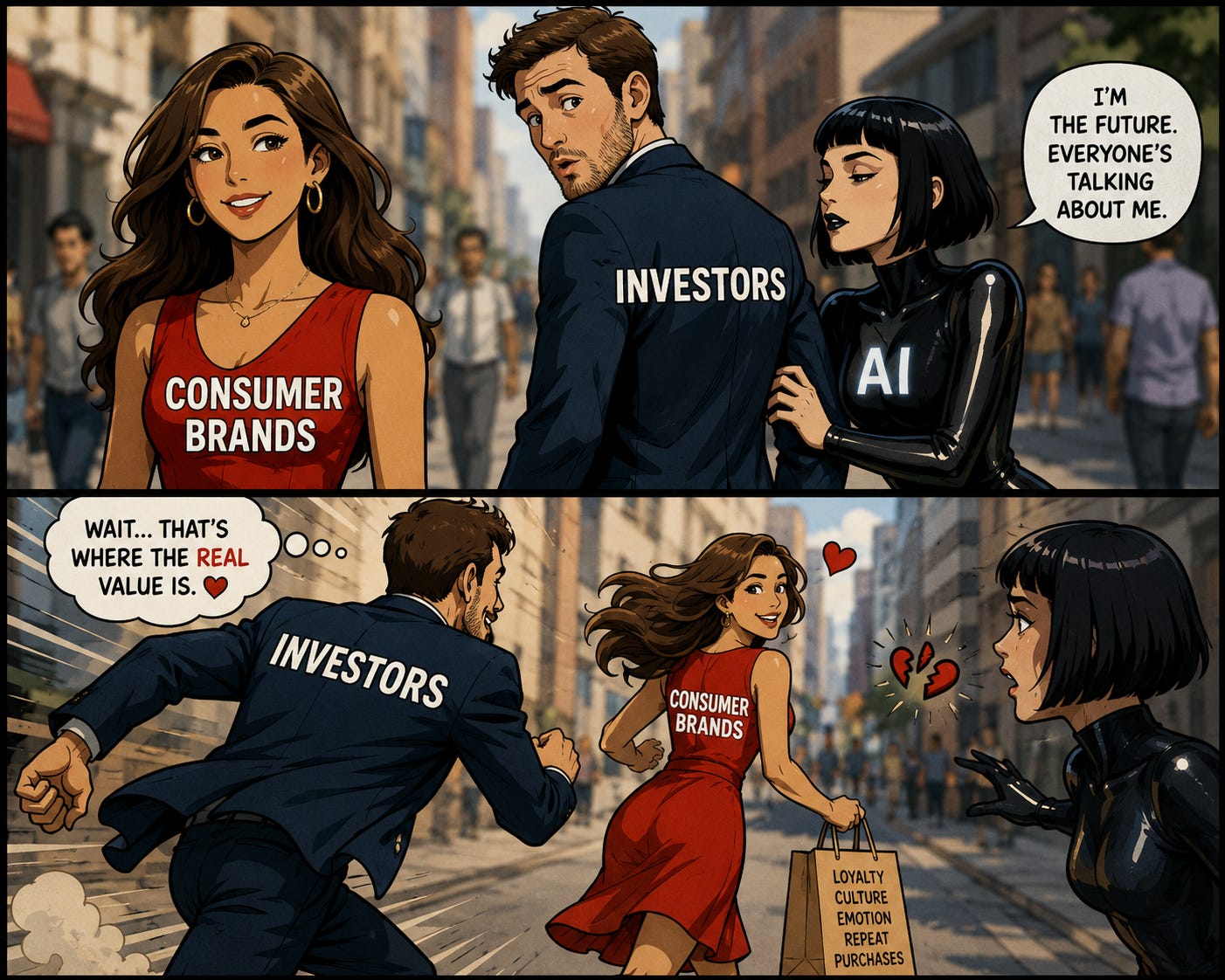
I want to share something that’s been sitting with me for a few weeks.
Bank of America CFO Alastair Borthwick noted something striking: roughly 70% of the US economy is driven by consumer spending. Consumer spending hit $19,667 billion in Q4 2025 and accounts for approximately 68% of US GDP the highest share in decades.
And here’s what I couldn’t stop thinking about: While virtually every dollar of venture capital conversation centres on AI infrastructure, developer tooling, and enterprise software, the category that drives two-thirds of the entire US economy is consistently treated as a second-tier investment category.
Consumer is either underestimated or misunderstood by almost everyone with capital. And I think the AI revolution the very thing being used to justify ignoring consumer is actually the argument for why consumer is about to become the most valuable category in the world.
Let me explain why.
The $16.86 Trillion Category That Venture Treats Like a Hobby
Consumer spending is set to rise 2.1% in 2026 to reach $16.86 trillion, having grown at a CAGR of 2.7% over the five years through 2026.
For context: the entire global software market the category venture capital treats as its primary mandate is approximately $700 billion annually.
Consumer spending is 24 times larger than software.
And yet venture capital allocates roughly 3-6% of total deployment to consumer, versus 40%+ to enterprise software and AI infrastructure.
This isn’t a market inefficiency. It’s a category misunderstanding.
For years, venture capital has treated consumer as:
Cyclical and trend-driven (not structural)
Less defensible than software (no “moat”)
Overly dependent on marketing (not a real business)
Hard to scale (capital-intensive, low margins)
Every one of these assumptions is collapsing. And AI is the reason.
The Paradox: Why AI Makes Consumer MORE Valuable, Not Less
Here’s the argument most people are making: “AI will commoditise content creation. CPG brands spend enormous amounts on marketing, content, and creative. AI will cut those costs dramatically. Consumer becomes cheaper to operate.”
This is true but incomplete. And the incomplete part is where the real insight lives. As artificial content becomes infinite, authenticity becomes scarce. And scarcity creates value. Think about what AI is actually doing to the content environment:
AI-generated content surpassed human-written content online for the first time in 2025. Nearly a third of consumers say they’re less likely to choose a brand that leans on AI in its advertising.
According to Edelman’s 2025 Trust Barometer, nearly 70% of consumers worry that misinformation and false content are increasingly being used to intentionally mislead the public. Audiences no longer trust polished messaging alone.
71% of consumers feel frustrated by impersonal brand communications. Nearly 40% worry about being misled or misinformed by brands using AI. And 46% of people trust a brand less if they learn it’s using AI to provide services they assumed were coming from a human.
Here’s what’s happening: When AI can generate an infinite supply of technically competent content perfect copy, perfect creative, perfect product design the thing that becomes scarce isn’t the content.
It’s the trust, identity, and emotional resonance behind the content.
Sir Lucian Grainge, Chairman of Universal Music, put it well, AI can generate endless music. More songs, more sounds, more content than ever before. But eventually much of it converges into the same emotional frequency. The same familiarity. The same optimised middle.
What it cannot generate is the thing that “lights your skin on fire.”
Simon Cowell made a similar observation: AI may become an extraordinary tool, but human beings are still the ones who create magic.
This is the thesis in its simplest form: When creation becomes infinite, the scarce asset becomes taste. Identity. Trust. Emotion. Community. Human connection.
In other words: culture. And in CPG, culture has always been the asset. We just didn’t have language for it.
What This Means for CPG Specifically
CPG has spent the last decade being told it’s behind. Behind on data. Behind on personalisation. Behind on DTC. Behind on performance marketing.
But the brands that have driven the most extraordinary exits in the last 36 months Poppi ($1.95B), Rhode ($1B), Salt & Stone ($500M+), Gruns ($1.2B), Huel (€1B), Siete Foods ($1.2B), Dr. Squatch ($1.5B) weren’t won on data or technology.
They were won on culture.
Poppi didn’t win because their prebiotic formula was defensible. They won because they made soda feel like a cultural act.
Rhode didn’t win because their Peptide Lip Treatment was technically superior. They won because they turned a skincare routine into an identity.
Salt & Stone didn’t win because deodorant is defensible. They won because they made body care smell like a $300 niche fragrance and positioned it as a lifestyle signal.
Gruns didn’t win because greens powder was novel. They won because a former PE analyst understood exactly which metrics drove acquisition multiples, built the financial machine precisely to those metrics, and surrounded it with a brand that had “aura” selective disclosure, coordinated PR, the perception of inevitable success.
In every case: the product was the vehicle. The culture was the asset.
Consumers buy into purpose, values, and belonging not just products. Creators are central, shaping culture, bridging brands to communities, and translating moments into trusted storytelling.
And this is precisely what AI cannot replicate.
The Three New Principles of CPG in an AI World
Principle 1: The Authenticity Premium Is Now Real and Measurable
Research shows that AI authorship often creates what researchers call a “trust penalty” lower trust, weaker engagement, and more negative brand evaluation. A 2025 study from the Nuremberg Institute for Market Decisions found that simply labelling an ad as AI-generated makes people see it as less natural and less useful, which lowers ad attitudes and willingness to research or purchase.
The implications for CPG brands: This is not a call to avoid AI. AI as an operational tool for supply chain, for personalisation, for testing, for efficiency is table stakes and you’d be foolish not to deploy it.
But AI as a brand voice is different. And the data is unambiguous: consumers penalise perceived inauthenticity with reduced trust and reduced purchase intent.
For CPG brands to continue to win with celebrity partnerships, authenticity must go beyond an endorsement. True impact comes when talent is genuinely embedded in the product or brand story — whether that means contributing to product development or a brand tapping into their viral cultural moments.
The brands winning right now, MOSH (Maria Shriver’s 20-year personal connection to Alzheimer’s research, embedded in every ingredient decision), Crazy Mountain (three men who already built a $1B drinks brand using the same trust currency they’re depositing here), Salt & Stone (a former pro snowboarder who actually lives the brand’s outdoor identity) are winning because their authenticity isn’t performed. It’s documented.
The founder’s story isn’t a marketing decision. It’s a founding condition.
In an AI world, the only authenticity that survives is the kind that predated the brand.
Principle 2: Community Is the New Distribution Moat
Communities provide the belonging people crave while delivering measurable business results like 23% higher profitability and significantly improved customer retention.
Fandoms now play a role as primary identity structures, emotional support systems, and cultural co-creation engines. 66% of Gen Z and Gen Alpha spend more time with fan-created content than with official content. 83% of Gen Z fans say their engagement shapes how creators and brands develop content. These are not passive audiences. They are active participants who generate cultural value.
Here’s the thing about distribution moats in CPG: The old moat was shelf space. Whoever had 30,000 retail doors had an insurmountable advantage. The new moat is community. Whoever has 300,000 people who buy because they belong not because the product was visible has a fundamentally different kind of asset.
The distinction matters because: Shelf space is rented. The retailer can delist you, deprioritise you, replace you with private label.
Community is owned. The people who buy Rhode because it’s part of their identity as a “clean girl aesthetic” consumer don’t stop buying because Sephora moves the SKU.
AI-generated content surpassed human-written content online for the first time in 2025. The brands paying attention are pivoting fast. And the ones that aren’t risk being left behind.
92% of consumers trust peer recommendations over brand content. 84% trust brands more when they feature UGC in marketing. 60% of consumers identify UGC as the most authentic content type, surpassing expert reviews, influencer content, and brand messaging.
The brands building community right now through missions (MOSH and Alzheimer’s advocacy), through identity (Salt & Stone’s outdoor lifestyle signalling), through belonging (Rare Beauty’s mental health community) are building distribution moats that DSD networks and shelf placements can’t replicate.
This is the infrastructure shift. And most traditional CPG is not paying attention.
Principle 3: Celebrity Isn’t the Asset, Cultural Proximity Is
Celebrity-driven businesses have historically scaled approximately 20% faster to liquidity outcomes and achieved exits roughly 20% larger than non-celebrity peers.
But that statistic obscures the most important distinction in modern CPG: The celebrity brands that are winning aren’t winning because a famous person endorsed a product. They’re winning because a culturally credible person embedded their identity into a product and the community that follows that person came with them.
The difference: Brands that show up opportunistically are rejected. Brands that participate meaningfully are rewarded.
Gwen Stefani’s GXVE was launched with Sephora distribution and VC backing. It died quietly in February 2026. Hailey Bieber’s Rhode launched DTC with three products, sold out in hours, built a 60,000-person waitlist, and was acquired for $1 billion in three years.
Same industry. Same celebrity model. Opposite outcomes.
The variable wasn’t fame. It was the depth of cultural authenticity behind the product.
Hailey Bieber had perioral dermatitis. Rhode exists because she needed a product that didn’t exist. The community follows because they share the same skin experience, the same aesthetic values, the same aspiration not because they follow Hailey Bieber.
In an AI world, the celebrity is increasingly just the loudest signal of an authentic point of view that the market was waiting to receive. And the brands smart enough to build cultural proximity founders with documented, personal relationships to the problem they’re solving will have distribution advantages that no performance marketing budget can buy.
The Structural Shift: Consumer Is Becoming Infrastructure
Here’s where the framing changes most dramatically. For decades, the mental model for a CPG brand was:
Product → Distribution → Marketing → Revenue
A linear chain. You make the thing, you get it onto shelves, you run ads, you generate sales. The mental model for the winning CPG companies of the next decade is:
Community → Content → Commerce → Infrastructure
Community first. You build a group of people who share an identity, a belief, or an experience.
Content as the bridge. Creators authentic ones, not paid ambassadors translate the community’s values into discoverable moments.
Commerce as the expression. The product is how the community member expresses their belonging. Buying Rhode isn’t buying lip treatment. It’s saying “I’m a glazed skin person.”
Infrastructure as the outcome. The community becomes the distribution engine. The product becomes the ecosystem.
Culture is what people pay attention to what they watch, share, laugh about, and rally around. To tap into that energy, brands must align investments with real behaviours and passion points, not demographic checkboxes. This is why the lines between categories are collapsing: Media companies are becoming commerce companies (MrBeast Burger, Feastables).
Consumer brands are becoming platforms (AG1 isn’t just a supplement, it’s a health optimisation identity ecosystem). Creators are becoming infrastructure (the creator’s community is more powerful distribution than 30,000 retail doors).
In 2026, consumers start to experiment with personal AI agents to manage shopping lists, compare prices, switch between retailers, and automatically fulfil routine items. This creates both a threat and an opportunity: Personal AI may or may not care about your brand equity.
This is the critical challenge: If consumers delegate purchasing decisions to AI agents that optimise on price and availability, commodity consumer brands die. The private label wins every time.
But the brands with genuine cultural resonance where the purchase is an identity signal, not just a transaction survive the AI agent era, because the consumer overrides the optimisation.
People will override their AI shopping agent to buy Rhode specifically. They won’t override it to buy a particular brand of tomato puree. Cultural resonance is the wall between your brand and commoditisation.
The Four CPG Archetypes That Win In This Era
Not every consumer brand can play this game. The question is which archetype you’re building toward.
Archetype 1: The Mission-Embedded Brand
Definition: The reason the brand exists predates the business decision to start it.
Examples:
MOSH (Maria Shriver’s 20-year Alzheimer’s advocacy)
Uncle Nearest (Fawn Weaver’s mission to honour Nearest Green — genuine even amid financial troubles)
Rare Beauty (Selena Gomez’s pre-brand mental health journey)
Why this works in an AI world: The mission is uncopiable. You can train an AI on Rare Beauty’s aesthetic. You cannot train it on Selena Gomez’s actual lived experience with mental health. The community is pre-built. Maria Shriver had an audience of brain health advocates before MOSH launched. The brand didn’t have to create the community. It gave the community a product.
The test: Does the brand’s reason to exist predate the business plan?
Archetype 2: The Identity Signal Brand
Definition: Buying the product is a public statement about who you are.
Examples:
Rhode (glazed skin aesthetic as identity)
Salt & Stone (outdoor/active lifestyle identity)
Liquid Death (anti-corporate punk identity)
Le Labo (taste connoisseur identity)
Why this works in an AI world: Identity signals are infinitely shareable. The drive for identity signalling is critical for Gen Z and Millennial audiences. Possessing or consuming a limited-edition, visually unique product is a public declaration of one’s membership in a fandom, acting as a form of social currency. When your product photographs itself when someone leaving the gym with a Salt & Stone deodorant is making a visual statement you have marketing that operates independently of your marketing budget.
The test: Would someone photograph buying this product and post it?
Archetype 3: The Science-First Brand
Definition: The product has defensible functional efficacy, not just lifestyle positioning.
Examples:
Gruns (3.0x LTV:CAC cohort economics, clinical nutrition formulation)
Huel (vertical manufacturing, nutritionally complete formulation, GLP-1 aligned)
MOSH (Cognizin Citicoline, the only bar with this clinical ingredient)
AG1 (80+ ingredients, clinical dosing transparency)
Why this works in an AI world: AI can generate infinite wellness content. It cannot generate genuine clinical efficacy. The brands that are both culturally resonant AND scientifically credible have a double moat. AI in marketing can result in a more emotional response initially, but consumers do not consider advertisements solely on their visual appeal, they consider the purpose and effort in the content. Authenticity has been noted to play an important role.
When the science is real, the cultural community built around it self-reinforces. AG1 doesn’t need to spend on trust the clinical transparency generates it.
The test: Could an independent researcher verify the efficacy claims? And would they?
Archetype 4: The Financial Machine Brand
Definition: The brand is built backwards from acquisition multiples, with unit economics designed for compounding.
Examples:
Gruns (Chad Janis, former PE analyst, built to 3.0x LTV:CAC on payback, exits in 3 years)
Huel (Julian Hearn bootstrapped to £18M revenue before Series A, maintained 49.3% ownership to exit)
Salt & Stone (Nima Jalali bootstrapped to $100M+ revenue, one minority round, kept 55%+)
Why this works in an AI world: AI is making customer acquisition more competitive, not less. The brands that engineer their unit economics precisely, LTV:CAC ratios, cohort stacking, contribution margin targets will survive rising CAC environments.
The brands that rely on paid performance marketing without the underlying cohort economics will get squeezed as AI optimises the ad auction against them.
The test: Does the founder know their 6-month LTV:CAC ratio? Their contribution margin trend? Their cohort retention curve? If not, they’re not running a financial machine. They’re running a marketing campaign hoping to become a business.
The Six Things I’d Do Right Now If I Were Building a CPG Brand in 2026
I’m going to be direct here, because this is where thought leadership usually gets vague.
1. Stop building the brand. Start building the community.
The sequence that works in 2026:
Year 1: Build the community (content, mission, point of view)
Year 2: Give the community something to buy (hero product)
Year 3: Scale the community’s buying behaviour (distribution, retail)
The sequence that’s failing:
Year 1: Build the product
Year 2: Try to build community around the product
Year 3: Wonder why the community never materialised
Community first. Product as the expression of community values.
Traditional advertising is losing its effectiveness due to digital fatigue and AI saturation. Consumers trust people more than brands. Communities provide the belonging people crave while delivering measurable business results like 23% higher profitability and significantly improved customer retention.
2. Invest in human storytelling, not AI-generated content
AI as operations: Yes. Absolutely. Use it for supply chain, for data analysis, for A/B testing, for CRM, for operational efficiency. AI as brand voice: Extremely carefully.
Simply knowing that a piece of content was crafted by an algorithm as opposed to by a human creative made people trust it less and engage with it less enthusiastically. The brands that will win in an AI-saturated content environment are the ones that invest MORE in human storytelling. Real founders. Real customers. Real experiences. Real imperfection.
A shaky phone video of a real customer using your product is harder to fake. In 2025, that imperfection has become more valuable than perfection ever was.
3. Engineer your unit economics before you scale your marketing
The Gruns lesson is the most important lesson in this newsletter’s history: 3.0x LTV:CAC on a 6-month payback basis is the threshold that determines whether you’re building a compounding machine or burning money. Before you spend another pound on customer acquisition, know:
Your CAC (actual, not blended)
Your 6-month LTV
Your contribution margin
Your cohort retention curve
If you don’t know these numbers, you’re marketing without a foundation.
4. Bootstrap longer than you think you need to
The data is now overwhelming:
Julian Hearn (Huel): Bootstrapped to £18M revenue, kept 49.3% at €1B exit = £420M
Nima Jalali (Salt & Stone): Bootstrapped to $100M+ revenue, kept 55%+ at $500M exit = ~$275M
Allison Ellsworth (Poppi): Raised only $25M total, kept enough equity that CAVU made 88x
Every year you bootstrap preserves 5-10% equity. At a $500M exit, that’s $25-50M per year of bootstrapping. The institutional pressure to raise early, raise large, and grow fast is real. But the founders who’ve built the most generational wealth in CPG are the ones who resisted that pressure longest.
5. Position for acquisition from day one, but don’t optimise for it
The counterintuitive truth about strategic M&A in CPG: The brands that get the best acquisition multiples are the ones that looked like they didn’t need to sell.
Poppi was growing 100%+ with strong unit economics. They didn’t need Pepsi’s money.
Rhode was selling out every launch, had 10 million Sephora opening weekend. They didn’t need e.l.f.’s money.
Gruns hit $300M revenue in 3 years with cohort economics that would have continued compounding. They didn’t need Unilever’s money.
The brands that need to sell get commodity multiples. The brands that could keep going get premium multiples. Build the business as if you’ll never sell it. Let the strategics fight over the opportunity to buy it.
6. Treat your finances like your product
The Uncle Nearest lesson deserves to end every CPG conversation right now. $1.1 billion claimed valuation. $100 million actual. No tax returns since 2018. No independent audit. Ever. Pre-2024 records deleted.
Financial discipline is not the enemy of creative, mission-driven brand building. It is the infrastructure that allows the mission to survive long enough to matter.
File your taxes. Get audited. Know your cap table. Keep clean books. Maintain covenant-required cash balances. The mission deserves a business underneath it that can outlast the founders.
What This All Means for the Next Decade
I left that trade delegation week with one conviction I didn’t arrive with: The venture capital community is about to be embarrassed by consumer.
Not because consumer suddenly becomes “tech-adjacent.” But because the very thing they’ve been betting on AI, is creating the conditions that make consumer uniquely valuable.
When every product can be commoditised, when every process can be automated, when every piece of content can be generated at infinite scale and near-zero cost:
The irreplaceable assets are the ones you can’t generate. Trust earned over decades. Community built through shared identity. Mission rooted in genuine human experience.
Cultural resonance that makes people buy not because the product is optimal but because buying is an act of belonging.
The future of CPG is consumer-centric, tech-driven, and human at its core, and the brands that embrace these trends will capture attention, loyalty, and sustainable growth.
The next decade of iconic companies will not just be the ones with the best technology.
They’ll be the ones that make people care. And in a world increasingly flooded with infinite AI-generated sameness, making people care is the rarest, most defensible, most valuable capability on earth.
Consumer isn’t secondary to the AI revolution. Consumer is the primary beneficiary of it.
Are you building something that makes people care? Or are you optimising something that makes people buy?
There’s a $16.86 trillion difference between those two questions.
P.S. The most important data point in this entire piece came from Bank of America’s CFO: consumer spending is now approximately 68% of US GDP the highest share in decades. Meanwhile, AI infrastructure attracts 40%+ of venture capital deployment against a fraction of that economic contribution. The reallocation of capital toward consumer, already evidenced by $16B in fresh consumer VC commitments in the last 15 months, $10B+ in brand M&A exits, and fund closes from L Catterton ($11B), VMG ($1B), Forerunner ($1B), and CAVU ($325M) isn’t the beginning of a trend. It’s the correction of a decade-long mispricing. The question isn’t whether consumer gets repriced. The question is whether you’re positioned to benefit when it does.
P.P.S. One last thing. The brands I’ve covered in this newsletter over the last six months Poppi, Gruns, Huel, Rhode, Salt & Stone, MOSH, Crazy Mountain have one thing in common beyond their exits: none of them tried to be everything at once. Poppi was prebiotic soda. Rhode was skincare. Salt & Stone was fragrance-led deodorant. Gruns was greens powder. Each was a single, extraordinarily clear positioning in the service of a specific community with a specific identity. In an AI era that will generate infinite variations of everything, the brands that win will be the ones that are irreducibly specific. Depth in one thing beats width across many things every time. Build the thing nobody else can build. Be the brand nobody else can be.
This is exactly why we are so bullish about consumer- great write up!