


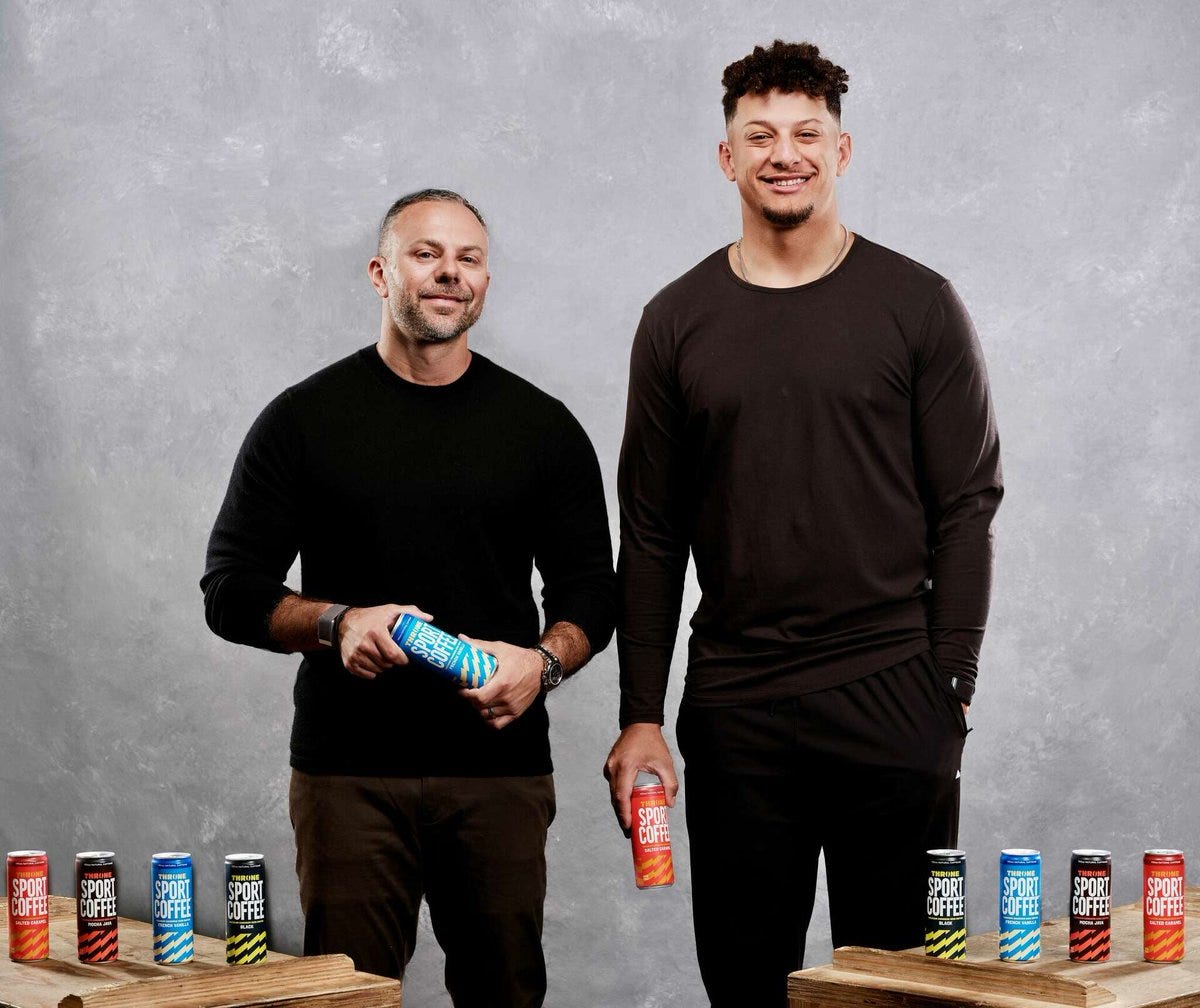
So Michael Fedele helped build BODYARMOR into the brand Coca-Cola paid $5.6 billion for in 2021.
Then he watched Coke write down $760 million of that value two years later.
He saw what worked. He saw what broke. And now he’s doing it again but different.
The new brand: Throne Sport Coffee
The raise: $18 million
The athlete: Patrick Mahomes (equity holder, not just endorser)
The distributor: Big Geyser (the same distributor that scaled Celsius and Vitaminwater in NYC)
The twist: This time it’s not a sports drink. It’s functional coffee targeting the moment before the workout, not after.
Now here’s what makes this fascinating: Fedele isn’t just copying the BODYARMOR playbook. He’s running the upgraded version that fixes everything Coke got wrong post-acquisition.
Let me show you what actually happened at BODYARMOR, why Coke’s $5.6B bet partially collapsed, and why Throne Sport Coffee might be the most capital-efficient beverage brand launch I’ve seen built on lessons learned from watching $760M evaporate.
The BODYARMOR Story: From Zero to $5.6B (And Then the Write-Down)
Let’s start with what Michael Fedele actually built at BODYARMOR:
BODYARMOR Timeline:
2011: Launch
Founded by Mike Repole (co-founder of Vitaminwater, sold to Coke for $4.1B in 2007)
Positioning: Premium sports drink (”better-for-you Gatorade”)
Initial traction: Minimal
2013: The Kobe Deal
Kobe Bryant becomes investor and brand ambassador
Takes equity stake (reportedly 10%+)
Signal: This is athlete equity, not endorsement
2013-2018: Distribution Build
Michael Fedele joins as Chief Marketing Officer (2013)
Focus on Direct Store Delivery (DSD) network
Partnership with Big Geyser and other regional distributors
Building retail footprint store by store
2018: Coke’s First Investment
Coca-Cola buys minority stake for $300M
Values BODYARMOR at ~$2B
Revenue: ~$400M
Coke gets distribution rights, BODYARMOR stays independent
2019-2021: Hypergrowth
Revenue: $400M (2018) → $1.4B (2021)
3.5x growth in 3 years
Market share: Became #2 sports drink (behind Gatorade, ahead of Powerade)
August 2021: Full Acquisition
Coca-Cola acquires remaining stake for $5.6 billion
Total valuation: $8 billion (including 2018 stake)
Revenue at acquisition: ~$1.4B
Multiple: 5.7x revenue
For context: This was the most expensive beverage acquisition Coke had ever made relative to revenue.
Kobe Bryant’s estate made $400M+ on the deal (from 10% stake acquired for ~$5M investment).
Mike Repole walked with $1B+ personally.
Everyone won. Until they didn’t.
The $760M Write-Down: What Went Wrong
Fast forward to November 2023 (just 2 years post-acquisition):
Coca-Cola announces $760 million goodwill impairment on BODYARMOR.
Translation: We overpaid by $760M. The brand isn’t worth what we thought.
What happened?
Let me show you the revenue trajectory that caused the write-down:
BODYARMOR Revenue:
2021 (at acquisition): $1.4B
2022: $1.5B (+7% growth)
2023: $1.6B (+6.7% growth)
2024: $1.7B (estimated, ~6% growth)
The problem:
Pre-acquisition growth: 35%+ annually
Post-acquisition growth: 6-7% annually
Growth rate collapsed by 80%.
Why?
Based on industry analysis and Fedele’s own comments about the beverage industry, here’s what broke:
Problem 1: Coke “Coke’d” It
What BODYARMOR was pre-acquisition:
Nimble startup (quick decisions)
Athlete-driven culture (Kobe’s influence)
Regional distribution strategy (DSD-focused)
Premium positioning (charged more than Gatorade)
Fast-moving challenger brand
What happened post-acquisition:
Coke integrated BODYARMOR into its existing systems:
Marketing through Coke’s centralized team (lost athlete-first positioning)
Distribution through Coke’s massive DSD network (good) but also into Coke’s fountain/convenience contracts (diluted premium positioning)
Product development through Coke’s R&D (slower innovation)
Lost the challenger brand edge
The result: BODYARMOR started showing up everywhere—gas stations, dollar stores, vending machines.
Premium brands don’t belong in dollar stores.
When you’re everywhere, you’re not premium. You’re just another Coke product.
Problem 2: PepsiCo’s Gatorade Fought Back
Gatorade’s response to BODYARMOR’s growth (2018-2021):
Launched Gatorade Zero (sugar-free, natural sweeteners)
Expanded Gatorade Endurance (performance-focused)
Increased marketing spend significantly
Defended market share aggressively
Gatorade’s market share:
2018: 67% of sports drink category
2021: 63% (lost 4 points, mostly to BODYARMOR)
2023: 65% (regained 2 points)
BODYARMOR’s market share:
2021: 18% (peak)
2023: 17%
Plateaued, unable to take more from Gatorade
Problem 3: The Sports Drink Category Itself Slowed
US Sports Drink Market:
2019-2021: Growing 12-15% annually (COVID boom, at-home fitness)
2022-2024: Growing 3-5% annually (normalized post-COVID)
Category growth cut in half
When you’re in a fast-growing category, even mediocre brands grow.
When category growth slows, you need to take share. BODYARMOR couldn’t.
Problem 4: The $5.6B Price Was Just Too High
Let’s do the math on what Coke actually paid:
2021 Acquisition:
Price: $5.6B (for remaining stake after $300M in 2018)
Total invested: ~$5.9B
Revenue: $1.4B
Multiple: 4.2x revenue
For a beverage brand, 4x+ revenue is expensive unless:
Growth continues at 30%+ annually, OR
You can extract massive synergies
Neither happened.
If BODYARMOR had kept growing 30% annually:
2021: $1.4B
2022: $1.82B
2023: $2.37B
2024: $3.08B
At 4x revenue, worth $12.3B by 2024
Actual trajectory:
2024: $1.7B
At 4x revenue: $6.8B
Delta: $5.5B in destroyed value vs. projections
The $760M write-down is actually conservative. Coke could have written down $2-3B based on revised growth expectations.
Michael Fedele saw all of this happen. He was CMO during the hypergrowth. He left before the acquisition.
And now he’s building Throne Sport Coffee with lessons learned from both the success and the failure.
Enter Throne Sport Coffee: The BODYARMOR Playbook 2.0
Here’s what we know about Throne Sport Coffee:
The Basics:
Founder/CEO: Michael Fedele (ex-BODYARMOR CMO)
Product: Functional coffee (RTD, ready-to-drink)
200mg caffeine (2x typical coffee)
Electrolytes (sports drink functionality)
Protein (10g per bottle)
Positioning: Pre-workout fuel, not post-workout recovery
Raise: $18 million (Series A, late 2024/early 2025)
Investors:
Patrick Mahomes (equity holder + brand partner)
Other undisclosed athletes
Beverage-focused VCs
Distribution:
Big Geyser (NYC/Northeast regional distributor)
DSD-focused (Direct Store Delivery model)
Starting premium retail (Whole Foods, specialty gyms, performance nutrition stores)
Pricing: $3.99-4.99 per bottle (premium positioning)
Now let me show you what Fedele changed from the BODYARMOR playbook—and what he kept:
What Fedele Kept From BODYARMOR (The Things That Worked)
Keep #1: Athlete Equity, Not Endorsements
BODYARMOR’s model:
Kobe Bryant took 10%+ equity
Invested own money ($5-6M)
Involved in product development, marketing strategy
Made $400M+ when Coke acquired
Throne’s model:
Patrick Mahomes took equity stake (% undisclosed, likely 5-15%)
On cap table as investor, not just endorser
His wealth tied to Throne’s success
Why this works:
Traditional endorsement deal:
Athlete gets $1-5M annually
Posts on social 10-20 times per year
Incentive: Collect checks, minimal involvement
Equity partnership:
Athlete gets 5-15% equity
If brand sells for $1B, athlete makes $50-150M
Incentive: Actually help build the brand
Patrick Mahomes with 10% of Throne:
If Throne exits at $500M: Mahomes makes $50M If Throne exits at $1B: Mahomes makes $100M If Throne exits at $2B (BODYARMOR scale): Mahomes makes $200M
vs. endorsement deal paying $3M/year for 10 years = $30M total
Equity model creates 3-7x more wealth for athlete AND better alignment with brand.
Keep #2: Direct Store Delivery (DSD) Moat
The DSD model:
Instead of shipping to retail warehouse → retail shelf (traditional CPG):
DSD means:
Distributor delivers directly to individual stores
Distributor stocks shelves, manages inventory, rotates product
Distributor owns the retail relationship
Why this matters in beverages:
Warehouse model (traditional CPG):
Brand ships pallets to Walmart DC
Walmart manages inventory, shelf placement
Brand has minimal control over execution
DSD model:
Distributor (Big Geyser) delivers to each Whole Foods store individually
Distributor’s team stocks Throne in premium cooler placement
Distributor provides POS (point-of-sale) data weekly
Brand controls shelf placement, freshness, visibility
BODYARMOR’s DSD advantage:
Before Coke, BODYARMOR built DSD network through regional distributors:
Big Geyser (NYC/Northeast)
Reyes (Midwest/West)
Swire (Mountain West)
This network gave BODYARMOR:
Premium placement (eye-level, front-of-cooler)
Fast inventory turns (fresh product always)
Local market expertise (distributor knows which stores to prioritize)
Throne is copying this exact playbook:
Starting with Big Geyser (NYC/Northeast):
Same distributor that scaled Vitaminwater ($4.1B exit to Coke)
Same distributor that scaled Celsius ($8B market cap)
Proven track record with premium functional beverages
The DSD moat:
Once you have DSD distribution locked in, competitors can’t easily displace you.
Why?
Distributors have limited cooler space. If Throne has 4 facings (SKUs) in Whole Foods cooler via Big Geyser, a competitor needs to convince Big Geyser to drop Throne and replace with their product.
Distributors protect brands that are working. They make money on commission (typically 18-25% of wholesale price).
If Throne is turning inventory 2x/month and generating $5K/store/month for Big Geyser, they’re not dropping it for an unproven competitor.
This is the same moat that BODYARMOR built. Throne is replicating it.
Keep #3: Functional Ingredients (Real Benefits, Not Marketing)
BODYARMOR’s formula:
Coconut water (electrolytes, natural)
Vitamins (B3, B5, B6, B9, B12)
Antioxidants
No artificial sweeteners, colors, or flavors
This wasn’t just marketing. The formula actually worked:
Better taste than Gatorade (consumer blind taste tests)
Better ingredients (clean label)
Better hydration (coconut water electrolytes)
Throne’s formula:
200mg caffeine (functional energy)
Electrolytes (sodium, potassium for hydration)
10g protein (muscle recovery/satiety)
Clean label (no artificial ingredients)
The positioning:
BODYARMOR = Post-workout recovery (rehydrate after exercise)
Throne = Pre-workout fuel (energize before exercise)
Different occasion, same functional benefit philosophy.
What Fedele Changed (Lessons From the $760M Write-Down)
Now here’s where it gets interesting. Fedele isn’t just copying BODYARMOR. He’s fixing what broke.
Change #1: Different Category (Coffee, Not Sports Drinks)
Why sports drinks are hard:
Market structure:
Gatorade: 65% market share (PepsiCo)
BODYARMOR: 17% market share (Coca-Cola)
Powerade: 13% market share (Coca-Cola)
Top 3 brands = 95% of category
To win in sports drinks, you need to take share from Gatorade.
Gatorade has:
$9B in annual revenue
50+ years of brand equity
NFL, NBA, MLB partnerships
Unlimited marketing budget (PepsiCo)
BODYARMOR grew from 0% to 18% market share, but then hit a wall.
Taking share from Gatorade beyond 20% is nearly impossible without infinite capital.
Functional coffee is different:
Market structure:
Starbucks RTD: ~30% share
Dunkin’ RTD: ~15% share
Celsius: ~8% share (but growing fast)
Prime Energy: ~5% share
Top brands = ~60% of category, leaving 40% fragmented
The opportunity:
Total RTD coffee market: $6B (2024)
Functional/performance coffee segment: $1.5B
Growing 25%+ annually
5x faster than traditional RTD coffee
Market is fragmented enough that a new entrant can carve 5-10% share without directly competing with Starbucks.
Throne isn’t trying to be “Starbucks but better.”
They’re creating a new subsegment: “Sport coffee for athletes.”
Change #2: Start Premium, Stay Premium (Don’t Scale Into Mass Too Fast)
BODYARMOR’s mistake (post-Coke acquisition):
Pre-acquisition distribution:
Premium grocery (Whole Foods, Sprouts)
Gyms/fitness centers (Equinox, 24 Hour Fitness)
Specialty sports (Dick’s Sporting Goods)
Premium positioning maintained
Post-acquisition distribution:
Everything above, PLUS:
Walmart, Target (mass grocery)
7-Eleven, Circle K (convenience)
Dollar General, Family Dollar (value channel)
Premium positioning destroyed
The result:
Consumers saw BODYARMOR at:
Whole Foods for $3.99
Dollar General for $1.99 (on promotion)
When premium brand shows up at discount retailer, it’s no longer premium.
Throne’s strategy (based on Fedele’s comments):
Phase 1 (Years 1-2): Premium only
Whole Foods, Sprouts, natural channel
Specialty fitness (Equinox, Barry’s Bootcamp, F45)
Performance nutrition stores (Vitamin Shoppe, GNC)
Build brand equity at premium price points
Phase 2 (Years 3-4): Selective mass
Target (upscale mass)
Select Walmart stores (high-income zip codes only)
Premium convenience (Wawa, Sheetz, not 7-Eleven)
Expand reach without destroying positioning
Phase 3 (Years 5+): Measured omnipresence
Evaluate broader mass distribution
Only if brand equity is strong enough to sustain it
Prioritize margin over volume
This is the opposite of what Coke did with BODYARMOR.
Coke chased volume growth. Throne will chase margin growth.
Change #3: Stay Independent Longer (Don’t Sell at First Big Offer)
BODYARMOR sold to Coke at $1.4B revenue.
In hindsight, this was probably right decision for founders:
$5.6B offer was extraordinary
Kobe had just died (2020), emotional decision to sell while his estate could benefit
COVID uncertainty (2021 deal closed mid-pandemic)
But from brand-building perspective, selling at $1.4B revenue was early.
If BODYARMOR had stayed independent:
Could have reached $2-3B revenue in 3-5 more years
Sold at same 4x multiple: $8-12B valuation
But: Would have needed $100M+ annual capital to fund growth
Throne’s likely path (my estimate based on industry standards):
Years 1-3: Build to $200-300M revenue
Raise Series B ($30-50M) at $200-300M valuation
Focus on NYC/Northeast (Big Geyser footprint)
Expand athlete partnerships (2-3 more equity athletes)
Years 4-5: Scale to $500-750M revenue
Raise Series C ($75-100M) at $750M-1B valuation, OR
Take strategic investment from Coke/Pepsi/Keurig Dr Pepper at $1-1.5B valuation
Expand nationally through regional DSD distributors
Years 6-7: Exit optionality at $750M-1B revenue
Full acquisition by strategic at $3-5B (4-5x revenue)
OR IPO at similar valuation
Stay independent longer = higher ultimate exit value
The lesson from BODYARMOR:
Selling at $1.4B revenue to Coke was great for founders but capped upside.
If BODYARMOR had stayed independent and reached $2.5B revenue, it would have been worth $10B+ at exit.
Fedele is building Throne to stay independent until $750M-1B revenue, then exit at $3-5B.
That’s 2-3x more value creation than BODYARMOR achieved per dollar of revenue.
Change #4: Build for 10-Year Hold, Not 5-Year Flip
BODYARMOR timeline:
Founded: 2011
Sold to Coke: 2021
10-year journey, but really grew 2013-2021 (8 years)
Most of the value created 2018-2021 (last 3 years).
Typical beverage brand exit timeline:
Years 1-3: Build to $50M revenue
Years 4-6: Scale to $200M revenue
Year 7: Sell at $500M-1B valuation
Throne’s likely timeline (based on Fedele’s experience):
Years 1-3: Build to $100-150M revenue (slower than BODYARMOR due to more disciplined growth)
Years 4-7: Scale to $500-750M revenue (measured expansion, premium focus)
Years 8-10: Either exit at $3-5B or continue growing to $1B+ revenue for IPO
The difference:
BODYARMOR: Grow fast, sell early, maximize founder outcome
Throne: Grow smart, sell later, maximize brand value
Fedele saw what happened when you grow too fast and sell too early. Growth collapses post-acquisition.
Better to grow slower, build real brand equity, and exit when the brand can sustain itself without founder.
The Numbers: Can Throne Actually Work?
Let’s model Throne’s path to $500M revenue and estimate what it’s worth:
Assumptions:
Year 1 (2024-2025):
Revenue: $10M
Distribution: NYC/Northeast via Big Geyser
~2,000 retail doors (Whole Foods, specialty fitness, gyms)
Average revenue per door: $5K annually
Focus: Product-market fit, early traction
Year 2 (2025-2026):
Revenue: $30M (3x growth)
Distribution: Expand Northeast, add Mid-Atlantic
~6,000 retail doors
Focus: Regional dominance
Year 3 (2026-2027):
Revenue: $75M (2.5x growth)
Distribution: Add Southeast, Midwest via new distributors
~15,000 retail doors
Focus: National footprint building
Year 4 (2027-2028):
Revenue: $150M (2x growth)
Distribution: West Coast launch
~25,000 retail doors
Focus: National coverage
Year 5 (2028-2029):
Revenue: $300M (2x growth)
Distribution: Full national DSD network
~40,000 retail doors
Focus: Market share consolidation
Year 6-7 (2029-2031):
Revenue: $500-750M (1.5-1.7x annual growth)
Exit window opens
Valuation at exit:
Conservative (4x revenue on $500M):
Valuation: $2B
Fedele equity (assume 25%): $500M
Mahomes equity (assume 10%): $200M
Investor returns: $2B on $18M seed + $50M Series B + $100M Series C = ~12x
Base case (5x revenue on $650M):
Valuation: $3.25B
Fedele equity: $812M
Mahomes equity: $325M
Investor returns: ~19x
Bull case (6x revenue on $900M):
Valuation: $5.4B
Fedele equity: $1.35B
Mahomes equity: $540M
Investor returns: ~32x
For comparison to BODYARMOR:
BODYARMOR sold at:
Revenue: $1.4B
Valuation: $5.6B
Multiple: 4x revenue
If Throne reaches $900M revenue and sells at 6x:
Valuation: $5.4B
Same exit value as BODYARMOR, on 35% less revenue
Why? Better margins from premium positioning, no mass dilution
This is the bet: Build slower, maintain premium, achieve same exit value with less revenue by having better unit economics.
The Risks: What Could Derail Throne
Let’s be realistic about what could go wrong:
Risk #1: Mahomes Injury/Scandal
The problem:
Brand heavily tied to Mahomes
If Mahomes gets injured, retires early, or has scandal, brand suffers
Single athlete dependency is dangerous
Mitigation:
Add 2-3 more athlete equity partners (diversify)
Build brand equity independent of Mahomes
But still a risk
Risk #2: Functional Coffee Category Gets Crowded
The threat:
Celsius is growing 30%+ annually, expanding into sport coffee
Starbucks could launch Starbucks Sport Coffee
Prime (Logan Paul/KSI) could launch Prime Coffee
Category competition intensifying
If 5-10 new functional coffee brands launch:
Retail shelf space fragmented
Price competition increases
Throne needs to differentiate or get drowned out
Risk #3: DSD Distribution Breaks Down
The problem:
Big Geyser has limited geographic reach (Northeast only)
Need to sign 5-8 more regional distributors for national coverage
Each distributor negotiation is complex
DSD network is hard to build
If Throne can’t sign quality distributors:
Forced into traditional warehouse distribution
Loses DSD moat advantage
Growth slows significantly
Risk #4: Premium Positioning Limits TAM
The math:
At $3.99-4.99 per bottle, Throne is 30-50% more expensive than traditional RTD coffee
Only affluent, fitness-focused consumers will pay premium
TAM might be too small to reach $500M+ revenue
Addressable market estimate:
US households willing to pay $4+ for functional coffee:
Fitness enthusiasts: 30M people
Purchase frequency: 2x/week
Annual TAM: 3.1B bottles = $12-15B market
If Throne captures 3-5% of this:
Volume: 90-155M bottles
Revenue: $360-620M
TAM is sufficient, but needs strong execution
Risk #5: Fedele Isn’t the Founder
The dynamic:
At BODYARMOR:
Mike Repole was founder/CEO (equity majority, full control)
Fedele was CMO (employee, minority equity)
Repole made $1B+, Fedele made $10-50M (estimated)
At Throne:
Fedele is CEO (likely 20-30% equity)
Needs to raise from VCs (dilution over time)
Will own less of Throne at exit than Repole owned of BODYARMOR
If Throne sells for $3B:
Fedele 25% stake = $750M (life-changing, but not $1B+)
But: Fedele has operating control and learned from BODYARMOR mistakes. That might be worth the equity tradeoff.
What This Means for Anyone Building Consumer Brands
You don’t need to have built BODYARMOR to learn from Fedele’s playbook:
Lesson 1: Athlete Equity > Athlete Endorsements (10x ROI)
Endorsement economics:
Pay athlete $1-3M annually
Get 10-20 social posts per year
Cost per post: $50-150K
Equity economics:
Give athlete 5-15% equity
Athlete invests $500K-1M of own money (skin in game)
Athlete posts organically, does product development, opens network
If brand exits at $1B, athlete makes $50-150M vs. $10-30M from endorsements
Higher upside for athlete = more involvement = better results for brand.
Structure equity deals, not endorsement deals.
Lesson 2: DSD Moat Is Real (But Takes 3-5 Years to Build)
If you’re in beverages, food, or any product that needs fresh inventory and premium placement:
Warehouse distribution = commodity positioning
DSD distribution = premium positioning + local control
Building DSD network:
Start with 1-2 regional distributors (prove model)
Expand to 5-8 regional distributors (national coverage)
Each distributor relationship takes 6-12 months to negotiate
Total time to national DSD: 3-5 years
But once built, it’s a real competitive moat.
Lesson 3: Premium Positioning Requires Premium Discipline
BODYARMOR’s mistake: Went mass too fast, destroyed premium perception
Throne’s strategy: Stay premium for years, expand to mass only when brand equity is bulletproof
The discipline:
Say no to Walmart for first 3 years (even though it’s $500M+ in potential revenue)
Say no to 7-Eleven forever (convenience channel destroys premium)
Revenue growth slower, but margin higher and brand equity protected
Grow slower with better margins > grow faster with worse margins
Lesson 4: Build to Last, Not to Flip
Most consumer brands:
Build to $50-100M revenue
Sell to strategic at 3-5x revenue
Founders make $150-500M
Exit fast
Best consumer brands:
Build to $500M-1B revenue
Sell to strategic at 4-6x revenue
Founders make $1-5B
Exit later, but 5-10x more wealth
The difference is patience and capital efficiency.
If you can reach $500M revenue on $100M raised (vs. $300M raised), you own more equity at exit.
BODYARMOR raised ~$100M total, sold for $5.6B.
Throne raising $18M now, targeting similar outcome with more capital efficiency.
Lesson 5: Learn From Failures, Not Just Successes
Fedele saw BODYARMOR succeed (0 to $5.6B).
He also saw BODYARMOR partially fail ($760M write-down).
Most people only learn from successes. Fedele learned from both.
Throne is built on:
What worked at BODYARMOR (athlete equity, DSD, functional ingredients)
Fixes for what broke (premium discipline, category selection, slower growth)
This is pattern recognition at the highest level.
The Final Reality
Michael Fedele helped build BODYARMOR from zero to the $5.6 billion brand Coca-Cola acquired in 2021.
Then he watched Coke write down $760 million because they:
Expanded too fast into mass retail (destroyed premium positioning)
Couldn’t sustain 30%+ growth (category matured, competition intensified)
Paid too much upfront (4.2x revenue assumed continued hypergrowth)
Now he’s building Throne Sport Coffee with lessons learned:
What he kept:
Athlete equity (Mahomes on cap table)
DSD distribution moat (Big Geyser, same distributor as Vitaminwater and Celsius)
Functional ingredients (200mg caffeine + electrolytes + protein)
What he changed:
Different category (functional coffee, not sports drinks)
Premium discipline (stay premium longer, don’t rush to mass)
Longer hold period (build to $500M+ before exit, not $1.4B)
Better unit economics (higher margins from premium positioning)
The bet:
Throne can reach $500-750M revenue and exit at $3-5B valuation with:
Less total capital raised ($100-150M vs. BODYARMOR’s similar amount)
Better margins (premium only distribution for longer)
Same or better outcome for founders/investors
If Fedele pulls this off:
Throne exits at $3-5B on $500-750M revenue = 4-6x multiple
BODYARMOR exited at $5.6B on $1.4B revenue = 4x multiple
Same multiple, less revenue needed, because the business is healthier.
That’s not luck. That’s pattern recognition.
Fedele saw a $5.6 billion success and a $760 million failure. And now he’s building the version that doesn’t break.
Are you learning from both successes and failures, or just copying what worked once?
Keep building,
David
P.S. Big Geyser the distributor moving Throne through NYC previously scaled Vitaminwater to a $4.1B exit and Celsius to an $8B market cap. Same distributor, same model, different category. If you’re building a premium beverage brand and you’re not talking to regional DSD distributors, you’re missing the entire moat. Warehouse distribution is for commodities. DSD is for brands that charge $4+ per unit and need premium placement. That’s the difference between building a $100M brand and a $1B brand.
Mr David, amazing breakdown and very insightful. I'd love to have a conversation with you. I am currently building in CPG.